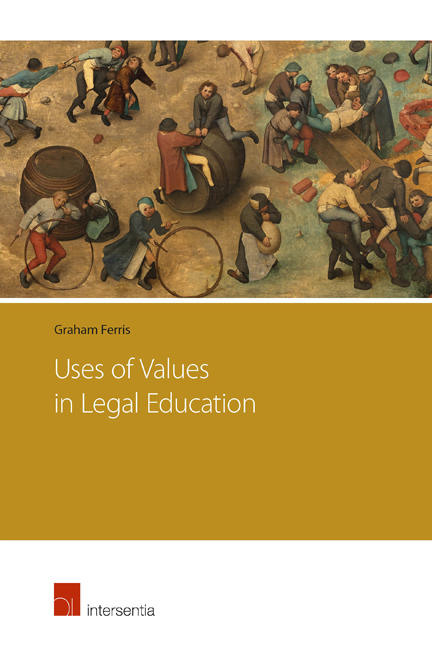
Uses of Values in Legal Education

-
Select format
-
- Publisher:
- Intersentia
- Publication date:
- 22 November 2017
- 06 July 2015
- ISBN:
- 9781780685724
- 9781780681238
- Dimensions:
- Weight & Pages:
- Dimensions:
- Weight & Pages:
- Subjects:
- Law: General Interest, Law
You may already have access via personal or institutional login- Subjects:
- Law: General Interest, Law
Show more authors 
You may already have access via personal or institutional login
Book description
Values both constrain and enable behaviour. They are a vital source of meaning in human life. They may be unconsciously inherited or consciously reflected upon. The challenge is to take the greatest advantage of value-informed teaching and learning in the context of a pluralist education and society. The values legal education imparts or generates impact upon the character of legal professionals. The work of jurists impacts upon the quality of public discourse. Legal education is under severe threat after a period of tremendous growth across the common law world. Legal markets are unstable; information technology drives specialisation of labour to new levels; rising costs for students and falling returns to the human capital generated by legal education make the prospect of a legal education less enticing. Enhanced engagement with values offers the best hope for a positive and coherent response to these pressures by legal educators. The Uses of Values in Legal Education makes a start by showing how using values in legal education might fulfil the promise of legal education.Incorporation of values into legal teaching, and reflection upon values as an integral part of the student learning experience, can facilitate the formation of robust and effective individual student identities. When this leads to an alignment of student values with life plans it can generate a sense of wholeheartedness in activity that enriches life. Students with clear and considered ethical ideas can become effective ethical agents beyond the educational setting.'This is a must-read for anyone designing law curricula. [...] He sources his arguments from the fields of literature, business, economics, politics, education, psychology, law and philosophy and he provides both theoretical and practical examples and perspectives. [...] This is an important book. It is not an easy read; the ideas are complex and the range of source material impressive, but once the premise is accepted, that we have an ethical responsibility to design legal education in the best interests of the law student, it is a game changer. 'Rebecca Huxley-Binns in The Law Teacher (2016) 411'Graham Ferris makes a clear and compelling case for why legal education should fully embrace values. He explores how values can be incorporated and taught in the law degree curriculum in order to enhance the welfare and capabilities of law students and restores the link between ethical judgment and professional practice. His book makes a significant contribution to the growing "balance in legal education" movement and is as relevant to contemporary debates about the future of legal education in the United States as it is to the reimagining of law school curricula in the United Kingdom.' Adrian J Walters, Ralph L Brill Professor of Law, Chicago-Kent College of Law, USA
Contents
Contents
Metrics
Full text views
Full text views helpTotal number of HTML views: 0
Total number of PDF views: 0 *
 Loading metrics...
* Views captured on Cambridge Core between #date#. This data will be updated every 24 hours.
Usage data cannot currently be displayed.
Accessibility standard: Unknown
Why this information is here
This section outlines the accessibility features of this content - including support for screen readers, full keyboard navigation and high-contrast display options. This may not be relevant for you.
Accessibility Information
Accessibility compliance for the PDF of this book is currently unknown and may be updated in the future.