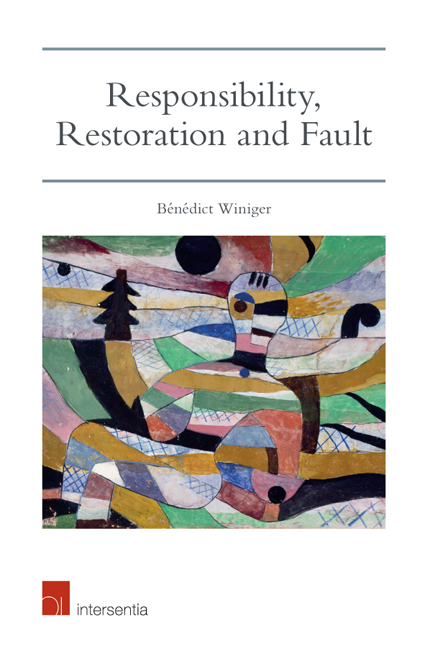
Responsibility, Restoration and Fault

-
Select format
-
- Publisher:
- Intersentia
- Publication date:
- 29 September 2018
- 15 January 2018
- ISBN:
- 9781780686202
- 9781780684765
- Dimensions:
- Weight & Pages:
- Dimensions:
- Weight & Pages:
- Subjects:
- Law: General Interest, Law
You may already have access via personal or institutional login- Subjects:
- Law: General Interest, Law
Show more authors 
You may already have access via personal or institutional login
Book description
Responsibility, Restoration and Fault suggests how we could measure responsible behaviour. What criteria do our actions have to abide by to protect individuals and society? This is particularly relevant in a period where modern technology has not only multiplied the risks and degree of damage, but also created long causal chains that often make it difficult to see a connection between action and damage, and when the damaging effects on individuals or society only emerge decades later.The author argues that a person's behaviour is responsible if the following criteria are fulfilled simultaneously: (i) the person, whose behaviour could cause damage, would be able to restore the victim, (ii) the person, whose behaviour causes actual damage, restores the victim (both criteria of restoration) and (iii) the person is not at fault when determining and executing an act (criteria of fault).With its historical and legal philosophical perspective Responsibility, Restoration and Fault is a must read for every lawyer.
Contents
Contents
Metrics
Full text views
Full text views helpTotal number of HTML views: 0
Total number of PDF views: 0 *
 Loading metrics...
* Views captured on Cambridge Core between #date#. This data will be updated every 24 hours.
Usage data cannot currently be displayed.
Accessibility standard: Unknown
Why this information is here
This section outlines the accessibility features of this content - including support for screen readers, full keyboard navigation and high-contrast display options. This may not be relevant for you.
Accessibility Information
Accessibility compliance for the PDF of this book is currently unknown and may be updated in the future.