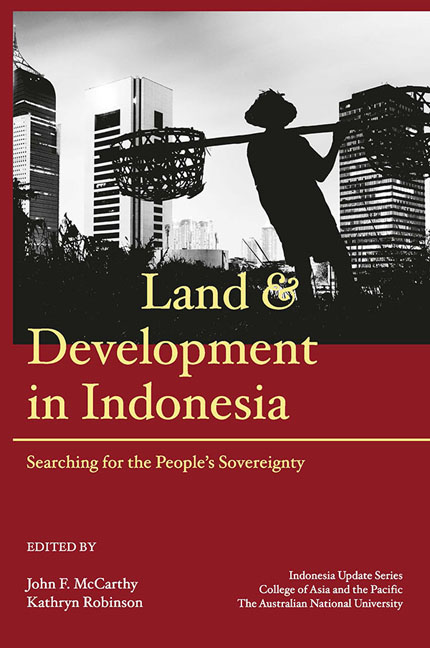
Land and Development in Indonesia

-
Select format
-
- Publisher:
- ISEAS–Yusof Ishak Institute
- Publication date:
- 29 July 2017
- 18 May 2016
- ISBN:
- 9789814762106
- 9789814762090
- 9789814762083
- Dimensions:
- Weight & Pages:
- 00kg,
- Dimensions:
- Weight & Pages:
- 00kg,
- Subjects:
- Politics: General Interest, Organisational Sociology, Politics and International Relations, Sociology
- Series:
- Books and Monographs
You may already have access via personal or institutional login- Subjects:
- Politics: General Interest, Organisational Sociology, Politics and International Relations, Sociology
- Series:
- Books and Monographs
Show more authors 
You may already have access via personal or institutional login
Book description
Indonesia was founded on the ideal of the 'Sovereignty of the People', which suggests the pre-eminence of people's rights to access, use and control land to support their livelihoods. Yet, many questions remain unresolved. How can the state ensure access_to land for agriculture and housing while also supporting land acquisition for investment in industry and infrastructure? What is to be done about indigenous rights? Do registration and titling provide solutions? Is the land reform agenda - legislated but never implemented - still relevant? How should the land questions affecting Indonesia's disappearing forests be resolved?The contributors to this volume assess progress on these issues through case studies from across the archipelago: from large-scale land acquisitions in Papua, to asset ownership in the villages of Sulawesi and Java, to tenure conflicts associated with the oil palm and mining booms in Kalimantan, Sulawesi and Sumatra. What are the prospects for the 'people's sovereignty' in regard to land?
Contents
Contents
Metrics
Altmetric attention score
Full text views
Full text views helpTotal number of HTML views: 0
Total number of PDF views: 0 *
 Loading metrics...
* Views captured on Cambridge Core between #date#. This data will be updated every 24 hours.
Usage data cannot currently be displayed.
Accessibility standard: Unknown
Why this information is here
This section outlines the accessibility features of this content - including support for screen readers, full keyboard navigation and high-contrast display options. This may not be relevant for you.
Accessibility Information
Accessibility compliance for the PDF of this book is currently unknown and may be updated in the future.