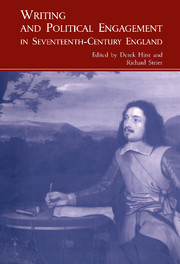
Book contents
- Frontmatter
- Contents
- Notes on contributors
- Dedication
- Introduction
- 1 “I am Power”: normal and magical politics in The Tempest
- 2 “Void of storie”: the struggle for insincerity in Herbert's prose and poetry
- 3 Sir Kenelm Digby's rewritings of his life
- 4 Thomas Hobbes and the Renaissance studia humanitatis
- 5 Casuistry and allegiance in the English Civil War
- 6 Thomas May and the narrative of civil war
- 7 Samuel Parker, Andrew Marvell, and political culture, 1667–73
- 8 Sidney's Discourses on political imagoes and royalist iconography
- Notes
- Index
4 - Thomas Hobbes and the Renaissance studia humanitatis
Published online by Cambridge University Press: 09 September 2009

Book contents
- Frontmatter
- Contents
- Notes on contributors
- Dedication
- Introduction
- 1 “I am Power”: normal and magical politics in The Tempest
- 2 “Void of storie”: the struggle for insincerity in Herbert's prose and poetry
- 3 Sir Kenelm Digby's rewritings of his life
- 4 Thomas Hobbes and the Renaissance studia humanitatis
- 5 Casuistry and allegiance in the English Civil War
- 6 Thomas May and the narrative of civil war
- 7 Samuel Parker, Andrew Marvell, and political culture, 1667–73
- 8 Sidney's Discourses on political imagoes and royalist iconography
- Notes
- Index
Summary
John Wallace was one of the first scholars to provide a convincing account of the intellectual context within which Hobbes worked out his civil philosophy. His was a pioneering attempt to demonstrate that, as he puts it in Destiny his Choice, Hobbes can be “brought into relation with contemporary political thought instead of standing outside it.” There are at least two routes, however, by which writers can be brought into an instructive – and perhaps explanatory – relationship with their immediate intellectual surroundings. One is by identifying the precise range of debates to which they contributed, treating their texts in effect as responses to the controversies in which they were involved. This is the approach followed by John Wallace in Destiny his Choice, in which he shows how far Hobbes's theory of political obligation was occasioned by, and in turn helped to advance, the arguments about “engagement” after the execution of Charles I in 1649. But it is possible to take a different though complementary route, focusing on the intellectual resources available to a given writer and seeking to assess how far he or she may have been molded and affected by them. This is the approach I shall adopt in what follows, in which I too shall be principally concerned with the figure of Thomas Hobbes. My aim will thus be to add a footnote to John Wallace's pathfinding scholarship not merely on Hobbes's political theory but on the discipline of contextual reading itself.
Information
- Type
- Chapter
- Information
- Publisher: Cambridge University PressPrint publication year: 2000
Accessibility standard: Unknown
Why this information is here
This section outlines the accessibility features of this content - including support for screen readers, full keyboard navigation and high-contrast display options. This may not be relevant for you.Accessibility Information
Accessibility compliance for the PDF of this chapter is currently unknown
and may be updated in the future.