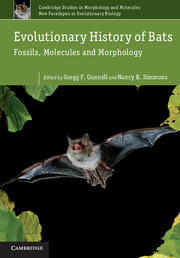
Book contents
- Frontmatter
- Contents
- Contributors
- Preface
- 1 Phylogenies, fossils and functional genes: the evolution of echolocation in bats
- 2 Systematics and paleobiogeography of early bats
- 3 Shoulder joint and inner ear of Tachypteron franzeni, an emballonurid bat from the Middle Eocene of Messel
- 4 Evolutionary history of the Neotropical Chiroptera: the fossil record
- 5 New basal noctilionoid bats (Mammalia: Chiroptera) from the Oligocene of subtropical North America
- 6 Necromantis Weithofer, 1887, large carnivorous Middle and Late Eocene bats from the French Quercy Phosphorites: new data and unresolved relationships
- 7 African Vespertilionoidea (Chiroptera) and the antiquity of Myotinae
- 8 Evolutionary and ecological correlates of population genetic structure in bats
- 9 A bird? A plane? No, it's a bat: an introduction to the biomechanics of bat flight
- 10 Toward an integrative theory on the origin of bat flight
- 11 Molecular time scale of diversification of feeding strategy and morphology in New World Leaf-Nosed Bats (Phyllostomidae): a phylogenetic perspective
- 12 Why tribosphenic? On variation and constraint in developmental dynamics of chiropteran molars*
- 13 Necromantodonty, the primitive condition of lower molars among bats
- 14 Echolocation, evo-devo and the evolution of bat crania
- 15 Vertebral fusion in bats: phylogenetic patterns and functional relationships
- 16 Early evolution of body size in bats
- Index
- Plate section
- References
8 - Evolutionary and ecological correlates of population genetic structure in bats
Published online by Cambridge University Press: 05 June 2012

Book contents
- Frontmatter
- Contents
- Contributors
- Preface
- 1 Phylogenies, fossils and functional genes: the evolution of echolocation in bats
- 2 Systematics and paleobiogeography of early bats
- 3 Shoulder joint and inner ear of Tachypteron franzeni, an emballonurid bat from the Middle Eocene of Messel
- 4 Evolutionary history of the Neotropical Chiroptera: the fossil record
- 5 New basal noctilionoid bats (Mammalia: Chiroptera) from the Oligocene of subtropical North America
- 6 Necromantis Weithofer, 1887, large carnivorous Middle and Late Eocene bats from the French Quercy Phosphorites: new data and unresolved relationships
- 7 African Vespertilionoidea (Chiroptera) and the antiquity of Myotinae
- 8 Evolutionary and ecological correlates of population genetic structure in bats
- 9 A bird? A plane? No, it's a bat: an introduction to the biomechanics of bat flight
- 10 Toward an integrative theory on the origin of bat flight
- 11 Molecular time scale of diversification of feeding strategy and morphology in New World Leaf-Nosed Bats (Phyllostomidae): a phylogenetic perspective
- 12 Why tribosphenic? On variation and constraint in developmental dynamics of chiropteran molars*
- 13 Necromantodonty, the primitive condition of lower molars among bats
- 14 Echolocation, evo-devo and the evolution of bat crania
- 15 Vertebral fusion in bats: phylogenetic patterns and functional relationships
- 16 Early evolution of body size in bats
- Index
- Plate section
- References
Summary
Introduction
Studies of intraspecific genetic structure are of central importance toevolutionary biology, as population differentiation can lead to distinctevolutionary trajectories and may be viewed as the first step in the process ofspeciation (Wright, 1932). The distribution of genetic variation amongpopulations is determined by a complex interaction of historical andcontemporary evolutionary forces – including genetic drift, mutation,selection and gene flow – which are influenced by the specific lifehistory, behavior and ecology of a species (Slatkin, 1987; Goodnight, 2006).Historical events such as vicariance, colonization events or glacial refugia canalso dramatically shape contemporary patterns of genetic subdivision. Gene flowis the primary force that leads to genetic homogeneity among populations, andspecies may be subject to geographic, behavioral or ecological barriers to geneflow. The task of teasing out the relative importance of different life-history,behavioral and ecological characteristics in determining genetic structure, eachtaking place across a range of temporal and spatial scales, continues tochallenge population geneticists (Hey and Machado, 2003; Estoup etal., 2004; Duminil et al., 2007).
Bats (order Chiroptera) which comprise nearly 1200 species, exhibit a wide rangeof life-history and ecological characteristics that make them an ideal group totest hypotheses regarding the correlates of population structure in animals(Nowak, 1999; Simmons, 2005). Being nocturnal and difficult to study bytraditional ecological methods (including direct observation, telemetry andcapture–mark–recapture), a growing number of studies have usedmolecular markers to examine the population biology of bats (Burland andWorthington-Wilmer, 2001). In general, population genetic studies of volantanimals are of particular interest because of their potential for long-distancedispersal and high levels of gene flow over terrestrial and oceaniclandscapes.
Information
- Type
- Chapter
- Information
- Evolutionary History of BatsFossils, Molecules and Morphology, pp. 267 - 316Publisher: Cambridge University PressPrint publication year: 2012
References
2000 Taxon sampling, correlated evolution, and independent contrastsEvolution 54 1480CrossRefGoogle ScholarPubMed
2005 Effects of life-history traits and species distribution on genetic structure at maternally inherited markers in European trees and shrubsJournal of Biogeography 32 329CrossRefGoogle Scholar
2006 Phylogeographic structure in (Chiroptera: Hipposideridae): implications for conservationActa Chiropterologica 8 63CrossRefGoogle Scholar
2007 Population structure and sex-biased dispersal in the forest dwelling vespertilionid bat, American Midland Naturalist 157 374CrossRefGoogle Scholar
1995 Meta-analysis: synthesizing research findings in ecology and evolutionTrends in Ecology and Evolution 10 236CrossRefGoogle ScholarPubMed
2006 Comparison of Bayesian and maximum-likelihood inference of population genetic parametersBioinformatics 22 341CrossRefGoogle ScholarPubMed
2008 The mitochondrial and nuclear genetic structure of (Chiroptera: Vespertilionidae) in the Eurasian transition, and its taxonomic implicationsZoologica Scripta 37 253CrossRefGoogle Scholar
1999 Dispersal, gene flow, and population structureQuarterly Review of Biology 74 21CrossRefGoogle ScholarPubMed
2008 Changes in prey abundance unlikely to explain the demography of a critically endangered Central European batJournal of Applied Ecology 45 641CrossRefGoogle Scholar
2004 Large shifts in pathogen virulence relate to host population structureScience 303 842CrossRefGoogle ScholarPubMed
1998 Genetic estimates of population structure and gene flow: limitations, lessons and new directionsTrends in Ecology and Evolution 13 202CrossRefGoogle ScholarPubMed
2002 Scaling bat wingbeat frequency and amplitudeJournal of Experimental Biology 205 2615Google Scholar
2007 Bat wing airfoil and planform structures relating to aerodynamic cleanlinessAustralian Journal of Zoology 55 237CrossRefGoogle Scholar
2001 Seeing in the dark: molecular approaches to the study of bat populationsBiological Review 76 389CrossRefGoogle Scholar
1999 Population genetic structure and gene flow in a gleaning bat, Proceedings of the Royal Society of London Series B - Biological Sciences 266 975CrossRefGoogle Scholar
2006 Bats: important reservoir hosts of emerging virusesClinical Microbiology Reviews 19 531CrossRefGoogle ScholarPubMed
2006 Resource distribution and social structure in harem-forming Old World fruit bats: variations on a polygynous themeAnimal Behaviour 72 687CrossRefGoogle Scholar
2006 Comparative population structure of fruit bats in peninsular Malaysia and southern ThailandMolecular Ecology 15 29CrossRefGoogle ScholarPubMed
2007 Contrasting patterns of genetic differentiation between endemic and widespread species of fruit bats (Chiroptera: Pteropodidae) in Sulawesi, IndonesiaMolecular Phylogenetics and Evolution 44 474CrossRefGoogle Scholar
2004 Exploring population genetic structure in three species of Lesser Antillean batsMolecular Ecology 13 2557CrossRefGoogle ScholarPubMed
2000 Is the Gibraltar Strait a barrier to gene flow for the bat (Chiroptera: Vespertilionidae)?Molecular Ecology 9 1761CrossRefGoogle Scholar
2001 Contrasted patterns of mitochondrial and nuclear structure among nursery colonies of the bat Journal of Evolutionary Biology 14 708CrossRefGoogle Scholar
2006 Population genetic structure and demographic history of the endemic Formosan lesser horseshoe bat ()Molecular Ecology 15 1643CrossRefGoogle Scholar
2008 Sex-biased gene flow and colonization in the Formosan lesser horseshoe bat: inference from nuclear and mitochondrial markersJournal of Zoology (London) 274 207CrossRefGoogle Scholar
1987 Mammalian Dispersal Patterns: The Effects of Social Structure on Population GeneticsChicago, ILUniversity of Chicago Press
2005 Does time since colonization influence isolation by distance? A meta-analysisConservation Genetics 6 665CrossRefGoogle Scholar
2006 Exploring the evolution of the basal metabolic rate in batsFunctional and Evolutionary Ecology of BatsNew YorkOxford University Press56Google Scholar
2003 Lack of genetic and plumage differentiation in the red-billed quelea across a migratory divide in southern AfricaMolecular Ecology 12 345CrossRefGoogle ScholarPubMed
2003 Anthropogenic change, biodiversity loss and a new agenda for emerging diseasesJournal of Parasitology 89 S37Google Scholar
2005 Phylogeography, population dynamics, and molecular evolution of European bat lyssavirusesJournal of Virology 79 10487CrossRefGoogle ScholarPubMed
2000 The comparative phylogeography of Neotropical mammals: patterns of intraspecific mitochondrial DNA variation among bats contrasted to nonvolant small mammalsMolecular Ecology 9 1307CrossRefGoogle ScholarPubMed
2007 Can population genetic structure be predicted from life-history traits?American Naturalist 169 662Google ScholarPubMed
2003 Bats and fruit: an ecomorphological approachBat EcologyChicago, ILUniversity of Chicago Press398Google Scholar
1992 Neocortex size as a constraint on group-size in primatesJournal of Human Evolution 22 469CrossRefGoogle Scholar
2009 Genetic structure of island populations of the endangered bat implications for conservationPopulation Ecology 51 153CrossRefGoogle Scholar
2008 Summary and analysis of the U.S. Government Bat Banding Program. Open-File Report 2008–1363US Geological Survey 117Google Scholar
2000 Social and population structure of a gleaning bat, Journal of Zoology 252 11CrossRefGoogle Scholar
2005 Mutation at high rates reduces spatial structure within populationsMolecular Ecology 14 703CrossRefGoogle ScholarPubMed
2009 , a hunted migratory species with a multinational home-range and a need for regional managementJournal of Applied Ecology 46 991CrossRefGoogle Scholar
2004 Genetic analysis of complex demographic scenarios: spatially expanding populations of the cane toad, Evolution 58 2021CrossRefGoogle Scholar
2001 Bats in continuous forest fragments and in an agricultural mosaic habitat-island at Los Tuxtlas, MexicoBiological Conservation 103 237CrossRefGoogle Scholar
1992 Analysis of molecular variance inferred from Mmtric distances among DNA haplotypes – application to human mitochondrial-DNA restriction dataGenetics 131 479Google ScholarPubMed
2009 Phylogeography of the greater horseshoe bat, : contrasting results from mitochondrial and microsatellite dataMolecular Ecology 18 306CrossRefGoogle ScholarPubMed
2007 Genetic structure in a swarming brown long-eared bat () population: evidence for mating at swarming sitesConservation Genetics 8 913CrossRefGoogle Scholar
2009 The Straits of Gibraltar: barrier or bridge to Ibero-Moroccan bat diversity?Biological Journal of the Linnean Society 96 434CrossRefGoogle Scholar
2005 Conflict and congruence in a combined DNA-morphology analysis of megachiropteran bat relationships (Mammalia: Chiroptera: Pteropodidae)Cladistics 21 411CrossRefGoogle Scholar
2004 Recent range expansion and low levels of contemporary gene flow in : its relationship with the emergence and spread of Argentine haemorrhagic feverHeredity 93 535CrossRefGoogle ScholarPubMed
2006 Genetics and evolution in structured populationsEvolutionary Genetics: Concepts and Case StudiesNew YorkOxford University Press80Google Scholar
1980 Mating systems, philopatry and dispersal in birds and mammalsAnimal Behaviour 28 1140CrossRefGoogle Scholar
2005 The roles of geological history and colonization abilities in genetic differentiation between mammalian populations in the Philippine archipelagoJournal of Biogeography 32 229CrossRefGoogle Scholar
2003 The study of structured populations – new hope for a difficult and divided scienceNature Reviews Genetics 4 535CrossRefGoogle Scholar
1998 Biogeography of the Indonesian archipelago: mitochondrial DNA variation in the fruit batEonycteris spelaea. Biological Journal of the Linnean Society 65 329Google Scholar
2004 Implications of contrasting patterns of genetic variability in two vespertilionid bats from the Indonesian archipelagoBiological Journal of the Linnean Society 83 421CrossRefGoogle Scholar
2003 Fruit bats (Chiroptera: Pteropodidae) as seed dispersers and pollinators in a lowland Malaysian rain forestBiotropica 35 491CrossRefGoogle Scholar
2004 Habitat structure, wing morphology, and the vertical stratification of Malaysian fruit bats (Megachiroptera: Pteropodidae)Journal of Tropical Ecology 20 667CrossRefGoogle Scholar
2004 Temporal variation in the relative abundance of fruit bats (Megachiroptera: Pteropodidae) in relation to the availability of food in a lowland Malaysian rain forestBiotropica 36 522Google Scholar
2003 Molecular phylogenetics of the chiropteran family VespertilionidaeActa Chiropterologica 5 1CrossRefGoogle Scholar
2004 Sexual selection and genital evolutionTrends in Ecology and Evolution 19 87CrossRefGoogle ScholarPubMed
1999 Correlation of pairwise genetic and geographic distance measures: inferring the relative influences of gene flow and drift on the distribution of genetic variabilityEvolution 53 1898CrossRefGoogle ScholarPubMed
2001 Microchiropteran Bats: Global Status Survey and Conservation Action Plan. IUCN Chiroptera Specialist Group. IUCNCambridgeUnited Kingdom and GlandCrossRefGoogle Scholar
2002 Biomechanic consequences of differences in wing morphology between and Acta Theriologica 4 193CrossRefGoogle Scholar
1993 Bimodal echolocation in pipistrelle bats – are cryptic species presentProceedings of the Royal Society of London Series B - Biological Sciences 251 119CrossRefGoogle ScholarPubMed
2002 A phylogenetic supertree of the bats (Mammalia: Chiroptera)Biological Reviews 77 223CrossRefGoogle Scholar
2003 Biological correlates of extinction risk in batsAmerican Naturalist 161 601CrossRefGoogle ScholarPubMed
1996 Allozyme variation of the Egyptian rousette () in the Gulf of GuineaBiochemical Systematics and Ecology 24 499CrossRefGoogle Scholar
2000 Morphological and allozyme variation of (Mammalia: Megachiroptera) in the islands of the Gulf of GuineaBiological Journal of the Linnean Society 71 359CrossRefGoogle Scholar
2003 Phylogeography of barbastelle bats () in the western Mediterranean and the Canary IslandsActa Chiropterologica 5 165CrossRefGoogle Scholar
1998 Organization and diversity of tropical bat communities through space and timeZoology: Analysis of Complex Systems 101 281Google Scholar
2006 Relatedness, life history, and social behavior in the Long-Lived Bechsteins batFunctional and Evolutionary Ecology of BatsOxfordOxford University Press199Google Scholar
2003 High gene diversity at swarming sites suggest hot spots for gene flow in the endangered Bechstein's batConservation Genetics 4 491CrossRefGoogle Scholar
2008 Communally breeding Bechstein's bats have a stable social system that is independent from the postglacial history and location of the populationsMolecular Ecology 17 2368CrossRefGoogle ScholarPubMed
2006 Phylogeography of southern and northeastern African populations of (Chiroptera: Molossidae)Durban Museum Novitates 31 42Google Scholar
2005 Diet of wrinkle-lipped free-tailed bat ( Buchannan, 1800) in central Thailand: insectivorous bats potentially act as biological pest control agentsActa Chiropterologica 7 111CrossRefGoogle Scholar
2005 Bats are natural reservoirs of SARS-like coronavirusesScience 310 676CrossRefGoogle ScholarPubMed
2003 Intraspecific phylogeny of the New Zealand short-tailed bat, , inferred from multiple mitochondrial gene sequencesSystematic Biology 52 460CrossRefGoogle ScholarPubMed
2003 The demographic history of the New Zealand short-tailed bat inferred from modified control region sequencesMolecular Ecology 12 1895CrossRefGoogle ScholarPubMed
1998 Avian wingtip shape reconsidered: wingtip shape indices and morphological adaptations to migrationJournal of Avian Biology 29 273CrossRefGoogle Scholar
2002 Location of roosts of the lesser long-eared bat and Gould's wattled bat in a fragmented landscape in south-eastern AustraliaBiological Conservation 106 237CrossRefGoogle Scholar
2003 Managing emerging diseases borne by fruit bats (flying foxes), with particular reference to henipaviruses and Australian bat lyssavirusJournal of Applied Microbiology 94 59SCrossRefGoogle Scholar
2006 http://mesquiteproject.org/mesquite1.0/mesquite/download/MesquiteManual.pdf
2003 Relationships between morphology, genetics, and geography in the cave fruit bat (Dobson, 1871) from IndonesiaBiological Journal of the Linnean Society 79 511CrossRefGoogle Scholar
2007 Mitochondrial DNA phylogeography reveals marked population structure in the common vampire bat, (Phyllostomidae)Journal of Zoological Systematics and Evolutionary Research 45 372CrossRefGoogle Scholar
2005 Reproduction of dipterocarps during low intensity masting events in a Bornean rain forestJournal of Vegetation Science 16 635CrossRefGoogle Scholar
2007 Indirect evidence that flying foxes track food resources among islands in a Pacific ArchipelagoBiotropica 39 436CrossRefGoogle Scholar
1987 Genetic structure of bat social groupsRecent Advances in the Study of BatsCambridgeCambridge University Press281Google Scholar
1981 Social organization and kinship in the polygynous bat Behavioral Ecology and Sociobiology 8 11CrossRefGoogle Scholar
1997 Genetic structure in migratory and nonmigratory populations of Brazilian free-tailed batsJournal of Mammalogy 78 348CrossRefGoogle Scholar
2000 Bat mating systemsReproductive Biology of BatsSan Diego, CA:Academic Press321CrossRefGoogle Scholar
2008 Brazilian free-tailed bats (: Molossidae, Chiroptera) at high altitude: links to migratory insect populationsIntegrative and Comparative Biology 48 107CrossRefGoogle ScholarPubMed
2008 Ecological correlates of vulnerability to fragmentation in Neotropical batsJournal of Applied Ecology 45 381CrossRefGoogle Scholar
2009 Small-scale fragmentation effects on local genetic diversity in two phyllostomid bats with different dispersal abilities in PanamaBiotropica 41 95CrossRefGoogle Scholar
1992 Old World Fruit Bats: An Action Plan for their ConservationGland, SwitzerlandInternational Union for Conservation of NatureCrossRefGoogle Scholar
2005
2003 Strong population substructure is correlated with morphology and ecology in a migratory batNature 424 187CrossRefGoogle Scholar
2000 A simulation model of Mexican long-nosed bat () migrationEcological Modelling 134 117CrossRefGoogle Scholar
2004 Colony dynamics of (Mexican long-nosed bat) related to flowering agave in Northern MexicoJournal of Mammalogy 85 4532.0.CO;2>CrossRefGoogle Scholar
2006 Correlates of genetic differentiation and isolation by distance in 17 congeneric speciesMolecular Ecology 15 1067CrossRefGoogle Scholar
2003 Genetic population structure and mobility of two nectar-feeding bats from Venezuelan deserts: inferences from mitochondrial DNAMolecular Ecology 12 3191CrossRefGoogle ScholarPubMed
2008 Spatial distribution of mitochondrial and microsatellite DNA variation in Daubenton's bat within ScotlandMolecular Ecology 17 3243CrossRefGoogle ScholarPubMed
1987 Ecological morphology and flight in bats (Mammalia, Chiroptera) – wing adaptations, flight performance, foraging strategy and echolocationPhilosophical Transactions of the Royal Society of London Series B - Biological Sciences 316 337CrossRefGoogle Scholar
2000 Soaring and non-soaring bats of the family Pteropodidae (flying foxes, spp.): wing morphology and flight performanceJournal of Experimental Biology 203 651Google Scholar
2005 Phylogeography and conservation genetics of the fruit bat genus Pteropus (Megachiroptera) in the western Indian OceanNational University of IrelandGoogle Scholar
2008 Population genetic structure and phylogeography of Southeast Asian flying foxes: implications for conservation and disease ecologyColumbia UniversityGoogle Scholar
2006 Monitoring the long-distance movement of wildlife in Asia using satellite telemetryConservation Biology in AsiaKathmandu, NepalSociety for Conservation Biology Asia Section and Resources Himalaya Foundation319Google Scholar
2003 Male dominance, paternity, and relatedness in the Jamaican fruit-eating bat ()Molecular Ecology 12 2409CrossRefGoogle Scholar
1992 A method for the analysis of comparative dataJournal of Theoretical Biology 156 431CrossRefGoogle Scholar
2000 Effects of metapopulation processes on measures of genetic diversityPhilosophical Transactions of the Royal Society of London Series B - Biological Sciences 355 1851CrossRefGoogle ScholarPubMed
2007 Evidence for coevolution of sociality and relative brain size in three orders of mammalsEvolution 61 2811CrossRefGoogle ScholarPubMed
1993 Genetic differentiation in Philippine bats of the genera and Biological Journal of the Linnean Society 49 203CrossRefGoogle Scholar
1999 Male dispersal in the noctule bat (): where are the limits?Proceedings of the Royal Society of London Series B - Biological Sciences 266 1717CrossRefGoogle ScholarPubMed
1999 No evidence of bottleneck in the postglacial recolonization of Europe by the noctule bat ()Evolution 53 1247Google Scholar
2005 Molecular phylogeny of North American long-eared bats (Vespertilionidae: ); inter- and intraspecific relationships inferred from mitochondrial and nuclear DNA sequencesMolecular Phylogenetics and Evolution 37 762CrossRefGoogle ScholarPubMed
2009 Intraspecific comparison of population structure, genetic diversity, and dispersal among three subspecies of Townsend's big-eared bats, , -, and the endangered -Conservation Genetics 10 143CrossRefGoogle Scholar
2007 Patterns of genetic, morphological, and behavioral differentiation in the African bat, University of CaliforniaLos AngelesGoogle Scholar
2006 Mating system and brain size in batsProceedings of the Royal Society of London Series B - Biological Sciences 273 719CrossRefGoogle ScholarPubMed
2002 Inferring sex-biased dispersal from population genetic tools: a reviewHeredity 88 161CrossRefGoogle ScholarPubMed
1996 Molecular systematics of the fruit bat, : origin of an unusual island populationJournal of Mammalogy 77 491CrossRefGoogle Scholar
2000 Life-history and reproductive strategies in batsReproductive Biology of BatsSan Diego, CAAcademic Press363CrossRefGoogle Scholar
2007 Microsatellite DNA polymorphism confirms reproductive isolation and reveals differences in population genetic structure of cryptic pipistrelle bat speciesBiological Journal of the Linnean Society 90 539CrossRefGoogle Scholar
2006 Sex ratio, population structure and roost fidelity in a free-ranging colony of Indian false vampire bat, Current Science 91 965Google Scholar
2000 Genetic diversity within and among populations of the microchiropteran bat based on a RAPD analysisZeitschrift fur Saugetierkunde 65 301Google Scholar
2005 Genetic population structure of Natterer's bats explained by mating at swarming sites and philopatryMolecular Ecology 14 4299CrossRefGoogle ScholarPubMed
2006 History, ocean channels, and distance determine phylogeographic patterns in three widespread Philippine fruit bats (Pteropodidae)Molecular Ecology 15 2183CrossRefGoogle Scholar
2000 Genetic variation and population structure in the endangered greater horseshoe bat Molecular Ecology 9 1131CrossRefGoogle ScholarPubMed
2005 Mate fidelity and intra-lineage polygyny in greater horseshoe batsNature 437 408CrossRefGoogle ScholarPubMed
2006 Causes and consequences of genetic structure in the greater horseshoe bat, Functional and Evolutionary Ecology of BatsOxfordOxford University Press213Google Scholar
2006 Long-term paternity skew and the opportunity for selection in a mammal with reversed sexual size dimorphismMolecular Ecology 15 3035CrossRefGoogle Scholar
1997 Genetic differentiation and estimation of gene flow from F-statistics under isolation by distanceGenetics 145 1219Google ScholarPubMed
2003 Genetic consequences of the ice ages on nurseries of the bat : a mitochondrial and nuclear surveyMolecular Ecology 12 1527CrossRefGoogle ScholarPubMed
2005 Genetic variation and migration in the Mexican free-tailed bat ()Molecular Ecology 14 2207CrossRefGoogle Scholar
2007 Working at the interface of phylogenetics and population genetics: a biogeographical analysis of spp. (Chiroptera: Hipposideridae)Molecular Ecology 16 839CrossRefGoogle Scholar
2008 Population genetic analysis of (Chiroptera: Myzopodidae) in MadagascarJournal of Mammalogy 89 209CrossRefGoogle Scholar
2007 Sex differences in population genetics, home range size and habitat use of the parti-colored bat (, Linnaeus 1758) in Switzerland and their consequences for conservationBiological Conservation 137 28CrossRefGoogle Scholar
2006 Irregular droughts trigger mass flowering in aseasonal tropical forests in AsiaAmerican Journal of Botany 93 1134CrossRefGoogle Scholar
2004 Mitochondrial DNA variation and population structure of the island endemic Azorean bat ()Molecular Ecology 13 3357CrossRefGoogle Scholar
1995 A genetic perspective of mammalian variation and evolution in the Indonesian archipelago: biogeographic correlates in the fruit bat genus Evolution 49 399CrossRefGoogle ScholarPubMed
2002 Genetic differentiation between Australian and North American populations of the monarch butterfly (L.) (Lepidoptera: Nymphalidae): an exploration using allozyme electrophoresisBiological Journal of the Linnean Society 75 437CrossRefGoogle Scholar
2005 Order ChiropteraMammal Species of the World: A Taxonomic and Geographic ReferenceBaltimore, MDJohns Hopkins University Press312Google Scholar
1996 Genetic variation in the little red flying-fox (Chiroptera: Pteropodidae): implications for managementBiological Conservation 76 45CrossRefGoogle Scholar
1987 Gene flow and the geographic structure of natural populationsScience 236 787CrossRefGoogle ScholarPubMed
2004 Gene flow and genetic characterization of Northern goshawks breeding in UtahCondor 106 826CrossRefGoogle Scholar
2001 Morphology and flight manoeuvrability in New World leaf-nosed bats (Chiroptera: Phyllostomidae)Journal of Zoology 254 505CrossRefGoogle Scholar
1999 Genetic consequences of mammalian social structureJournal of Mammalogy 80 553CrossRefGoogle Scholar
2002 Testing for genetic evidence of population expansion and contraction: an empirical analysis of microsatellite DNA variation using a hierarchial bayesian modelEvolution 56 154CrossRefGoogle Scholar
2001 Genetic consequences of polygyny and social structure in an Indian fruit bat, . I. Inbreeding, outbreeding, and population subdivisionEvolution 55 1215CrossRefGoogle Scholar
2001 Genetic consequences of polygyny and social structure in an Indian fruit bat, . II. Variance in male mating success and effective population sizeEvolution 55 1224CrossRefGoogle Scholar
2003 Ecomorphology of bats: comparative and experimental approaches relating structural design to ecologyBat EcologyChicago, ILUniversity of Chicago Press257Google Scholar
2006 Dynamic complexity of wing form in bats: implications for flight performanceFunctional and Evolutionary Ecology of BatsNew YorkOxford University Press110Google Scholar
2005 A molecular phylogeny for bats illuminates biogeography and the fossil recordScience 307 580CrossRefGoogle ScholarPubMed
2004 Long-distance movements of the grey-headed flying fox ()Journal of Zoology 263 141CrossRefGoogle Scholar
2002 Phylogeography and population structure of the big brown bat (Eptesicus fuscus)Unpublished Honors thesisBoston UniversityGoogle Scholar
1995 Breeding tactics, social structure and genetic variation in mammals: problems and prospectsActa Theriologica 3 165CrossRefGoogle Scholar
2004 The role of swarming sites for maintaining gene flow in the brown long-eared bat ()Heredity 93 342CrossRefGoogle Scholar
1987 A multispecies approach to the analysis of gene flow in marine shore fishesEvolution 41 385CrossRefGoogle ScholarPubMed
1996 Mobility of Australian flying-foxes, spp. (Megachiroptera): evidence from genetic variationProceedings of the Royal Society of London Series B - Biological Sciences 263 497CrossRefGoogle ScholarPubMed
2002 Geographical variation and population structure in the White-rumped Sandpiper as shown by morphology, mitochondrial DNA and carbon isotope ratiosOecologia 131 380CrossRefGoogle ScholarPubMed
2007 Phylogeographic structuring and volant mammals: the case of the pallid bat ()Journal of Biogeography 34 1233CrossRefGoogle Scholar
2005 Unraveling the effects of sex and dispersal: Ozark big-eared bat () conservation geneticsJournal of Mammalogy 86 1136CrossRefGoogle Scholar
2004 Abundance and species richness of nocturnal insects on organic and conventional farms: effects of agricultural intensification on bat foragingConservation Biology 18 1283CrossRefGoogle Scholar
1985 The social organization of the common vampire bat. 2. Mating system, genetic structure, and relatednessBehavioral Ecology and Sociobiology 17 123Google Scholar
1996 Migration and evolution of lesser long-nosed bats , inferred from mitochondrial DNAMolecular Ecology 5 329CrossRefGoogle ScholarPubMed
2004 The effect of unequal migration rates on FstTheoretical Population Biology 66 185CrossRefGoogle ScholarPubMed
2003 Patterns of range size, richness, and body size in ChiropteraBat EcologyChicago, ILUniversity of Chicago580Google Scholar
1999 Genetic structure and male-mediated gene flow in the ghost bat ()Evolution 53 1582Google Scholar
1932 The roles of mutation, inbreeding, crossbreeding, and selection in evolutionProceedings of the Sixth International Genetics Congress 1 356Google Scholar
2008 Genetic and acoustic population structuring in the Okinawa least horseshoe bat: are intercolony acoustic differences maintained by vertical maternal transmission?Molecular Ecology 17 4978CrossRefGoogle ScholarPubMed
Accessibility standard: Unknown
Why this information is here
This section outlines the accessibility features of this content - including support for screen readers, full keyboard navigation and high-contrast display options. This may not be relevant for you.Accessibility Information
Accessibility compliance for the PDF of this chapter is currently unknown
and may be updated in the future.
- 7
- Cited by