




Social media summary: Trusting advice from others can involve risks of misinformation. This study supports the idea that people are wary of this risk in advice-giving scenarios, and that market expansion is associated with higher trust.
Introduction
Individuals must often make critical decisions based on information provided by others who might be untrustworthy, either because their information is poor or they have incentives to deceive. As an example, suppose that a herder suggests to another where he should move his livestock during the dry season to find grass and water. In a semi-arid ecology such as northern Tanzania, this advice implies an unavoidable cost (moving the herd to another area) with a large but uncertain benefit. How should the herder decide if this advice is trustworthy? (Here, we define ‘trust’ as ‘reliance upon [socially learned] information … about uncertain environmental states and their accompanying outcomes in a risky situation’; Schlenker, Helm, & Tedeschi, Reference Schlenker, Helm and Tedeschi1973, p. 419; see also Yamagishi, Kikuchi, & Kosugi, Reference Yamagishi, Kikuchi and Kosugi1999.)
Current theories of social learning focus on the source of information and/or risks of acting on the information. Some theories emphasise evolved learning biases, triggered by cues such as the prestige of the information source (Henrich, Reference Henrich2017; Richerson & Boyd, Reference Richerson and Boyd2005), which we refer to as the prestige bias model (PBM). Other theories emphasise flexible copying based on incentives, i.e. expected outcomes of acting on the information and possible conflicts of interest with the information source (Binmore, Reference Binmore2011; Mercier, Reference Mercier2020; Morin, Reference Morin2015), which we refer to as the risk and incentives model (RIM). In a preregistered study, we test the PBM and the RIM among Maasai pastoralists. Evaluating socially learned information is further complicated when individuals traverse varying cultural and economic contexts: individuals who might be trusted sources of information in one context might be mistrusted in another. We investigate these effects in a post hoc exploratory analysis.
Prestige bias model of trust
In the simplest models of social learning, individuals simply learn from a random individual in the population (Rogers, Reference Rogers1988). Social learning can be enhanced, however, by preferentially copying more knowledgeable individuals. One strategy would be to assess the knowledge of all group members via personal experience over time, and then choose to copy the most knowledgeable individual(s). However, this would be time consuming and error prone – directly observing performances can be noisy, leading a learner to misperceive competence (e.g. see Boyd & Richerson, Reference Boyd and Richerson1985, pp. 92–94, ch. 8). Alternatively, dual inheritance theorists argue that evolved context biases can solve this problem by exploiting simple and indirect social cues, triggering simple decision rules (Richerson & Boyd, Reference Richerson and Boyd2005). Prestige bias involves preferentially copying individuals with prestige gained by ‘freely conferred deference’ (Boyd & Richerson, Reference Boyd and Richerson1985; Henrich & Gil-White, Reference Henrich and Gil-White2001). This is efficient because it simplifies a complex learning task into a much simpler one. Relying on such a cue can reduce noise by ‘averag[ing] over many performances, which can help reduce the error in the learner's assessment of who to learn from’ (Henrich & McElreath, Reference Henrich and McElreath2007, p. 559; see also Hill & Kintigh, Reference Hill and Kintigh2009). Prestige bias is also adaptive because this simplification can be trusted across socioecological contexts and generational time (Henrich & McElreath, Reference Henrich and McElreath2003). Modelling studies demonstrate that prestige can signal locally relevant skills and/or expertise (Plourde, Reference Plourde2008), and naive learners can trust prestige signals to acquire locally adaptive knowledge (‘information goods’) quickly and accurately in a wide range of conditions (Panchanathan, Reference Panchanathan2010). As Henrich et al. (Reference Henrich, Boyd, Young, McCabe, Alberts, Ockenfelds and Gigerenzer2001) explain (p. 345, emphasis added):
A substantial amount of cross-cultural ethnography (e.g. Dove, 1993; Hammel, 1964; Rogers, 1995; Moore, 1957) and laboratory psychology (for a summary, see Gil-White and Henrich, 1999) suggests that humans everywhere possess a tendency to copy prestigious individuals, i.e. those who receive the most displays of respect/deference from others. This mechanism embodies two shortcut heuristics. First, by preferentially copying a ‘bundle’ of cultural traits from prestigious individuals (prestige correlates with skill/knowledge and often wealth) copiers can rapidly acquire a repertoire of fitness-enhancing or success-oriented traits (i.e. better-than-average solutions to the problems of life). Second, rather than gradually learning via individual experience who the most successful, knowledgeable, or skillful individuals are, copiers rely on honest ethological and sociolinguistic signals of respect that other individuals display toward such high status individuals.
Empirical support for the PBM is mixed (Jiménez & Mesoudi, Reference Jiménez and Mesoudi2019). In support, food taboos among pregnant and breastfeeding women in Fiji largely improved their health outcomes, and some of these taboos were transmitted by prestigious elderly women (Henrich & Henrich, Reference Henrich and Henrich2010; cf. Placek, Madhivanan, & Hagen, Reference Placek, Madhivanan and Hagen2017). Prestige was also a reliable indicator of hunting skill among the Hadza (Stibbard-Hawkes, Attenborough, & Marlowe, Reference Stibbard-Hawkes, Attenborough and Marlowe2018) and Tsimane (von Rueden, Gurven, & Kaplan, Reference von Rueden, Gurven and Kaplan2008), although for the latter, ethnobotanical knowledge did not predict prestige (Reyes-Garcia et al., Reference Reyes-Garcia, Molina, Broesch, Calvet, Huanca and Saus2008). In experiments, children and adults use prestige cues to improve their performance in a novel task, especially when they are performing poorly (Atkisson, O'Brien, & Mesoudi, Reference Atkisson, O'Brien and Mesoudi2012; Chudek, Heller, Birch, & Henrich, Reference Chudek, Heller, Birch and Henrich2012). Experiments have also found that when cues of success are available, participants will favour those cues over prestige cues (Brand, Heap, Morgan, & Mesoudi, Reference Brand, Heap, Morgan and Mesoudi2020). Surveys of the ethnographic literature on social learning among hunter–gatherers and on leadership, however, found little evidence of prestige-biased learning (Garfield, Garfield, & Hewlett, Reference Garfield, Garfield and Hewlett2016; Garfield, Hubbard, & Hagen, Reference Garfield, Hubbard and Hagen2019).
Because the PBM relies on a narrow, restricted range of cues, a cost–accuracy tradeoff leaves room for costly or ‘irrational’ behaviours with specific, unavoidable, maladaptive side effects (e.g. see Richerson & Boyd, Reference Richerson and Boyd2005, pp. 119–124, 156 for discussion). In weaker versions of the PBM prestige is conceptualised as one important cue among many, whereas in stronger versions of the PBM prestige can override other cues and decisions thus sharply diverge from individual self-interests, including non-adaptive food taboos (Aunger, Reference Aunger1994; Henrich & Henrich, Reference Henrich and Henrich2010), market bubbles (Bell, Reference Bell2013) and suicide epidemics (Henrich & McElreath, Reference Henrich and McElreath2007; Mesoudi, Reference Mesoudi2009). This ambiguity among possible interpretations in the prestige-bias literature is discussed in Morin (Reference Morin2016).
Risk and incentives model of trust
People might also be ‘epistemically vigilant’, or largely resistant to social influence while conditionally trusting advice based on message content, risk, incentives and perceived conflicts of interests with the sender (Mercier & Sperber, Reference Mercier and Sperber2017; Trouche, Johansson, Hall, & Mercier, Reference Trouche, Johansson, Hall and Mercier2018; see also Binmore, Reference Binmore2011; Hess & Hagen, Reference Hess and Hagen2006; Mercier, Reference Mercier2020; Morin, Reference Morin2015). If the trustworthiness of socially learned information is questionable, the RIM emphasises that acting on it is a gamble between two options, possibly with equivalent expected values, with a low-variance safe option (high probability of receiving a low payoff) and a high-variance risky option (lower probability of a high payoff). Individuals preferring the safe option are risk averse, and those preferring the risky option are risk seeking.
Which of these option types is adaptive depends strongly on an organism's current state: Foragers with a sufficient energy budget, for example, should be risk averse, whereas foragers with a dangerously low energy budget should be risk seeking (Stephens, Reference Stephens1981). The relationship between resource scarcity and risk seeking, mediated by stress, is supported in non-human animal experiments manipulating energy budgets (Caraco et al., Reference Caraco, Blanckenhorn, Gregory, Newman, Recer and Zwicker1990; Kacelnik & Bateson, Reference Kacelnik and Bateson1996), as well as observational studies in humans (see Winterhalder, Reference Winterhalder2007 for review). As biologists and economists have observed, this apparent risk sensitivity of decision-making might be explained as maximising long-term growth rates under multiplicative dynamics (Kacelnik & Bateson, Reference Kacelnik and Bateson1996; Peters, Reference Peters2019; Peters & Gell-Mann, Reference Peters and Gell-Mann2016; Price & Jones, Reference Price and Jones2020).
Theoretical distinctions between social vs. individual learning strategies could distract from the fundamental task in most real-world decision-making: weighing the expected costs and benefits (Morin, Reference Morin2015). If acting on social influence is cheap and outcomes are trivial, then a useful decision rule should not seek more expensive cues, but if the stakes are high enough, then a high cost for accuracy might be worth paying.
Experimental evidence has supported some key aspects of the RIM in humans. People are more likely to take high-risk decisions under stress and resource scarcity (Dalton, Nhung, & Rüschenpöhler, Reference Dalton, Nhung and Rüschenpöhler2019; Kirchler et al., Reference Kirchler, Andersson, Bonn, Johannesson, Sørensen, Stefan and Västfjäll2017; Putman, Antypa, Crysovergi, & van der Does, Reference Putman, Antypa, Crysovergi and van der Does2009), although some experiments show that poverty induces risk aversion (a poverty trap; Yesuf & Bluffstone, Reference Yesuf and Bluffstone2009). Kuznar (Reference Kuznar2001) also showed that higher levels of wealth were associated with risk aversion among moderately wealthy herders, but with the exception of risk-prone herders in the highest wealth class. In social contexts, participants’ evaluations of argument persuasiveness are conditioned on how relevant the consequences of its message would be for them (Petty & Wegener, Reference Petty, Wegener, Gilbert, Fiske and Lindzey1998). If consequences are not relevant, then people rely on social information and heuristics such as expertise and audience approval (Axsom, Yates, & Chaiken, Reference Axsom, Yates and Chaiken1987). If they are relevant, then they evaluate the content of the message (Petty, Cacioppo, & Goldman, Reference Petty, Cacioppo and Goldman1981). Content evaluation might trend towards psychologically attractive ideas (Miton, Claidière, & Mercier, Reference Miton, Claidière and Mercier2015), individual preferences (Acerbi & Tehrani, Reference Acerbi and Tehrani2018) or attempts to reduce the ambiguity of social cues when multiple cues are available (Conway & Schaller, Reference Conway and Schaller2005). People are sensitive to conflicts of interest and social informational ‘dependencies’ (Hess & Hagen, Reference Hess and Hagen2006; Mercier & Miton, Reference Mercier and Miton2019), and are more likely to trust expert advice when they are given clear demonstrations of expertise rather than an argument from expertise (Mercier et al., Reference Mercier, Majima, Claidière and Léone2019).
The impact of changing ideational and material culture on trust
Another perspective, which is consistent with the RIM and some interpretations of the PBM, is that decisions about social information can flexibly adapt to variation in ‘ideational’ (values and norms) and ‘material’ (economic) culture. If widespread incentives are suddenly distorted by changing material conditions, such as market integration and/or developing infrastructure, then ideational changes might predictably follow (Aoki, Reference Aoki2011; Binmore, Reference Binmore2011; Yamagishi & Suzuki, Reference Yamagishi and Suzuki2009). Proponents of this view often start from an assumption of methodological individualism, similar to the RIM (i.e. social phenomena are grounded in individual incentives; see North, Reference North1990). Market integration in developing nations and small-scale societies imposes novel transaction costs, which can in turn disrupt existing sharing institutions and undermine widespread trust (e.g. Ensminger, Reference Ensminger1992; Baird, Reference Baird2014; Kasper & Borgerhoff Mulder, Reference Kasper and Borgerhoff Mulder2015). This might render social status, kinship and reciprocity insufficient for establishing trust in most social interactions. This would create a demand for culturally evolved norms to sustain mutually beneficial exchanges, such as fairness and/or religious beliefs that stabilise trust by manipulating perceived incentives (Henrich et al., Reference Henrich, Ensminger, McElreath, Barr, Barrett, Bolyanatz and Ziker2010) or encourage the use of inferred mental states in moral judgements (Curtin et al., Reference Curtin, Barrett, Bolyanatz, Crittenden, Fessler and Fitzpatrick2020). Costly religious rituals also signal trustworthiness among strangers (Ensminger, Reference Ensminger1997; Power, Reference Power2017), and religious beliefs in omniscient, moralistic gods stabilise trust in large-scale, market-integrated communities (Lang et al., Reference Lang, Purzycki, Apicella, Atkinson, Bolyanatz, Cohen and Henrich2019; Purzycki et al., Reference Purzycki, Apicella, Atkinson, Cohen, McNamara, Willard and Henrich2016).
Study aims and context
Here, we (a) test the PBM and RIM as models of trust using a vignette-based experiment involving advice about livestock among Maasai pastoralists and (b) conduct an observational study of the impact of recent cultural and economic changes, such as market integration and shifting cultural values, on trust.
Preregistered predictions
We preregistered predictions for strong and weak versions of the PBM, and for the RIM. Our prediction for both the strong and weak versions of the PBM model was that: (a) advice about livestock would be more likely to be trusted and acted on when it comes from a prestigious person than when it comes from a person deemed generally knowledgeable from personal experience. Our prediction for the strong version only was that (b) trust would not be impacted by material incentives, such as household resource scarcity or livelihood diversification (i.e. how much they depend on livestock for subsistence).
Our predictions for the RIM were that: (a) advice would be more likely to be trusted when resources are scarce (i.e. participants are more likely to take a risk) and less likely to be trusted when a participant is wealthy and mostly depends on livestock for subsistence (i.e. participants are more risk averse). Additionally, it predicts (b) no additional effect of prestige cues on trust over other social cues, such as knowing from experience that someone is generally knowledgeable.
Our prediction for the weak version of the PBM only was that advice would be more likely to be trusted when it comes from a prestigious person and when resources are scarce (PBM+RIM).
Preregistration materials can be viewed at https://osf.io/5p7ut.
Description of the field site
This study took place in Eluwai, a Kisongo Maasai village in Monduli Juu highlands of northern Tanzania. (In Tanzania, ‘villages’ refer to administrative jurisdictions, and do not necessarily imply that households in the community are clustered together.) Kisongo Maasai groups in Monduli Juu have depended mainly on cattle for centuries. Rainfall occurs bimodally and consists of short, massive downpours separated by long, hot dry seasons. Maasai have traditionally been semi-nomadic, patterning seasonal movement with expected rainfall while navigating livestock risks, such as drought and disease (Jacobs, Reference Jacobs1965; Spear & Waller, Reference Spear and Waller1993). Strategies for reducing risk can include manipulating herd composition and breeding rate in ways that maximise long-term household survival (Dahl & Hjort, Reference Dahl and Hjort1976; Mace, Reference Mace1993), and avoiding energetically expensive migrations into overgrazed or excessively dry areas (Butt, Reference Butt2016). Cattle herding is a high-risk livelihood, and in a semi-arid ecology such as Monduli Juu, a successful herder is a risk averse and mobile herder.
In the present day, however, people in Monduli Juu are almost completely settled into sedentary lifestyles, a result of postcolonial land privatisation and the Ujamaa villagisation initiative that divided rural regions into administrative jurisdictions termed ‘villages’ (Boesen, Reference Boesen1976). Land conflict and overgrazing now make pastoralism an exceedingly difficult subsistence strategy (McPeak, Doss, & Little, Reference McPeak, Doss and Little2011). The last two decades or so have seen a sharp uptick in agricultural practices, land privatisation, spreading urbanisation and infrastructure development. Now, more than ever before, herd movements are restricted by property lines, and the grass and water on which livestock rely are scarce resources. These changes are accompanied by market integration and a steady influx of cash from safari tourism, non-government organisations investing in formal education, and increasingly influential local Christian missionaries (Hodgson, Reference Hodgson2005). As a result, there is some tension between traditional vs. modern lifeways: Maasai value their traditions and pure reliance on cattle is considered an ideal, but a growing number of Kisongo Maasai see ongoing cultural and economic changes as opportunities they should embrace (Heckelsmiller, Reference Heckelsmiller2015; Hodgson, Reference Hodgson1999; see also Galaty, Reference Galaty1982; Homewood, Trench, & Kristjanson, Reference Homewood, Trench and Kristjanson2009; Jandreau & Berkes, Reference Jandreau and Berkes2016).
Eluwai village spans a wide range of rural landscapes in Monduli Juu, and is roughly split into northern and southern regions by a forested mountain, about 600 metres in height (average base to peak; see Figure 1). The southern region is connected by a walking path to Emairete, a small but densely populated town with a weekly market, multiple churches and a few small businesses. Cell phone communication in the southern region is both possible and frequent, and Emairete has an Airtel retailer for purchasing cell phone minutes. Emairete itself is linked by paved road to Monduli Chini, a much larger town nearby consisting of several businesses and biweekly markets. The northern region, in contrast, is relatively isolated, surrounded by sparsely populated highlands and the Rift Valley running along the northeast. Cell phone reception is mostly lacking. Contact from the northern to southern region can require about a day or so of walking during the dry season, but is difficult when walking routes and erosion canals are flooded in the rainy season.

Figure 1. Eluwai village area with terrain image showing the approximate center of sampling area 1 (southern region) and sampling area 2 (northern region), both of which are separated by a small mountain (center). Emairete town neighbors the south of sampling area 1, and is connected by paved road to a larger town, Monduli Chini, which is slightly further south (not included in this map). Inset: Map of Tanzania showing the approximate location of the fieldsite in northern Tanzania (blue point, encircled in white).
Methods
Data collection involved structured surveys and a trust vignette experiment with adult Kisongo Maasai pastoralists (N = 225; 41% female, 59% male) in both northern (N = 141) and southern (N = 84) regions of Eluwai. Surveys in the southern region were collected by A.D.L. with assistance from a Maasai translator, and by an additional local Maasai research assistant. Surveys in the northern region were collected by another local Maasai research assistant. Both research assistants have more than 10 years of experience administering surveys to local populations, and were trained to conduct the survey by A.D.L. Data were collected from January to March 2020. Interviews took about 30 minutes. Each participant was paid 10,000 Tanzanian Shillings (about US$4.35) for their participation (about the price of lunch at a local restaurant). All preregistered predictions, models and analysis scripts can be found at https://osf.io/5p7ut. All protocols and survey materials were approved by Washington State University IRB and Tanzanian Commission for Science and Technology (COSTECH) prior to data collection.
Study design
To test the PBM and RIM, we conducted a vignette experiment in which a hypothetical person from the community describes an inconveniently faraway location (about a day walking), where he says the participant should move their livestock to find plenty of available grass and water. The advice presents a conundrum: should the participant trust the advice and act on it? Should they be sceptical and fact-check it first? Should they reject the advice altogether? If the advice is accepted, then it will lead to a large benefit if true, but a large cost if false. If it is rejected, then it will be an opportunity cost if true, but avoid a large cost if false. If the advice is fact-checked before acting on it, then a smaller cost is taken on to reduce the risk of accepting the advice and acting on it. (In the literature on the evolution of social learning, asocial learning is a priori more costly than social learning. It is worth emphasising that our study does not compare social with asocial learning. Instead, it compares social to state-dependent learning, with asocial learning as one of our two outcomes (i.e. the ‘fact-checking’ outcome variable), consistent with the literature we cite on trust. In other words, given social learning, what predicts trust – prestige or state?)
Each participant was randomly assigned to either a prestige condition or a participant experience condition. In the prestige condition (N = 113) the source of advice was described as a person with high levels of nkanyit, an important Maasai prestige concept that translates in Maa to ‘respect’, but also has connotations of fear and deference, cattle wealth and indisputable authority (Spencer, Reference Spencer1965, Reference Spencer2004b). To confirm these connotations, we asked a subset of our participants to freelist what gives a person nkanyit. The most salient responses included cattle wealth, caring for a large family, having good moral character, helping others and being knowledgeable (see the Supporting Information). Consistent with the assumptions in our study design, informants also emphasised that, although nkanyit can imply knowledge, knowledge does not imply nkanyit.
Prestige bias theorists argue that cues of prestige can be more reliable than ‘gradually learning via individual experience who the most successful, knowledgeable, or skillful individuals are’ (Henrich et al., Reference Henrich, Boyd, Young, McCabe, Alberts, Ockenfelds and Gigerenzer2001, p. 345). In the participant experience condition (N = 107) the source of advice was therefore described as someone the participant has known from personal experience to be generally knowledgeable. (Our use of the term experience refers to the participant's experience that the fictional advisor is generally knowledgeable, and does not imply that the fictional advisor actually has experience of the grazing conditions that he is describing.)
Participants were then asked how much they trusted the advice, and whether or not they would fact-check it first (i.e. personally visit before taking their livestock there). A more comprehensive structured survey was then conducted (described below). It is worth emphasising that in neither condition was the fictional source of advice described as having specific or direct knowledge of grazing conditions. See the Supporting Information for complete vignette text and nkanyit freelist data.
Measures
Experimental outcomes
Our two post-intervention outcome variables were trust (stated level of belief that the advice given is true) and fact-checking (if the participant would verify the advice before acting on it). Trust outcomes were coded on a three-point scale (1 = completely trust, 0.5 = somewhat trust, 0 = does not trust). Fact-checking outcomes were measured as simple yes/no responses (1 = yes, 0 = no). See the preregistration https://osf.io/5p7ut and Section 3 of the Supporting Information for details.
Observational measures for preregistered tests
Household-level resource scarcity was based on food insecurity scores and a proxy measure of household need. Food insecurity scores were determined by a modified five-item version of a standard six-item household food insecurity survey, where higher values indicate higher insecurity (Blumberg, Bialostosky, Hamilton, & Briefel, Reference Blumberg, Bialostosky, Hamilton and Briefel1999). (Prior to data collection, a question about diet breadth was removed because it did not make sense for participants in this region, where narrow diets of milk and meat are ideal.) Household need was approximated using consumer-to-producer ratios (i.e. total number of people living in the household, divided by people reported to regularly contribute to subsistence in the household; more consumers per producer implied higher need). Measures of household wealth were based on an index consisting of three reliable wealth indicators in the region: presence/absence of a solar panel (1 = presence, 0 = absence), roof material (1 = metal, 0 = grass) and number of wives in the household. To measure how dependent a household was on livestock, we collected a list of the different ways in which people in the household made a living, using freelists and prompted options with yes/no responses. Prompts were livestock, farming, milk/meat sales, crop sales, handcraft sales, wage labour, owning a business, teaching and other (if yes, specify). Dependence on livestock was then estimated by dividing presence/absence of herding livestock for subsistence (1 = yes, 0 = no) by the total number of subsistence sources listed, creating a proportion of livelihood strategies involving livestock (1 = completely dependent on livestock, 0 = not dependent on livestock at all).
Exploratory measures
Our survey included several measures across two domains – ideational and material – for which we had no preregistered hypotheses. Measures of traditional beliefs (TB) included cultural values, such as religious beliefs and practices, e.g. religious affiliation, frequency of prayer (coded on a ranked scale between 1 = never and 5 = very often) and beliefs about god's characteristics. Whether or not god punishes misbehaviour; rewards good behaviour and is omniscient, omnibenevolent and/or omnipotent were each measured as yes (1), no (−1), or don't know (0). Cultural values involved agree/disagree responses to divisive statements that are rooted in traditional Maasai ideals. Traditionally agreeable statements include: females should be circumcised, all cattle in the world rightfully belong to Maasai people, it is acceptable to raid cattle from people who are not Maasai and it is ideal for elder men to have multiple wives. A disagreeable statement includes: it is acceptable for women to see a warrior eat meat. Traditionally neutral statements held mostly by Christians in the region include: belief in god is the most important thing in life, and women and children should be educated in school (e.g. Jacobs, Reference Jacobs1965; Hodgson, Reference Hodgson1999; Spear & Waller, Reference Spear and Waller1993; Spencer, Reference Spencer1965). Responses to each statement in the cultural values survey were measured as strongly agree (2), agree (1), no opinion (0), disagree (−1), strongly disagree (−2).
Material domains included an a priori index of market integration (MI) to approximate frequency of cash sales and purchases, based on how often people made purchases at the market (coded on a ranked scale between 1 = never and 5 = very often), whether or not participants sold handcrafts, crops and/or dairy products at markets (0 = no, 1 = yes for each) and frequency of cell phone use (1 = never, 2 = sometimes, 3 = often), yielding an index range of 2–10. Measures also included level of education (0 = none, 1 = primary, 2 = secondary) and literacy (0 = no, 1 = yes). Herd size and composition (e.g. cattle, sheep, goats, donkeys and chickens) were self-reported and also included as tropical livestock units, an estimate of livestock resources based on grazing capacity (Jahnke & Jahnke, Reference Jahnke and Jahnke1982).
Although our use of nkanyit as a prestige cue was motivated by prior key informant interviews and existing literature (e.g. Spencer, Reference Spencer1965, Reference Spencer2004a, Reference Spencerb), we also collected freelist data (N = 57; south, N = 41, north, N = 16) about nkanyit to validate this choice. See Supporting Information for details.
Confirmatory analyses
We tested our predictions using separate sets of logistic regression models for the PBM and the RIM, as specified in our preregistration, with α = 0.05. For the strong version of the PBM, our independent variable was the vignette condition only (VC: 0 = experience, 1 = prestige). To adhere to our preregistration, we modelled both outcomes using logistic regression, despite the trust outcome being on a three-point scale (0, 0.5 and 1; see Britt & Weisburd (Reference Britt, Weisburd, Piquero and Weisburd2010) and the Supporting Information where we fit ordinal regression models). We predicted a statistically significant positive coefficient for VC for the trust outcome, and a statistically significant negative coefficient for the fact-checking outcome:


For the RIM, our independent variables were food insecurity scores (F), household need (N), wealth (W) and dependence on livestock (D) for subsistence. We predicted that for trust outcomes aggregated across conditions (i.e. ignoring any effect of VC), we would find statistically significant positive coefficients for F and N, and statistically significant negative coefficients for W and D. We predicted these coefficients to be reversed for fact-checking outcomes:


We then compared the PBM, RIM and PBM + RIM (PBM + RIM comprised the RIM models with an additional term for VC, which corresponds to the weak version of the PBM) using the corrected Akaike information criterion (AICc), preferring the model with the lowest AICc value (Burnham & Anderson, Reference Burnham and Anderson2004).
Exploratory analyses
Prior to fieldwork, we anticipated that cultural and economic variation would be associated with different response patterns but did not know how it would be distributed. To explore covariation of all diverse variables characterising sociodemographic, economic and ideational aspects of participants in our dataset, we conducted a principal components analysis (PCA) on all quantitative observational measures on households and participants for which there were 10 or fewer missing values, resulting in 53 measures across all domains in the survey. If the principal components were interpretable, we aimed to test if one or more of them was associated with our trust and fact-checking outcomes. (The PCA excluded both outcome variables, region, and experimental condition.)
To use data from all participants, we imputed missing values using the mice package (van Buuren & Groothuis-Oudshoorn, Reference van Buuren and Groothuis-Oudshoorn2011) for multiple imputation by chained equations (Azur et al., Reference Azur, Stuart, Frangakis and Leaf2011), with the default predictive mean matching method for numeric and logistic regression for binary variables. MICE assumes that data are missing at random. That is, after controlling for all other variables in the study, any remaining missingness is completely random. All exploratory results, including the PCA, are pooled estimates from five imputed datasets (Rubin, Reference Rubin1988). See the Supporting Information for a walkthrough of variable selection, multiple imputation processes and quality checks on imputed datasets. (Because we did not preregister imputation, we did not use it for the confirmatory analyses.) Two participants had extremely high numbers of children, which had an undue influence on the PCA, and were therefore removed from the exploratory analyses.
Results
Cultural and regional variation
Summary statistics are provided in Table 1. PCA results showed systematically different response patterns corresponding to ideational, material and regional variation around Eluwai. The variables with high negative loadings on PC1 exclusively represented adherence to traditional Maasai ideals, beliefs and material practices (large herds; high dependence on livestock; approval of cattle raiding, female circumcision and polygyny; and agreement with traditional Maasai beliefs about cattle ownership). The variables with high positive loadings on PC1 represented adherence to more recently introduced ideals, beliefs and material behaviours, such as crop sales, farming, higher education, literacy, handcraft sales and prayer frequency (prayer frequency is generally higher among Christians, mean = 3.6, than among traditional Maasai believers, mean = 2.5; t = 5.1, p = 10−6). PC2 reflected household size (see Figure 2a).
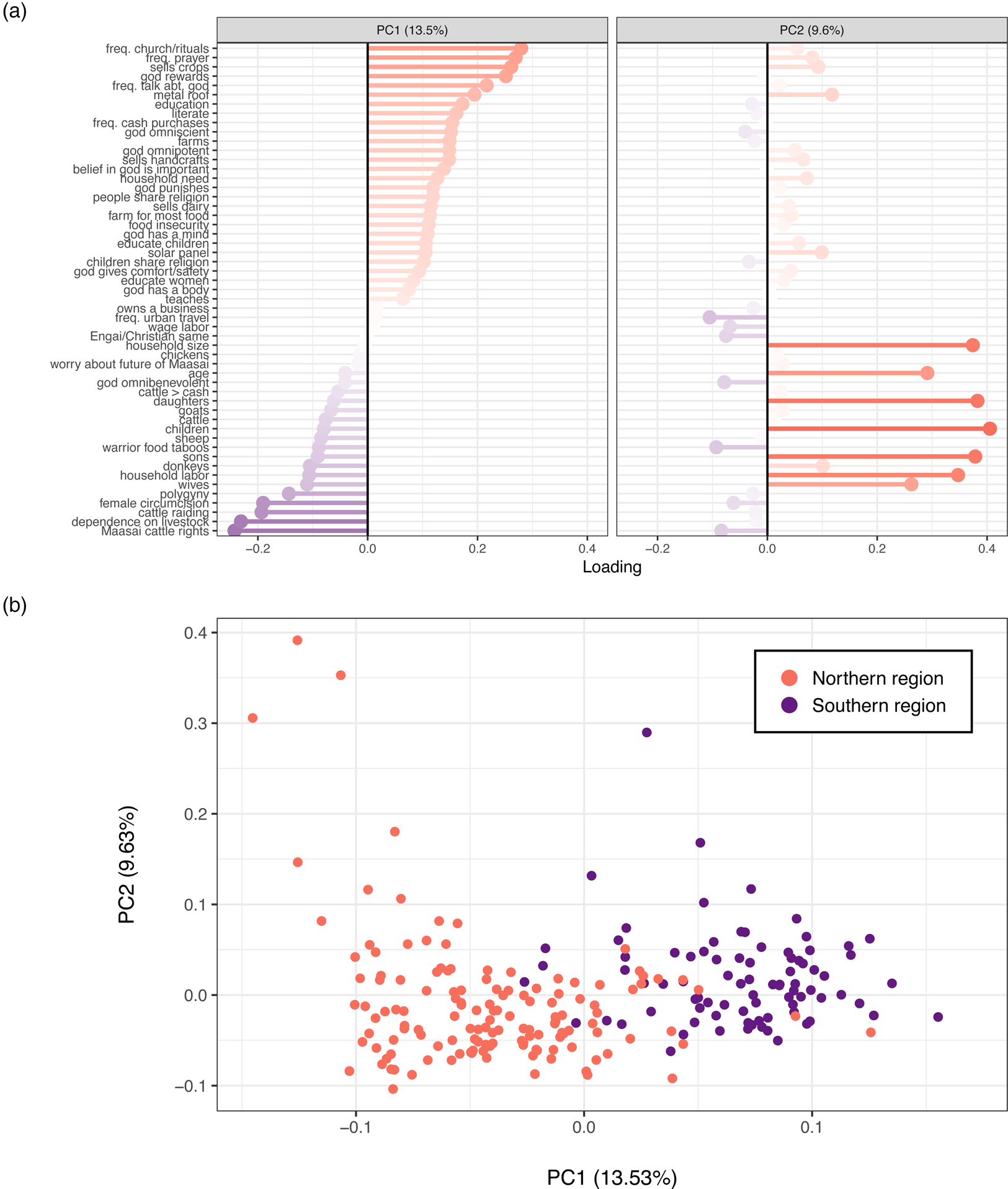
Figure 2. A: PCA loadings on PC1 and PC2, after including 53 quantitative variables from diverse domains in our analysis. PC1 corresponds to a latent variable characterizing acculturation vs. traditional practices and beliefs. PC2 corresponds to a latent variable characterizing household size. B: PCA biplot, with each point representing one participant. Point colors correspond to participant region.
Table 1. Summary statistics for most of the quantitative and ranked observations data used in this study. This includes data used to model and test our study predictions, but also includes descriptive variables about the sample and a few key variables systematically varying across different regions of the field site. Trust and check refer to our two outcome variables, and food insecurity, household need, wealth and dependence on cattle were used as observed predictors. Excluding both outcome variables, each variable showed here was included in the principal components analysis described in the text

We therefore interpret PC1 as a latent acculturation variable corresponding to both ideational and material changes in the area (e.g. market integration, missionisation, education). (Acculturation is defined as an exchange of cultural features resulting from different cultural groups coming into continuous first-hand contact, such that cultural patterns of either or both groups might be changed and the groups remain distinct; see Kottak (Reference Kottak2013, p. 569). Here, it refers to Tanzanian Maasai adopting ideas and behaviours that are a consequence of globalisation.) Ideational and material variation along PC1 largely mapped onto regional variation, such that participants living north of the mountain clustered along the lower end of PC1 (more traditional) and participants living south of the mountain (near town, markets, churches, paved roads, and schools) clustered along the higher end of PC1 (more acculturated) (see Figure 2b). We found no meaningful sex differences in our PCA results. See Supporting Information for details.
Confirmatory analyses: testing the PBM and RIM
In both the vignette prestige condition and the experience condition, advice was treated with strong levels of scepticism (experience condition: 32% did not trust, 5.5% somewhat trusted and 11% completely trusted; prestige condition: 33% did not trust, 4.6% somewhat trusted and 14% completely trusted), and most participants stated that they would fact-check the advice before acting on it (86% in the experience condition, 82% in the prestige condition). Thus, participants had approximately equal, but low, trust for advice from both the prestigious individual and from the individual known to be knowledgeable from personal experience.
In our confirmatory analyses for trust outcomes, the RIM was supported (see Table 2 for logistic regression model parameters and statistics, and Figure 3 for RIM effects plots). AICc model selection suggested that the RIM had better support than the PBM (strong version) and PBM + RIM (weak version). (We re-ran trust models using an ordered logistic regression and found similar effects in each of our models. See the Supporting Information for additional analyses and weighted AICc table.)

Figure 3. Logistic regression models for RIM predictors on trust outcomes. Model coefficients are in table 2 (column 2). Trust outcomes equal to 0.5 were rounded to 0 or 1 if their residuals were negative or positive, respectively.
Table 2. Logistic regression models for trust outcomes (left three models) and fact-checking outcomes (right three models) based on condition, and on scaled measures of household food insecurity, need, wealth and dependence on livestock as a source of subsistence. Estimates are log odds, with standard error in parentheses. For each outcome variable, output is shown for preregistered models: prestige bias model (PBM), risk and incentives model (RIM) and PBM + RIM.

*p < 0.05; **p < 0.01; ***p < 0.001.
Exploratory analyses
Regional variation at the field site
We interpreted PC1 (Figure 2) to be a latent acculturation variable, which was systematically lower in the northern region and higher in the southern region. Responses in the northern vs. southern regions varied on trust outcomes (north: 1 = 51%, 0.5 = 24%, 0 = 25%; south: 1 = 7.8%, 0.5 = 1.4%, 0 = 86%) and fact-checking outcomes (north: 1 = 69%, 0 = 31%; south: 1 = 92%, 0 = 8%) (see Figure S7). We therefore modelled each outcome variable as a function of PC1. Consistent with regional patterns, more acculturated participants were more likely to trust livestock advice and less likely to fact-check it, whereas less acculturated participants were less likely to trust and more likely to fact-check (Figure 4).

Figure 4. Fact-checking outcomes (A) and trust outcomes (B) predicted by PC1, the acculturation variable characterizing response patterns along the northern vs. southern sampling areas. Higher levels of PC1 correspond to higher levels of acculturation, such as Christianization and market integration. Lower levels of PC1 correspond to lower levels of acculturation, or traditional Maasai beliefs and economic practices. In (B), trust outcomes equal to 0.5 were rounded to 0 or 1 if their residuals were negative or positive, respectively.
Hierarchical cluster analysis
Variables belonging to both ideational and material categories had high loadings on PC1 (Figure 2a), which in turn distinguished the northern and southern regions (Figure 2b). To explore if response patterns naturally formed ideational vs. material clusters, we conducted a hierarchical cluster analysis using the Ward agglomeration method, with distances as 1 − corr, and cluster p-values computed via multiscale bootstrap resampling (Suzuki, Terada, Shimodaira, & Suzuki, Reference Suzuki, Terada, Shimodaira and Suzuki2019). We identified five clusters that were reasonably well-supported by the bootstrap procedure (p > 0.8). These were education/urban, elder/household size, farming/religious, MI, and traditional beliefs/large herds (TB). See Figure 5. Two of these (TB and MI) were clearly interpretable as ideational vs. material. Because we also developed an a priori MI index (see ‘Exploratory measures’), we denote the MI cluster here as empirically determined MI (EMI). (Note that we made no a priori TB index, as we did with MI.)
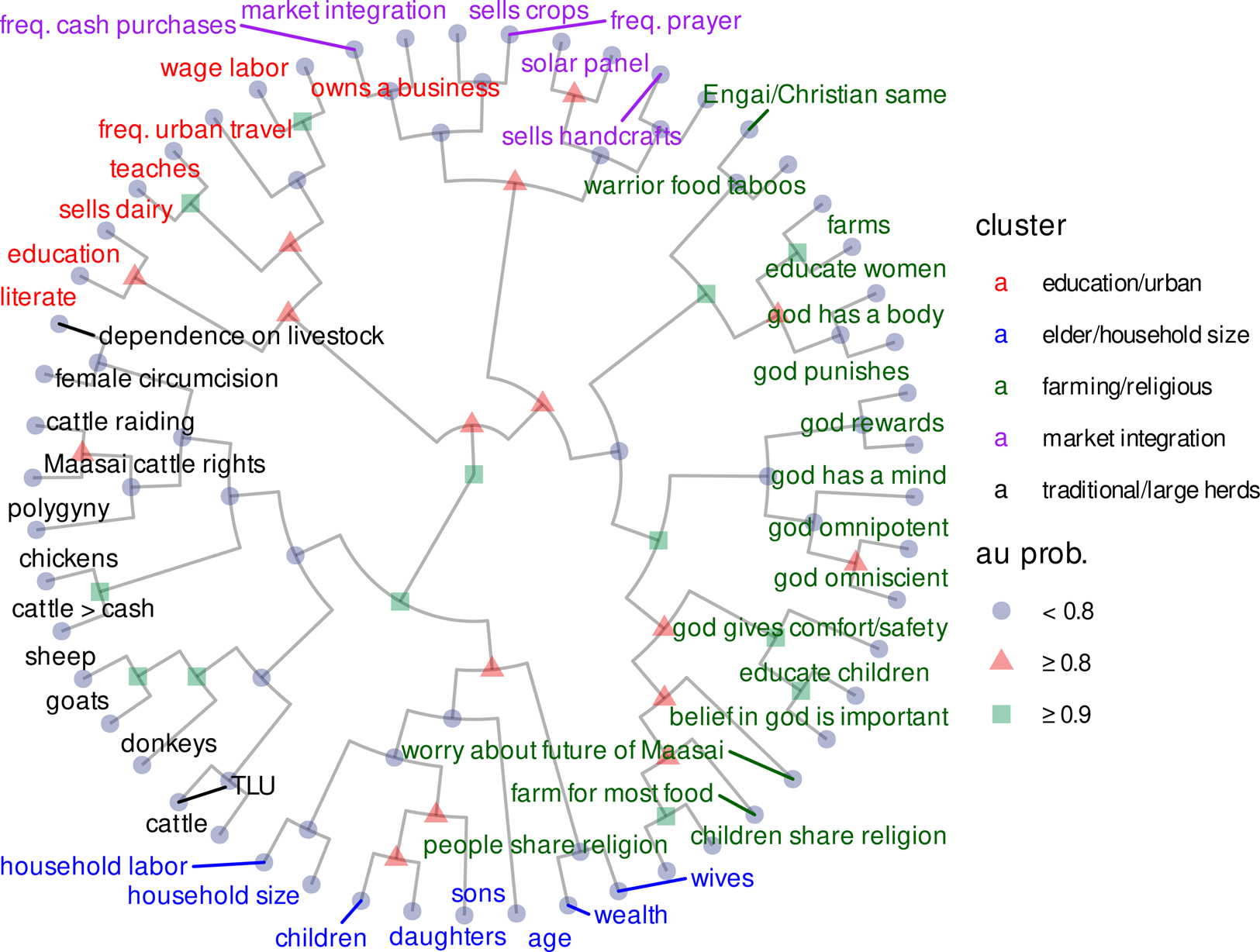
Figure 5. Hierarchical clustering dendogram with shapes corresponding to approximately unbiased (au) branching probabilities (bootstrapped n = 10,000), and colors corresponding to cluster ID. Each cluster is based in part on au probabilities and our interpretation of cohesive clusters (e.g., market integration, traditional livelihoods) Some clusters are less straightforward than others to interpret, but we nevertheless include a short cluster description next to each color.
To explore if material or ideational clusters better predicted trust than PC1, we used MI, EMI, TB and dependence on livestock for subsistence each as separate predictors of trust and fact-checking outcomes. (We included a model with dependence on livestock (referred to in the RIM as depend) because it strongly correlated with PC1, and varied markedly by region. In Figure 6, this model is abbreviated as DEP.) Comparing these models with each other and the confirmatory models, we found that MI and EMI each predicted higher trust and lower fact-checking, and while these effects were larger than those in the RIM, neither were as large as the effect of PC1. Compared with MI, TB weakly predicted lower trust and higher fact-checking. (Because the effects of MI and EMI were similar, we refer to them interchangeably in the Discussion section as ‘market integration’; see Figure 6.) AICc model selection consistently suggested across imputations that PC1 models outperformed the other models, including the MI, EMI, TB, depend and confirmatory models (Table S5). Market integration nevertheless appeared to have a large impact on trust, compared with adherence to traditional beliefs and values. See Supporting Information for a more detailed discussion.

Figure 6. Coefficients plot for exploratory logistic regression models predicting trust and fact-checking outcomes. Points indicate regression coefficients (log odds scale), and error bars are +/- 2 SE. Colors correspond to different predictors included in various models, whereas facets separate models included in the model comparison in this section. Facets are ordered from top to bottom in order of AICc score in weighted model selection. Tables for this are included in the SI.
Discussion
In a preregistered vignette-based experiment, we tested the roles of learning biases (PBM) and incentives (RIM) in evaluating socially learned information about grazing conditions for livestock. The PBM predicted that, if a source of information is prestigious compared with known from personal experience to be knowledgeable, people would be (a) more likely to trust and act on the advice and (b) less likely to fact-check it first. Neither of these predictions were supported. Regardless of whether the source was prestigious vs. believed from personal experience to be generally knowledgeable, trust in socially learned information about grazing conditions was equally low in both conditions, and preferences for fact-checking were also equally high in both conditions. This lack of support was found when considering ‘strong’ and ‘weak’ versions of prestige bias (sensu Morin, Reference Morin2016; see ‘Preregistered predictions’ and ‘Study design’ sections); we tested the weak version in PBM + RIM but did not find a statistically significant effect of prestige (Table 1). Nevertheless, 24% of participants did trust the fictional advice giver, suggesting that persons known to be knowledgeable via either their prestige or via personal experience are trusted to some extent.
The RIM predicted that resource scarce participants who are less dependent on cattle would be (a) more willing to take a risk and act on socially learned information and (b) less likely to fact-check it first. Prediction (a) was supported, and prediction (b) was not. Observational measures of resource scarcity (household food insecurity scores and need) significantly predicted higher trust in, and willingness to act on, advice about livestock. Conversely, as predicted, proxy measures of livestock dependence for subsistence and household wealth predicted lower trust in the same advice. These measures, however, did not significantly impact participants’ stated need to fact-check before acting on information.
The RIM outperformed the both strong and weak versions of the PBM by AICc on both trust and fact-checking (see Tables 1 and S2). These results imply that, for Maasai in this region, risks and incentives influence trust about livestock advice, whereas the effect of prestige is indistinguishable from assessments of knowledgeability based on participants’ personal experiences. More notably, trust and reliance on social learning, at least for advice about livestock movement, were generally quite low (see also Toelch, Bruce, Newson, Richerson, & Reader, Reference Toelch, Bruce, Newson, Richerson and Reader2014; Mesoudi, Chang, Murray, & Lu, Reference Mesoudi, Chang, Murray and Lu2015).
Exploratory analysis of regional acculturation as a predictor of trust
Regional acculturation strongly predicted trust. Acculturation was the first principal component of variables reflecting market integration vs. dependence on livestock, and traditional vs. non-traditional views about polygyny, female circumcision and cattle raiding (Figure 2). The study site comprised two distinct regions separated by a small mountain, with southern, more acculturated participants living closer to densely populated towns exhibiting higher trust, and northern, less acculturated participants living on a more rural and isolated side of the mountain exhibiting lower trust (Figures 1 and 4).
To more precisely characterise acculturation, we identified clusters of variables related to material culture (MI) and ideational culture (TB). MI was a stronger predictor of trust than TB, and a model with MI alone outperformed a model with both, suggesting that MI better explained the strong positive relationship between regional acculturation and trust. Nevertheless, the model with acculturation, which reflects covariation among many variables beyond MI, had the best performance of all (see Supporting Information for AICc tables). This suggests that acculturation was irreducible to either economic or ecological accounts alone (e.g. Edgerton, Reference Edgerton1971). Our results also suggest that acculturation has a larger influence on advice-taking than do risks and incentives.
Material and ideational culture
Material vs. ideational theories of culture have a long history in social sciences. Materialist accounts emphasise environmental feedback and incentive structures: individuals must learn to maximise resources and behavioural patterns varying between groups correspond to different relevant features in the environment (e.g. MI, livelihood risks). If risk and uncertainty are part of a local subsistence strategy, cultural adaptations might feature heightened sensitivity to risk (Goldschmidt & Goldschmidt, Reference Goldschmidt and Goldschmidt1976; Steward, Reference Steward1972). East African pastoralists optimise herd size and composition (Mace, Reference Mace1990; Mace & Houston, Reference Mace and Houston1989; see also Næss, Bårdsen, Pedersen, & Tveraa, Reference Næss, Bårdsen, Pedersen and Tveraa2011), and pattern herd movement based on past and current payoffs (Butt, Shortridge, & WinklerPrins, Reference Butt, Shortridge and WinklerPrins2009; see also Domjan & Burkhard, Reference Domjan and Burkhard1986).
Ideational accounts, in contrast, emphasise beliefs, attitudes and values. Socially transmitted information can establish complex behavioural conventions (Boyd & Richerson, Reference Boyd and Richerson1985; Tennie, Call, & Tomasello, Reference Tennie, Call and Tomasello2009), and acculturation can be driven, at least in part, by novel ideational changes such as religious conversions or Westernisation. In Monduli Juu, missionaries fund organisations, led by Maasai locals, that advocate helping women and children gain access to formal education. Efforts to convert Maasai to Christianity have largely succeeded, in part, by appealing to women (Hodgson, Reference Hodgson2005) and prioritising compatibility with some (but not all) Maasai traditions (Rigby, Reference Rigby1989). More broadly, Maasai in Monduli are well aware that their culture is shifting as a consequence of globalisation, and many anticipate that adopting new ideas will improve their lives (see also Hodgson, Reference Hodgson1999). In our data, ideational variables covaried with materialist ones (Figure 2).
Conflict and coordination by region
Land conflicts over grazing are a primary cause of neighbour conflicts across the broader Monduli Juu region, and large sisal plants now fence many property lines. This increases resource scarcity (e.g. available grass) and conflicts of interest among herders. Payoffs to individual vs. social learning strongly depend on the accuracy of learning (McElreath, Reference McElreath2004), and when misinformation is incentivised, the accuracy of social learning is reduced, and thus so is trust.
Regional variation in trust might reflect different culturally evolved solutions to a coordination problem (Binmore, Reference Binmore2011; Yamagishi & Suzuki, Reference Yamagishi and Suzuki2009), which is mutually compatible with materialist and ideational accounts. Evidence for this would include low variation within regions, and sharp discontinuities between regions (Efferson, Vogt, Elhadi, Ahmed, & Fehr, Reference Efferson, Vogt, Elhadi, Ahmed and Fehr2015; Mackie, Reference Mackie1996). Our data are partially consistent with this: only 8% of participants in the north trusted livestock advice compared with 51% in the south.
Based on the RIM, which was partially supported, herders should be sceptical about possibly deceptive advice about their grazing routines (e.g. Trouche et al., Reference Trouche, Johansson, Hall and Mercier2018). This is what we observe in the less market-integrated, more cattle-dependent northern region. Kinship is an important criteria for trust among Maasai (Fratkin, Reference Fratkin2001; Spencer, Reference Spencer1965), and northern herders might generally mistrust non-kin with livestock advice – regardless of prestige or experience. The advice-giver in the vignette was not specified to be kin (if participants asked, they were told he was not kin).
In the south, however, trust outcomes were more split. Southern herders must routinely trust non-kin and distant relatives to successfully participate in markets. This is a novel coordination problem, because cash markets and fewer livestock also reduce the scope for land conflict among herders (see also Cronk & Leech, Reference Cronk and Leech2013). Market-integrated southern herders might therefore see a demand for ‘market norms’, e.g. expectations for fairness beyond kin groups (Henrich et al., Reference Henrich, Ensminger, McElreath, Barr, Barrett, Bolyanatz and Ziker2010), which can be transmitted socially (Richerson & Boyd, Reference Richerson and Boyd2005) or preferentially attended to by content biases (Cronk, Reference Cronk2017). This account was particularly well supported by regional variation in trust outcomes. Controlling for region, individual incentives did not predict additional variation in trust, possibly supporting group-level social learning processes. (Although, as noted here and in Figure 2, these incentive variables were confounded with region.)
Mistrustful southerners might reflect the recent and ongoing nature of market expansion, infrastructure development and formal education (Hodgson, Reference Hodgson1999; Swebe, Reference Swebe1984). Multiple small-scale societies, including a separate Maasai community near Monduli Juu (Baird & Gray, Reference Baird and Gray2014), saw disruptions in traditional social conventions after market expansion (e.g. Ensminger, Reference Ensminger1992; Gurven, Jaeggi, von Rueden, Hooper, & Kaplan, Reference Gurven, Jaeggi, von Rueden, Hooper and Kaplan2015; Kasper & Borgerhoff Mulder, Reference Kasper and Borgerhoff Mulder2015; North, Reference North1990). Higher livelihood diversification and lower dependence on cattle could motivate some southern herders to take strategic risks with their livestock, but cattle remain common among southern herders. This alone might explain split trust outcomes, which we did not see in the north. Alternatively, it is difficult to overstate the importance of cattle to Maasai culture, regardless of actual subsistence strategy used (Spear & Waller, Reference Spear and Waller1993). It is therefore possible that these split trust outcomes near town result from risk aversion, not to livelihood risk per se, but to risk to cultural valuation of cattle (see also Herskovits, Reference Herskovits1926; cf. Dahl & Hjort, Reference Dahl and Hjort1976).
Limitations
This study involved testing preregistered hypotheses using both experimental and observational study designs. Only one of the preregistered hypotheses regarding the RIM was supported, with observational data. Compared with experimental studies, observational studies provide weak evidence for causality, but allow researchers to study real-world behaviours that experimental studies usually cannot (e.g. Hutchins, Reference Hutchins2000). Evidence supporting the RIM is therefore suggestive, and results should be interpreted with caution. Our vignettes also did not include a condition in which the advice giver was depicted as unknowledgeable, so we cannot determine if knowledgeability, inferred from either prestige or personal experience, influences trust. It is also worth noting that our study investigated trust in a single domain, namely, advice relating to livestock. Whether or not the findings in this study generalise to trust in other domains, such as farming, medicine or conflict resolution, is an open question.
Although we found clear evidence that acculturation was associated with trust outcomes, this key finding was not from the preregistered hypotheses but from post hoc exploratory analyses. Exploratory analyses are especially vulnerable to misinterpreting noise as genuine signals. Also, data in the northern vs. southern regions were collected by different research assistants, raising the possibility that regional differences in acculturation and trust were somehow a consequence of the procedures followed by each assistant. Although we cannot completely rule out an interviewer effect, we doubt it for the following reasons: both assistants were local adult men with many years of experience administering surveys. One assistant and A.D.L. separately collected data in the southern region, and their results were quite similar (i.e. a term for interviewer in regression models of data only from the southern region was not statistically significant; see the Supporting Information). Further, many of the survey items were relatively objective questions involving roof material, solar panels, number of wives, household size and so forth, where interviewer effects would not be expected, and these also differed systematically by region (see Supporting Information for tests of differences by region).
Conclusion
Socially learned information can imply non-trivial costs and benefits, including risks of misinformation. Risk and incentives predicted increased willingness to trust in advice, but prestige did not increase trust compared with knowledgeability learned from personal experience. Acculturation, which varied markedly by region, was found to have an even larger positive association with trust. Much of this effect was due to the positive effect of market integration on trust, but weaker adherence to traditional Maasai values was also positively associated with trust to some degree. The causal pathways among market integration, acculturation and trust remain to be clarified.
Supplementary material
To view supplementary material for this article, please visit https://doi.org/10.1017/ehs.2021.10
Acknowledgements
We especially thank the Maasai people of Eluwai who participated in this study. We are also grateful to Musa Kamaika, Kotoke Ngilepoi and one anonymous Maasai research assistant for their help during fieldwork. We thank Anne Pisor, Cynthiann Heckelsmiller, Lee Cronk, Serah Shani and two anonymous reviewers for many helpful comments and discussions that improved this manuscript.
Author contributions
A.D.L. and E.H.H. designed the study. A.D.L. collected data. A.D.L. and E.H.H. analysed the data. A.D.L. wrote the first draft of the paper. A.D.L. and E.H.H. wrote the final draft of the paper.
Financial support
This project was funded by an NSF Doctoral Dissertation Improvement Grant (award number 1918523).
Conflicts of interest
The authors declare no conflicts of interest.
Data availability
All preregistration materials are publicly available at https://osf.io/5p7ut. Data are available at https://doi.org/10.5281/zenodo.4118454, and supplementary information and analysis scripts are available at https://doi.org/10.5281/zenodo.4118474.


 Open access

