To save content items to your account,
please confirm that you agree to abide by our usage policies.
If this is the first time you use this feature, you will be asked to authorise Cambridge Core to connect with your account.
Find out more about saving content to .
To save content items to your Kindle, first ensure no-reply@cambridge.org
is added to your Approved Personal Document E-mail List under your Personal Document Settings
on the Manage Your Content and Devices page of your Amazon account. Then enter the ‘name’ part
of your Kindle email address below.
Find out more about saving to your Kindle.
Note you can select to save to either the @free.kindle.com or @kindle.com variations.
‘@free.kindle.com’ emails are free but can only be saved to your device when it is connected to wi-fi.
‘@kindle.com’ emails can be delivered even when you are not connected to wi-fi, but note that service fees apply.
When men and women in early medieval England thought about the world around them, they did so in ways that often strike us as strange. In their surviving writings, we are confronted continually with unfamiliar ideas – about the creatures and beings which populated the world, about the forces and phenomena which shaped it, and about the ways in which human beings might enact change upon it through ritual, magic, and prayer. Although unfamiliar, these ideas give us important indications of how early medieval English thinkers characterized and categorized their surroundings and their experiences. Of substantial interest to many of them was the question of how they might distinguish correctly between what was 'natural' in the world, and what was not. This Element examines what that distinction meant to the inhabitants of early medieval England, and under what circumstances they felt compelled to explore it.
The earliest English writers left little comment on their literary forms. In contrast to the grammatical treatises of late antiquity or critical studies of contemporary and modern literature, early medieval English writing offers only sparse contemporaneous self-commentary, often in brief or conventional notes along the way to other things. But Old English and Latin literature had lively and evolving practices of literary form and formal innovation. Literary Form in Early Medieval England examines both more and lesser known forms, considering the multilingual landscape of early medieval England and showing that Old English literary forms do not simply end with the rupture of the Norman Conquest but continue in surprising ways. Literary Form in Early Medieval England offers a concise tour of what we do know of literary forms, both those that have received more attention and those that have been relatively overlooked, across the first six centuries of English literature.
This Element examines the sociopolitical hierarchy of England in the tenth and eleventh centuries, focusing upon the plasticity of the boundary between the ranks of ceorl and thegn. Offering a nuanced analysis of terms such as ceorl and thegn in both earlymedieval texts and modern scholarship, the Element highlights the mechanisms that allowed these non-institutional signifiers to hold such socialweight while conferring few tangible benefits. To better describe the relative social positions, the author argues that a compound method is preferable, supporting this proposal via a thorough deconstruction of writings by Archbishop Wulfstan II of York − responsible for many of scholars' ideas about rank in the period − and the examination of sources that evidence a blurring of 'middling' social boundaries across the two centuries under discussion. Together, these strands of interrogation allow for a fuller understanding of how status was constructed in earlymedieval England.
The people of early England (c. 450–1100 CE) enjoyed numerous kinds of entertainment, recreation and pleasure, but the scattered records of such things have made the larger picture challenging to assemble. This volume illuminates the merrier aspects of early English life, extending our understanding of the full range of early medieval English culture. It shows why entertainment and festivity were not merely trivial aspects of culture, but had important functions, in ritual, in community-building, in assuming power, and in resistance to power. Among the activities explored are child's play; drinking and feasting; music, dance, and performance; the pleasures of literature, festivals and celebrations; hunting and sport; and games.
This Element explores ideas about the sick and healthy body in early medieval England from the seventh to the eleventh centuries, proposing that surviving Old English texts offer consistent and coherent ideas about how human bodies work and how disease operates. A close examination of these texts illuminates the ways early medieval people thought about their embodied selves and the place of humanity in a fallen world populated by hostile supernatural forces. This Element offers a comprehensive and accessible introduction to medical practice and writing in England before the Norman Conquest, draws on dozens of remedies, charms, and prayers to illustrate cultural concepts of sickness and health, provides a detailed discussion of the way impairment and disability were treated in literature and experienced by individuals, and concludes with a case study of a saint who died of a devastating illness while fighting demons in the fens of East Anglia.
This Element Recovering Old English examines the philological activities of scholars involved in the recovery of Old English in the period between c. 1550 and 1830. This Element focuses on four philological pursuits that dominated this recovery: collecting documents, recording the lexicon editing texts and studying the grammar. This Element demonstrates that throughout the vicissitudes of history these four components of humanist philology have formed the backbone of Old English studies and constitute a thread that connects the efforts of early modern philologists with the global interest in Old English that we see today.
In the words of its own historians, pre-Norman Britain held five languages and four peoples. Yet in modern scholarship, Old English is too often studied separately from the other languages that surrounded it. This Element offers a comprehensive synthesis of the evidence from the pre-Norman period that situates Old English as one of several living languages that together formed the basis of a vibrant oral and written literary culture in early medieval Britain. Each section centres around a key thematic topic and is illustrated through a series of memorable case studies that encapsulate the extent to which multilingualism appeared in every facet of life in early medieval Britain: religious and scholarly; political and military; economic and cultural; intellectual and artistic. The Element makes an overall argument for the dynamic extent of transcultural literary and linguistic culture in early medieval Britain before the arrival of the Normans.
The early medieval English were far more diverse and better connected to a broader world. Their writings reveal substantial interest in Europe, Asia, and Africa while they situated themselves firmly within Christian Europe. They drew many ideas from textual sources and filled out their conceptions from their own travels and interactions with visitors. Chronicles, histories, poetry, homilies, saints' lives, and occasionally maps tell of peoples and lands from the British Isles to their near neighbors in Scandinavia to such distant places as Jerusalem, North Africa, and India. They also imagined geographies that veered into the fantastic and vividly depicted hell, purgatory, and heaven. This Element provides insights about early medieval English who were engaged deeply in a variety of modes with other parts of their world. Both the connections and the divisions they constructed still have impact today.
This Element covers the art produced in early medieval England from the departure of the Romans to the early twelfth century, an art that shows the input of multi-ethnic artists, patrons, and influences as it develops over the centuries. Art in early medieval England is an art of migrants and colonisers and the Element considers the way in which it was defined and developed by the different groups that travelled to or settled on the island. It also explores some of the key forms and images that define the art of the period and the role of both material and artist/patron in their creation. Art is an expression of identity, whether individual, regional, national, religious, or institutional, and this volume sheds light on the way art in early medieval England was and continues to be used to define particular identities, including that of the island on which it was produced.
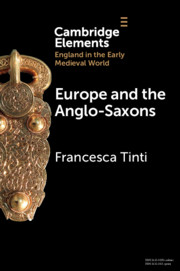
This publication explores the interactions between the inhabitants of early medieval England and their contemporaries in continental Europe. Starting with a brief excursus on previous treatments of the topic, the discussion then focuses on Anglo-Saxon geographical perceptions and representations of Europe and of Britain's place in it, before moving on to explore relations with Rome, dynasties and diplomacy, religious missions and monasticism, travel, trade and warfare. This Element demonstrates that the Anglo-Saxons' relations with the continent had a major impact on the shaping of their political, economic, religious and cultural life.
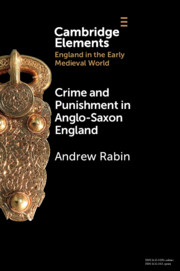
Arguably, more legal texts survive from pre-Conquest England than from any other early medieval European community. The corpus includes roughly seventy royal law-codes, to which can be added well over a thousand charters, writs, and wills, as well as numerous political tracts, formularies, rituals, and homilies derived from legal sources. These texts offer valuable insight into early English concepts of royal authority and political identity. They reveal both the capacities and limits of the king's regulatory power, and in so doing, provide crucial evidence for the process by which disparate kingdoms gradually merged to become a unified English state. More broadly, pre-Norman legal texts shed light on the various ways in which cultural norms were established, enforced, and, in many cases, challenged. And perhaps most importantly, they provide unparalleled insight into the experiences of Anglo-Saxon England's diverse inhabitants, both those who enforced the law and those subject to it.
Recommend this
Email your librarian or administrator to recommend adding this to your organisation's collection.