To save content items to your account,
please confirm that you agree to abide by our usage policies.
If this is the first time you use this feature, you will be asked to authorise Cambridge Core to connect with your account.
Find out more about saving content to .
To save content items to your Kindle, first ensure no-reply@cambridge.org
is added to your Approved Personal Document E-mail List under your Personal Document Settings
on the Manage Your Content and Devices page of your Amazon account. Then enter the ‘name’ part
of your Kindle email address below.
Find out more about saving to your Kindle.
Note you can select to save to either the @free.kindle.com or @kindle.com variations.
‘@free.kindle.com’ emails are free but can only be saved to your device when it is connected to wi-fi.
‘@kindle.com’ emails can be delivered even when you are not connected to wi-fi, but note that service fees apply.
From a formal theological point of view, it would be common to distinguish the experience I describe in Chapter 8 from revelation: it would be called ‘religious’ or ‘spiritual’ experience rather than revelation as such. However, if revelation is God's self-revelation, that is, if it is always personal, then that act of communication in relationship is always a self-revealing. For a Christian, if this is truly God's self-revealing, then the hermeneutic context of the Christian tradition will bring a degree of intelligibility to the experience. In Chapter 9, I consider this possibility through an examination of the spiritual tradition of Ignatius Loyola. Ignatius sets great store on experience as the place where one might find God. To ‘find God in all things’ is to reflect on where God has passed in experience. Ignatian discernment is about becoming attentive to feeling; I argue that this is not simply learning to be attentive to emotions but to be sensitive to moods as ways of experiencing God’s presence, although this distinction goes beyond the letter of the Ignatian text. Ignatius’ approach can be helpful for contemporary reflection because it is coextensive with everyday life.
In Chapter 4, I consider some responses to the charge that theology bases itself on a metaphysics that is onto-theological. While I do not question any potential differences between a revealed theology and a natural theology, to the extent that theology is articulated in conceptual categories, it is included in this charge. One response to this view, represented by John Milbank, strongly reaffirms a scholastic metaphysics and embraces the belief that by means of revelation, Christians can judge the world from a higher vantage point than others. In fact, according to his approach, Christians have such a high vantage point that they can have a ‘God’s-eye view’ or what is sometimes called a ‘view from nowhere’. To demonstrate a second type of response by theologians to the charge that theology can simply be dismissed as onto-theological, I examine the complex case of Marion's engagement with a number of Thomistic thinkers. While Marion does not prosecute his case with resounding success, his questions at least disturb some of the assumptions of a scholastic approach that is seen to be fundamental to Catholic theology.
Chapter 1 introduces the major themes of the book. I argue that the idea of divine revelation does not make much sense in the contemporary world, because it is primarily thought about in terms of beliefs rather than experience. Philosophically, experience is (i) what happens at the point of opening in the world, which is a given instance of life, as well as (ii) conscious reflection on that experience as it is lived. For both senses of the word, using a hermeneutic-phenomenological methodology, it is possible to speak of prepredicative experience – that is, what takes place (or 'events') prior to thematisation in language. I argue that it is the prepredicative sense of experience that is engaged in revelation. This is because God cannot be made an 'object' of experience. Now, since in modern life, the word ‘belief’ risks coming to mean simply what is untrue or subjective, it is no longer very helpful in communicating something about God. In contrast, 'the event' can be used to consider the possibility of encountering a God who reveals Godself in person. To conclude the introduction, I set out how my argument about experience and the 'event' is carried through each chapter.
Chapter 7 considers how the event has been characterised in philosophy and the implications for theology. Concerned that opposition to it is generated by fear that it simply (re)asserts theistic beliefs, I examine how Marion’s understanding of the event can legitimately engage with the thought of others. Jean Grondin's views illustrate one extreme of that engagement. Caputo's analysis of the opposition between intuition and intention illustrates a need to discern whether a phenomenological approach to the event is being undertaken on the basis of theistic or atheistic beliefs, or whether a point earlier to that distinction is envisaged. Jean-Luc Nancy 's event takes place prepredicatively and it is cast in terms of an empty intentionality of faith. I suggest that this is reminiscent of hyperphasis. I look to Lieven Boeve to see how such a radical apophatics might work theologically. Boeve dialogues with Jean-François Lyotard, who thinks the event in terms of its emptiness and givenness to feeling. I then consider how Claude Romano thinks the event as prepredicative, and I use his criteria to discern whether a philosophical reading of the event would preclude a theological application.
Chapter 2 is a reflection on how people in Western societies seem to struggle to understand the ongoing place of religion, which means that they also and perhaps particularly struggle with the idea of a divine revelation and the possibility that there is anything more than the immanence of the world. The average person growing up today – whether or not he or she is religious in some way – inhabits the world as a secular reality. That person might have links to a religious community, might have a sense of openness to the transcendent and might name that transcendence 'God' in ways that are shaped by the tradition of that community. Any commitment to transcendence will be challenged, however, not only in the face of the encounter with multiple other beliefs and worldviews, and not only because something like Charles Taylor's 'immanent frame' overwhelms the social imaginary, but also in the face of the radical interruption and forgetting of traditional symbolic networks on which particular religious systems and their communities depend. The injunction to remember that is at the heart of the three Abrahamic religious traditions simply no longer comes to mind in the once-Christian West.
In Chapter 3, I consider several ways in which philosophical discourse has become allergic to the concept of revelation. While Catholic theology is largely dependent on scholastic and, more recently, modern philosophy as it tries to articulate understandings of faith, philosophy has been part of shaping a modern and postmodern culture that is frequently hostile or simply indifferent to religious faith and its notions of divine revelation. Various philosophical approaches seek to exclude theology from the realm of academic discourse, either because revealed religion is seen to be partial and therefore detrimental to the pursuit of universal wisdom, or because it seems to articulate merely its own will to power, using a metaphysics that is oblivious to having founded itself. Bound up in metaphysical systems, all discourse potentially becomes (onto-)theological. 'Religion' has recently returned in philosophy only by means of its transformation: used in Levinas’ sense as the ethical relation with the other, it effects a powerful critique. Yet, excluding the very particularity of religious traditions is a totalitarian and secularising act.
In Chapter 5, I look at how revelation is understood in Catholic theology. There are two fundamental approaches to understanding this concept: the propositional ('static') and the relational ('dynamic'), which are sometimes at odds with one another. While propositional accounts provide the conditions of possibility (and impossibility) for conversations about God’s revelation to take place, and provide principles against which the discernment of truth can be evaluated, propositions can harden and become brittle as they are brought into new contexts. When this happens, the symbolic nature of all talk of God is forgotten, and the literal sense is brought to the fore. Propositions are weaponised and used in authoritarian ways to resist difference and change. This alienates the church from the culture/s in which it is embedded, making some of its choices and actions inexplicable and others indefensible. I then consider the relationship between revelation and tradition more closely. I argue that the proper work of developing tradition is not to defend propositions that have ceased to promote authentic reflection on revelation in dialogue with the context, but to renew what lies at its heart.
In Chapter 8 I examine Lacoste's study of affective experience and consider the possibility that God might be recognised in the affect as an event. For Lacoste, God’s presence to affection takes place in moods rather than feelings. The recognition that God has passed in experience is always subject to self-deception and must be tested against the tradition of the believing community. Revelation and truth are connected by means of Augustine's reversal: when it comes to God, we do not love what we first know but know what we first love. This attends to the paradox that occurs in the reception of phenomena appearing only to freedom – paradoxical phenomena appear as credible rather than indubitable and are open to acceptance or rejection. For Lacoste, such phenomenality ‘cannot be perceived without our decision to see it’ and begins in ‘an experience formed in the element of non-self-evidence’. It arouses love; it is the experience of love that first draws the 'believer'. Revelation touches experience in an encounter that is felt before it is known. Prepredicative, signifying by way of moods rather than feelings, the revelatory encounter is primarily relational rather than doctrinal.
In Chapter 6, I introduce hermeneutic phenomenology as a philosophical method relating to the description and interpretative analysis of experience. French phenomenology has become a dialogue partner for theology and religion because of its capacity to accommodate what might be given without appearing as such. For Marion, this opens the possibility of recognising phenomena that signify in excess of or counter to experience, including phenomena of r/Revelation. After sketching Marion's typology of saturated phenomena and considering some of the criticism that has emerged in response, I observe his deepening insight that the phenomenality of the event characterises each of the counter-experiences he describes, and so has a particular importance. If what exceeds intentionality is described in terms of the event rather than as a phenomenon of revelation, we avoid the difficulties of the r/Revelation distinction that Marion draws, and decrease the sense that revelation is being smuggled into phenomenology. I also note that the event is a figure used more broadly in contemporary thought and so enables us to connect Marion’s work with that of others in potentially fruitful dialogue.
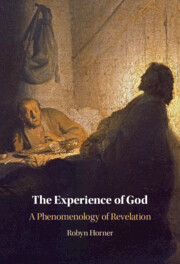
In the final chapter, I examine the question of revelation by looking again at the Emmaus story. In the generally accepted reading of this text, it is a story about moving from blindness to sight. I argue that the event of revelation is more nuanced than this reading allows. God is revealed to the disciples in the event of their burning hearts on the road, in a presence in the affect to which they only advert afterwards (Lacoste). The disciples personally recognise Jesus in the event of the breaking of the bread, in the saturated phenomenon of his appearing and disappearing (using the tools of Marion, otherwise). And Cleopas and his companion reveal the God of Jesus Christ in the event of their joyful witness to the other disciples back in Jerusalem, and in their personal transformation (Romano). That divine revelation might be one of the possibilities of a hermeneutic of the event allows sufficient ambivalence between the immanent and the transcendent to accommodate readings that might sometimes be plausible either way. Learning to discern the movements of the affect takes seriously, however, the possibility that God reveals Godself in experience through a love that appears to freedom.
Belief and credal commitment sometimes seem to make less and less sense in the West. A kind of 'cultural amnesia' has taken hold, where formal religious adherence begins to seem almost unthinkable. This is especially so for the idea of divine revelation. Robyn Horner argues this means we need to re-evaluate how theology proceeds, focusing not so much on beliefs but on experience. Exploring ways in which the experiential might open human beings up to divine possibility, the author turns to phenomenology (especially in the French philosophical tradition) because it seeks to examine unrestrictedly what is given through involved encounter. Bringing phenomenology and poststructuralism together, Horner develops the idea of revelation as an 'event' wherein God interrupts and exceeds human experience, affecting and transforming it. This striking concept, named but largely unexplored by theology, articulates a notion of supernatural revelation which now starts to appear both coherent and plausible.
Recommend this
Email your librarian or administrator to recommend adding this to your organisation's collection.