To save content items to your account,
please confirm that you agree to abide by our usage policies.
If this is the first time you use this feature, you will be asked to authorise Cambridge Core to connect with your account.
Find out more about saving content to .
To save content items to your Kindle, first ensure no-reply@cambridge.org
is added to your Approved Personal Document E-mail List under your Personal Document Settings
on the Manage Your Content and Devices page of your Amazon account. Then enter the ‘name’ part
of your Kindle email address below.
Find out more about saving to your Kindle.
Note you can select to save to either the @free.kindle.com or @kindle.com variations.
‘@free.kindle.com’ emails are free but can only be saved to your device when it is connected to wi-fi.
‘@kindle.com’ emails can be delivered even when you are not connected to wi-fi, but note that service fees apply.
Alejo Carpentier in Context examines one of the greatest novelists of Latin American literature in the 20th century. The Cuban Carpentier was one of the regions firmest supporters of the Cuban Revolution yet was revealed later to have hidden important details of his biography. A polymath of encyclopedic knowledge, contributions to this book showcase his influence, not only as a novelist but also as a musicologist, writer of ballet scenarios, radio broadcaster, opera aficionado and expert in modernist architecture. This volume offers perspectives on Carpentier's concept of the marvelous real, which later morphed into magical realism, as well as on the baroque as a defining characteristic of Latin American culture. Debates focus on Carpentier's role as a public intellectual in Cuba and abroad, on new revelations about his biography and readings of his major novels, introducing ecocritical perspectives, theories of intermediality and recent philosophies of history.
When Elizabeth Maconchy entered the British compositional scene in 1930 with the premiere of her orchestral suite, The Land, she and her fellow composers had an unsettled relationship with the prevailing musical styles of Europe. Whereas continental composers were highly regarded by British critics as cutting edge, their British contemporaries were faulted as derivative, unoriginal, and too steeped in national traditions to contribute to the ‘new’ music. Constant Lambert argued his rival countrymen (and women) had let their moment to be ‘modern’ pass them by. This chapter examines the scope of modernism on the continent and scholars’ difficulties in pinning down a precise functional definition of the so-called ‘modernist’ style. Practitioners of European modernism sought to be sensational or at the very least individual. British modernism, on the other hand, tended toward the juxtaposition of ‘old’ and ‘new’, an eclecticism that is not bound to any specific ideology.
In 1934, Pablo Neruda arrived in Barcelona as a Chilean diplomat, and in February 1935, he became the Chilean consul in Madrid. Living in Spain during the Second Republic and the Spanish Civil War marked a turning point in Neruda’s poetry. The Spanish Civil War provoked a historical awakening in Neruda’s poetics – as exemplified in España en el corazón – that paved the way to his ambitious poetic project of Canto general, as he aimed to historicize and politicize his portrayal of Latin American ruins. This essay on how the Spanish Civil War marks Neruda’s poetics examines how the use of the apostrophe throughout España en el corazón reveals the dialogic nature of his poetic project, which intends both to speak to a Republican Spain, with its dead soldiers and poets, and to defy the fascist leaders of the war.
Industrial imperialism affected Europe before anywhere else, bringing a dizzying burst of modernization that altered habits of life and the ways in which wealth was created and distributed. Among the many results of this disruption would be the opening of new niches in what had become an ossified theatrical environment. At the same time, realism and romanticism offered new ways of viewing the world and shaped how theatre artists filled those niches. Ballet and opera were transformed by romanticism although both would also eventually be touched by realism. The literary romanticism of spoken theatre was overwhelmed by competition from melodrama (which effectively integrated romanticism and realism) and the “well-made play” (which eschewed literary ambition in favor of stage-worthiness). It was then outflanked by a stringent realism that emphasized psychological and social issues, whose theatrical plainness led to avant-garde efforts to “retheatricalize” theatre.
This chapter explores the significant impact of the digital age on the realm of literature, focusing specifically on Hebrew poetry as a distinctive case study. This focus is driven by the declining status of literature within Israeli culture and the dynamic state of its reviving literary landscape. The study is structured in two phases: the first delves into practices and phenomena, while the second aims to provide a comprehensive understanding of the field’s logic and values by examining different participants and levels. The chapter claims that the necessity of the second phase arises from the current state of the field, where the adaptation of media has become so ingrained that it conceals its influence on literary themes, forms, and language. The chapter addresses this gap using the theoretical framework of mediatization, which explores long-term changes associated with media evolution.
This chapter considers how Australian poetry of the 1970s participated in major social changes that were fuelled by a range of factors, including greater access to higher education, the sexual liberation movement, a drug subculture and Australia’s involvement in the Vietnam War. It traces how Australian writers turned to America for influence and were able to utilise new technologies to generate a vibrant small press culture. The chapter outlines the surge in collaboration, collectives and overlapping literary circles. It also examines a series of anthologies that sought to feature new energies and voices, with some seeking to demarcate such poetry from earlier or more traditional forms. Lastly, it analyses the significance of the poetry workshops based at Melbourne’s La Mama Theatre, little magazines, and the development of small presses that produced poetry collections during the decade of the 1970s.
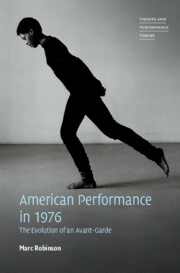
A survey of drama and performance in the period 1975-1980, with emphasis on the innovative plays and experimental productions that appeared in New York in 1976, along with consideration of surrounding developments in visual art, literature, film, and music, and attention to the politics of these transitional years.
1976 was a febrile, transitional year in cultural history, coming after Watergate and Vietnam and before the AIDS epidemic and the rise of the Conservative movement. Bicentennial triumphalism sounded dissonant against a violent past and uncertain future. Marc Robinson here explores how innovative artists across disciplines – drama, dance, music, film, visual art – responded to this period, before zeroing in on avant-garde theater. Over 1976, five landmark productions could be seen within months of one another: Cecil Taylor's A Rat's Mass / Procession in Shout, Meredith Monk's Quarry, the Robert Wilson / Philip Glass opera Einstein on the Beach, Joseph Chaikin's production of Adrienne Kennedy's A Movie Star Has to Star in Black and White, and, finally, the Wooster Group's first open rehearsal of Spalding Gray and Elizabeth LeCompte's Rumstick Road. In close readings of these five works, Robinson reveals the poetics of a transformative moment in American culture.
Between the turn of the twentieth century and the outbreak of the Second World War, avant-garde theatre artists challenged traditional norms through experimentation and radical innovation. Blurring the boundaries separating drama, theatre, and performance, these artists employed deliberate provocations and welcomed the audience’s displeasure. In subject matter, the theatrical avant-garde was equally pathbreaking, addressing a number of issues crucial to early twentieth-century modernity: war and revolution, gender roles, technology, rationality and the subconscious, futurity and the new, and the role of art in a rapidly transforming world. Futurism, Dadaism, and surrealism – three of the leading avant-garde movements – incorporated new materials and activities; brought theatre into dialogue with cabaret, variety show performance, circus, and the art of declamation; and dramatically redefined the actor’s role. Their innovations inspired contemporary experiments in non-realist staging, environmental theatre, performance art, and immersive performance.
This epilogue offers a rumination on the continuing place of the modernist theatre in the plays and performance practices of the latter twentieth century and beyond. It begins with the aesthetic disputes staged within Lorraine Hansberry’s The Sign in Sidney Brustein’s Window, written and set at the cusp of the transition from the modern to the postmodern. The shadow of modernism looms large over Hansberry’s characters, just as it does over many of the plays and productions to follow. From the evergreen influence of the avant-gardists to the long-lasting legacy of a figure like Bertolt Brecht to the perpetual restagings and radical rewriting of works by Henrik Ibsen or August Strindberg, the figures and aesthetics of the modernist era permeate and help give shape to the postmodern. Far from a retrograde revolution, modernism may best be regarded as a still-living mode of aesthetic and theatrical practice.
The introduction makes the case that while theatre has tended to be ignored or marginalised in modernist studies, it deserves a central place in accounts of modernism alongside poetry, prose, cinema, and the visual arts. It further contends that while there is an impressive variety amongst its practitioners, the hallmarks of modernist theatre are antagonism and provocation. Indeed, modernist theatre-makers rebelled against dominant genres, conventions, institutions, and audiences by creating new artistic forms and advocating for different values and worldviews. In so doing, this chapter argues that scholars need to go beyond the usual Euro-American cultures to consider how modernist theatre was manifested in the wider world and to recalibrate the historical trajectory of modernism that such broader geographies demand.
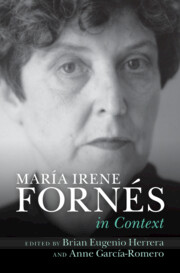
María Irene Fornés is both one of the most influential and one of the least well-known US theatermakers of the late twentieth century, with former students including leading US playwrights, directors and scholars. This is the first major scholarly collection to elucidate Fornés' rich life, work, and legacy. Providing concise and wide-ranging contributions from notable scholars, practitioners and advocates drawn from the academic and artistic communities most informed and inspired by her work, this engaging volume provides diverse points of entry to specialists and students alike.
Although María Irene Fornés is recognized by her peers as one of the great avant-garde innovators of her time, her absence from many critical and mainstream accounts of American playwriting suggests that her experimental techniques were not easily intelligible as part of a movement, even one fabled for the unintelligibility of its creative effects. As a corrective critical gesture, Roy Pérez looks to Art (a short and sparsely documented play from 1986) to understand the role of the avant-garde in Fornés’s larger body of work. Pérez argues that – even as the avant-garde earned a reputation for being fixated on unpragmatic political ideals, aesthetic difficulty for its own sake, or humorless alienation – Fornés wrote plays plays that danced their characters and viewers through spellbinding thought experiments, making lofty questions seem like everyday ruminations, that we might pursue with a sense of play, or at least with authentic feeling.
This essay details selected experiences from Fornés’s early life that were formative to her philosophy of life and art in order to highlight how her theatremaking relates to and extends from Havana’s vanguard movements of the 1920s–1940s. Considering Fornés’s migration alongside the trajectories of transnational movement of artists like director Francisco Morín and composer Mario Bauzá, Mayer-García evinces how this experience disposed her to approaching the world through “errant thinking” wherein one comes to know oneself through an immersion in foreign lands and cultures. By highlighting connections with some of Cuba’s most notable artists, the author argues that shared mobility, portable affects of place, and errant thinking all implicate Fornés as a displaced artist from Havana’s avant-garde circles.
Summarizes the contents of the volume, focusing on cross-cutting themes: the reality of the premiere; the synthesis of the arts; avant-garde currents of the early twentieth century; Russian folklore and national identity; and the legacy and afterlife of Stravinsky’s score.
Chapter 14 presents a dynamic model of long-term, art historical trends and shows the complexity of overlapping styles and movements. It is based on a modification af a dynamic model of development on the timescale of the human life course. The basic evolution rules are those of simultaneously operating processes of consolidation of the status quo and processes of innovation driven by a familiarity-novelty optimum. The simulation explores different scenarios, one of which generates the typical art-historical pattern of overlapping continuous as well as discontinuous processes.
Artist Tetsu Takeda left Japan for America in 1986 and returned to Japan in 2011. Shortly after the Fukushima nuclear disaster, Takeda started identifying himself as a “professional artist” and only doing “high art” by rethinking life and our role as human beings interfering with nature. Takeda is an eccentric collector of ocean rubbish flushed ashore by waves. In his tiny home studio, he creates various big-eyed rubbish creatures in diverse forms, shapes, dimensions, and colors in his unorthodox way reminiscent of Victor Frankenstein in this lab. For him, doing new artistic endeavors is a ritual of giving life—to “vitalize” rubbish—and inhabiting a reformulated society of nature, whether privately (in his home) or publicly (in galleries).
This chapter provides an overview of twentieth- and twenty-first-century explorations of poetic form, with a focus on late Imperial and early Soviet Modernism. Rebelling against nineteenth-century norms, Modernist poets sought to devise a poetic idiom more in tune with their era of rapid cultural, political, and technological change. The rich and diverse poetic output of this period did not simply reject the limits imposed by formal convention. Rather, it expanded them, experimenting with metrical forms as well as the visual and sonic shape of the poem to uncover the particular qualities of poetic language. The chapter also considers the effect of shifting social circumstances on poetry, and particularly the new forms it took as it addressed mass audiences. The final part of the chapter traces the resonance of Modernist experiments in later Soviet poetry and the continued importance attached to form in the work of contemporary poets.
This chapter provides an introduction to Russian literature in the Modernist and avant-garde period, stretching from about 1890 to 1930. This period was one of extraordinary experimentation in Russian literature and the chapter outlines the differences between the key movements that emerged and their leading practitioners, including Symbolism (Aleksandr Blok), Futurism (Vladimir Maiakovskii, Velimir Khlebnikov), and Acmeism (Anna Akhmatova, Osip Mandelshtam). It highlights the inextricable links between literature and politics in this period, especially following the Revolution of 1917, which saw the Bolsheviks take power and establish the Soviet Union. While the early 1920s witnessed a genuine debate among writers about what the new Soviet literature would look like, this diversity vanished by the end of the decade as centralisation took hold. By the 1930s, Socialist Realism had become the only approved official aesthetic. The chapter concludes with remarks about the Modernists’ legacy within and beyond Russia.
The work of avant-garde auteurs from the mid-twentieth century onward is a testament not only to Pirandello’s ongoing influence but to the ways artists continue to break open fresh paths, building on Pirandello’s aesthetic. Through the destabilization of day-to-day existence, especially in his theatre trilogy – Six Characters in Search of an Author (1921), Each in His Own Way (1924), and Tonight We Improvise (1930) – Pirandello shatters every kind of theatrical binary. Out of these eruptions, a sense of the postmodern emerges, evoked via the experience of a messy, chaotic collaborative process that culminates in an “anti-play” filled with seemingly random and often sinister playfulness. This essay closely examines the processes and performances of the Living Theatre’s (New York, 1959) and Robert Brustein’s American Repertory Theatre (Cambridge, Massachusetts, 1987) productions of Tonight We Improvise. John Jesurun and Takeshi Kawamura’s Distant Observer: Tokyo/New York Correspondence at La MaMa (New York, 2018) is the next focal point – only one of many current transmittals of Pirandello’s genius, moving forward.