To save content items to your account,
please confirm that you agree to abide by our usage policies.
If this is the first time you use this feature, you will be asked to authorise Cambridge Core to connect with your account.
Find out more about saving content to .
To save content items to your Kindle, first ensure no-reply@cambridge.org
is added to your Approved Personal Document E-mail List under your Personal Document Settings
on the Manage Your Content and Devices page of your Amazon account. Then enter the ‘name’ part
of your Kindle email address below.
Find out more about saving to your Kindle.
Note you can select to save to either the @free.kindle.com or @kindle.com variations.
‘@free.kindle.com’ emails are free but can only be saved to your device when it is connected to wi-fi.
‘@kindle.com’ emails can be delivered even when you are not connected to wi-fi, but note that service fees apply.
Chapter 3 examines the blood libel invented by Hyppolitus Guarinoni in 1619, Tyrol, Austria. The fictional murder of the boy, Andreas of Rinn, would have taken place in July of 1462. The accepted explanation for this unusual blood libel is a response to Protestant incursions into the Tyrol area, where Rinn is located. The chapter provides a systemic account of the blood libel, which includes complex responses to drought, plague, famine, along with the continuing influence of pagan magic. These elements created an internal dissonance within the Catholic system that Guarinoni was trying to fortify.
Contrary to the narrative of the Irish Catholic Church’s decline, there exists a range of evidence for a twenty-first-century religious revival. Some of the modern religious deviate from formal practice, engaging with Christianity away from the major churches, while other spiritual practices accord with twenty-first-century Ireland’s cultural diversity. Irish literature has challenged literature but, at times, idealised it. As the religious landscape of Ireland changes, Irish culture finds new ways to explore faith.
Building on the previous chapter, this one zooms in on the role of psychiatry in stimulating the discourse of homosexuality. Comparing developments in France to those in Belgium, it demonstrates how, in the former, a rising psychiatric profession latched onto sexual psychopathology to help establish medical control over the largely Catholic system of insane asylums in close alliance with an anticlerical state. The homosexual ‘invert’ thus served as an emblem of secularism. Belgium’s political culture, by contrast, was dominated by Catholics and laissez-faire liberals, neither of whom could support state expansion in the realm of mental health care, which the former dominated and the latter approached as a business. The country’s insane asylums would remain firmly in the hands of religious congregations and private entrepreneurs, stunting the development of an independent, confident, and militant psychiatry. Dominated by Catholics, the Belgian Society of Mental Medicine was hostile to new-fangled ideas about ‘sexual inversion.’ This is shown through the growing skepticism of its members to the work of the pioneering Austrian psychiatrist Richard von Krafft-Ebing, who increasingly came to see ‘contrary sexual feeling’ as an innate and morally innocent ‘condition.’
This concluding chapter draws together several strands and original dimensions of Leroi-Gourhan’s technology. Alongside his palaeontological and archaeological research, Leroi-Gourhan also addressed two seemingly contradictory dimensions of techniques: the machine and the artisan. Given his long-standing interest in machines and mechanical devices, including photography, film and also computers, Leroi-Gourhan’s quasi-cybernetic understanding of prehistoric flintknapping is less surprising. Moreover, such a broadly positive attitude towards modern techniques needs to be understood in relation to philosophical and intellectual debates emerging during the post-war years of economic and social reconstruction. While thinkers like Jacques Ellul emphasized the risks of disruption and loss of control associated with modern techniques, Leroi-Gourhan retained, on the whole, his technophile confidence in the cumulative and incremental continuity of techniques, as demonstrated (in his view) across prehistory. This approach also derived from his distinctive Catholic faith and his affinities with the thoughts of Jesuit-palaeontologist Teilhard de Chardin. It embodied his belief in the long-term redemptive capacities of techniques, as evidenced by the plenitude achieved by the artisan of all times who ‘thinks with his fingers’, a crafting Homo faber present in each and every one of us.
The fin de siècle’s newly emerging scientific discourse of homosexuality was part and parcel of a broader tension between ‘materialists’ and ‘spiritualists.’ Whereas the former believed that human agency was fatally compromised by the determining influence of hardwired compulsions, the latter insisted on the existence of free will and man’s higher calling to resist basic impulses. For this reason, the notion of congenital homosexuality was an unacceptably radical one to the spiritualist faction of liberals and Catholics, which dominated among Belgian intellectuals and policymakers. Like those abroad, Belgian spiritualists associated the notion of inborn homosexuality with socialism in general and with the left-leaning French Third Republic in particular. This chapter zooms in on a series of international conferences to demonstrate how deeply interwoven the issue of homosexuality was with wider ideological tensions. It also shows why in Belgium the issue was sidelined so that its controversial nature would not stand in the way of penal reform.
The specter of demographic decline haunted many European nations as they faced mutual competition, growing geopolitical tensions, and dwindling birth rates from the late nineteenth onwards. Amid these developments, the homosexual emerged as a loathsome incarnation of decadence, effeminacy, and infertility, but it did so in some countries more than others. This chapter compares the discourse of demographic decline in France and Belgium. It shows how alarmist declinism was much more pronounced in the former following defeat in the Franco-Prussian War. Belgium, by contrast, was not a major geopolitical power and far less concerned with military and demographic prowess. Moreover, when the birth rate began tapering off there too, the Catholic Church rather than nationalist voices formulated the country’s response. It did so in a vocabulary specifically calibrated to avoid naming sexuality’s supposed ‘aberrations,’ including homosexuality, so as not to let the genie out of the bottle. The latter, these Catholics argued, had been the fatal mistake of countries where a scientific discourse of ‘perversion’ had been allowed to circulate freely, and where ‘perverts’ and ‘inverts’ had now begun using that very scientific vocabulary in their own defense.
Since the 1970s, historians have claimed that an insatiable 'will to know' has powered the growing concern with male homosexuality across Europe and the West, especially from the late nineteenth century onwards. Unwilling To Know challenges this dominant narrative by demonstrating how, unlike in neighbouring France, Germany, and Britain, a mixture of silence and code surrounded homosexuality in Belgium until well after the Second World War. Whereas over a thousand scientific monographs on homosexuality were published in wider Europe between 1898 and 1908, the lack of publishing in Belgium was combined with a marked lack of interest from the police, psychiatrists and wider society. Through internationally comparative analyses, and with particular reference to the importance of religion, Wannes Dupont complicates overly monolithic views of European developments based on a handful of familiar cases. In doing so, this study lays bare the many national, cultural, institutional, legal and religious differences that have shaped the scrutiny of homosexuality in diverging ways.
The first of the three topics that occupied censors across the regimes was ‘religion’, which predominantly meant Catholicism. This chapter traces examples of self- and bureaucratic censorship under the Ancien Régime, when the king was in power through divine right, through the Revolution, where plays criticizing the Church exploded, and onto the Empire and the Restoration, both of which had an uneasy relationship with biblical and Catholic material for the theatre, especially on secondary stages like the Vaudeville. Generally, the larger the role the Catholic Church played at the time, the more difficult the representation of religious material became. However, when such material did make it to the boards, lateral censorship meant that religion could quickly act as an ersatz vehicle to discuss the ruling regime. Religion was an even tricker subject as reactions were far from homogenous: context was key, and whilst a play might be acceptable to one audience, another could boil over into violence in its quest to promote or silence specific worldviews.
This chapter begins with reference to the veneration and obscurity that characterises Webb’s reputation. It relates the early Webb’s mentoring by Norman Lindsay and his subsequent rejection of Lindsay’s secular aesthetics and anti-Semitism. Webb’s expatriate years in Canada and then England are discussed as a search for creative independence, although England was the place of his first hospitalisation for mental illness. The chapter observes that some of Webb’s most resonant poems are responses to the East Anglia landscape. It traces Webb’s return to Australia, his continued hospitalisation, and his Catholic devotion. The chapter explores the concept of schizophrenia as a pathology of language to understand Webb’s poetic language, particularly its metaphorical aspects. Lastly, the chapter focuses on Webb’s ‘explorer’ poems, their metaphorics of journeying, and their relationship to Australia’s cultural history, or national mythology, in the late 1950s and 1960s.
This chapter considers the fraught and complex history of religion and poetry in Australia, given the context of settler – colonialism, Aboriginal understandings of Country, and Australia’s growing cultural diversity. Discerning that anti-religious sentiment has emerged through a perception of Christianity as too close to settler – colonialism, it argues for a broad understanding of religion to include major world faiths and Aboriginal spirituality. It considers how nineteenth-century poets responded to the crises of faith brought about by Darwin’s theory of evolution, and then how poets grappled with meaning-making and value-making following the two world wars. At the same time, it recognises that many poets; including Francis Webb, James McAuley, Vincent Buckley; and Les Murray; still shared an institutional understanding of religion. The chapter considers how recent poets have meditated on the relationship between the secular and the sacred. It analyses the mosaic quality of Fay Zwicky’s reflections on her Jewish ancestry, as well as the navigation of Buddhism in poets like Harold Stewart, Robert Gray; and Judith Beveridge; Christianity in the work of Kevin Hart and Lachlan Brown; and Islam in the work of Omar Sakr.
What does 'Irish romanticism' mean and when did Ireland become romantic? How does Irish romanticism differ from the literary culture of late eighteenth- and nineteenth-century Britain, and what qualities do they share? Claire Connolly proposes an understanding of romanticism as a temporally and aesthetically distinct period in Irish culture, during which literature flourished in new forms and styles, evidenced in the lives and writings of such authors as Thomas Dermody, Mary Tighe, Maria Edgeworth, Lady Morgan, Thomas Moore, Charles Maturin, John Banim, Gerald Griffin, William Carleton and James Clarence Mangan. Their books were written, sold, circulated and read in Ireland, Britain and America and as such were caught up in the shifting dramas of a changing print culture, itself shaped by asymmetries of language, power and population. Connolly meets that culture on its own terms and charts its history.
Justin Reynolds narrates how Christians argued for religious freedom in rights terms at a moment of transatlantic hegemony in the 1940s, divorcing protection for religious practice from that for religious belief. That required abandonment of older models of Christian politics, but the results have been fateful for the regulation since of non-Christians around the world.
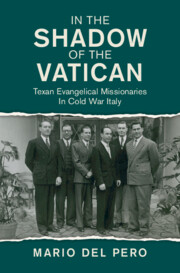
After a successful fundraising campaign, the Church of Christ missionaries arrived in Italy in early 1949. They acquired a villa in Frascati, in the Castelli Romani area southeast of Rome, where they established a school and an orphanage and launched an ambitious missionary effort. Their activities quickly alarmed the local Catholic clergy and Vatican hierarchies, who viewed the mission as part of a broader Protestant strategy to undermine the Catholic Church’s near monopoly on religion in Italy. The Vatican promptly urged the Italian government to take action, relying on Fascist-era laws to curb the missionaries' activities. The Italian Ministry of the Interior, led by the conservative Christian Democrat Mario Scelba, targeted the Texas evangelicals for overstaying their short-term tourist visas and for opening a school without the requisite authorizations. Efforts to spread their message in various towns of the Castelli Romani were met with significant resistance, including violent attacks by locals. As tensions escalated, the missionaries grew increasingly frustrated with what they perceived as the indifference of US diplomats stationed in Rome. They began lobbying their congressional representatives in Washington, and soon members of Congress took up their cause, pressuring the State Department to intervene.
In 1948, joining the wave of post-World War II evangelical missionary activism, the small, nondenominational Church of Christ from Lubbock, Texas, decided to establish its own mission in Italy. The missionaries believed that by promoting religious freedom, they would help spread democracy and American values. But they were also motivated by fervent anti-Catholicism and a conviction that they could challenge the Vatican's near monopoly on religion in Italy. Their zeal and naivety were met with a harsh response from the Catholic Church and its allies within the Italian government. At the same time, the omnipresent Cold War soon forced all the actors involved to adapt their strategies and rhetoric to leverage the situation to their advantage.
This chapter traces the history of Roman Catholicism in American politics and society, beginning with an overview of the tenets of the Catholic faith. The chapter then discusses historic tensions and division between Protestants and Catholics, tracing patterns of assimilation and eventual acceptance of Catholicism into American civil religion.
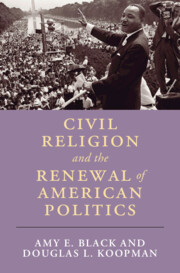
American culture is evolving rapidly as a result of shifts in its religious landscape. American civil religion is robust enough to make room for new perspectives, as religious pluralism is foundational for democracy. Moreover, as Amy Black and Douglas L. Koopman argue, American religion and politics are indivisible. In this study, they interrogate three visions of American identity: Christian nationalism, strict secularism, and civil religion. Whereas the growth of Christian nationalism and strict secularism foster division and threaten consensus, by contrast, a dynamic, self-critical civil religion strengthens democracy. When civil religion makes room for robust religious pluralism to thrive, religious and nonreligious people can coexist peacefully in the public square. Integrating insights from political science, history, religious studies, and sociology, Black and Koopman trace the role of religion in American politics and culture, assess the current religious and political landscape, and offer insights into paths by which the United States might reach a new working consensus that strengthens democracy.
After the death of their beloved dog Whym Chow, Katharine Bradley and Edith Cooper, who write collectively as Michael Field, underwent a radical spiritual and poetic shift by converting to the Roman Catholic Church. Each partner viewed this shift differently. Bradley focused on the ways in which Whym Chow’s death represented a rupture in their domestic Trinity, while Cooper focused on the sacrificial aspects of euthanising the dog as an act of their own will. Converting to the Roman Catholic Church impacted both Bradley and Cooper’s relationship with one another and their poetic creativity and dominated the final years of their shared life.
This chapter considers Michael Field’s position as ‘Victorian decadents’ in the early twentieth century. It outlines Katharine Bradley and Edith Cooper’s ambivalent response to fin-de-siècle decadence, as seen in their reactions to the likes of Oscar Wilde and The Yellow Book. The chapter then proposes that Michael Field actually became more attached to decadence as the ‘yellow nineties’ waned, focusing on how Bradley and Cooper’s dedication to decadence is expressed most clearly in poems about Whym Chow, their beloved dog whose death in 1906 catalysed their conversion to Catholicism. The chapter finally discusses the decadent tropes found in Whym Chow: Flame of Love (1914) and Michael Field’s Catholic poems.
This chapter proposes new readings of the poems of Whym Chow: Flame of Love based on ideas of unconventional domesticity, alternative divinity, and queer, chosen families. The chapter explores the ways in which animal characteristics disrupt and subvert conventional poetic form and religious teachings in the volume, specifically elegy and Catholicism. It also focuses on connections between Michael Field’s writing and animal poetry found in the work of other fin-de-siècle and modernist writers. The chapter proposes that these poems can and should be celebrated for their eccentricity, oddity, and queerness rather than overlooked and marginalised within Michael Field’s oeuvre.
Centring the lived experiences of enslaved and free people of colour, Black Catholic Worlds illustrates how geographies and mobilities – between continents, oceans, and region – were at the heart of the formation and circulation of religious cultures by people of African descent in the face of racialisation and slavery. This book examines black Catholicism in different sites – towns, mines, haciendas, rochelas, and maroon communities – across New Granada, and frames African-descended religions in the region as “interstitial religions.” People of African descent engaged in religious practice and knowledge production in the interstices, in liminal places and spaces that were physical sites but also figurative openings, in a society shaped by slavery. Bringing together fleeting moments from colonial archives, Fisk traces black religious knowledge production and sacramental practice just as gold, mined by enslaved people, again began to flow from the Pacific coast to the Atlantic world.