To save content items to your account,
please confirm that you agree to abide by our usage policies.
If this is the first time you use this feature, you will be asked to authorise Cambridge Core to connect with your account.
Find out more about saving content to .
To save content items to your Kindle, first ensure no-reply@cambridge.org
is added to your Approved Personal Document E-mail List under your Personal Document Settings
on the Manage Your Content and Devices page of your Amazon account. Then enter the ‘name’ part
of your Kindle email address below.
Find out more about saving to your Kindle.
Note you can select to save to either the @free.kindle.com or @kindle.com variations.
‘@free.kindle.com’ emails are free but can only be saved to your device when it is connected to wi-fi.
‘@kindle.com’ emails can be delivered even when you are not connected to wi-fi, but note that service fees apply.
This collection addresses some of the injustices associated with modern European politics. It begins by addressing the evils of conquest, of Christian oppression and the crusades. Then follows a series of poems denouncing the human debasement and the immorality of slavery. Nationalism is decried. Some European defenders of peace and justice are cited, including Bartolomé de Las Casas, Fénelon, and Montesquieu. Their contribution to a more just history of humankind, described here as a natural history of humankind, is acknowledged. Prominent historical figures such as Vasco de Gama, Afonso de Albuquerque, Hernán Cortés, and Francisco Pizarro are condemned for their acts of conquest. A model of perpetual peace based on universal fairness, humaneness, and active reason is put forward as an alternative to that offered by Kant. On this basis, several practical dispositions to peace are given. The damaging effects of a history based on illusions of progress are described, and, with James Burnett, Lord of Monboddo, as an example, a non-teleological history is promoted. The collection ends with an appeal to true Christianity, which is seen as dictating the good of all humanity.
Part II, ‘The Treasury’, begins in Westminster Abbey, where imported silks and jewels were highly visible, considering the difference between medieval practices of display and contemporary museum practice. Chapter 3 unravels the meanings of Arabic and Pseudo-Arabic textiles in medieval England, as devotional and resistant texts. The category of ‘Syriana’ is most clearly advertised in the case of these fabrics, with Italian weavers in Lucca explicitly recorded as the producers of ‘soriani’. By the fourteenth century, high quality Italian ‘Damasks’ were effectively indistinguishable from original Syrian wares. I consider the significance of the known inauthenticity of ‘Syrian’ textiles. Imported silks were ostentatiously used to construct sacred spaces in England, as seen in the instructions left by William Wey in his will for the reconstruction of the Holy Sepulchre in Wiltshire. Arabic-inscribed fabrics were venerated as Holy Land relics. The ownership of silks was regulated through sumptuary legislation, indicating – as with the legal regulation of sweet wines – an anxiety around the category. At the same time, imitative silks knowingly fabricated their origins, destabilising the relic discourse through which these items were venerated. Imported Arabic and Pseudo-Arabic textiles inscribe the role of mobility across borders in the creation of culture.
Chapter 2 explores spices as recorded in medieval English recipe books, poetry and drama, in light of the legacies of the crusades. This chapter focuses on the main Mamlūk exports of pepper, ginger, cinnamon, cloves and sugar: the ‘dyvers spices’ on Sturmy’s ship. The Levant was a global centre for the spice trade, and for sugar production, only declining in the sixteenth century in the face of competition from the new colonial plantations in the Americas. Crusading narratives continued to shape the exoticism of medieval English recipe books and hostile representations of Syrian spice traders, coexisting with a dialogic mode of digestion which attributed scientific agency to those imported goods.
Part I, ‘The Dispensary’, focuses on the consumables on Sturmy’s ship – sweet wines and spices – reflecting on their medicinal, spiritual and commercial value. Chapter 1 analyses Eucharistic images which presented sweet wine as the Christian blood of the Holy Land, providing an ethnonationalist rationale for the essentialised Christianity of the lost crusader territories. Sweet wine was revered and regulated as a category distinct from ‘ordinary’ wines. Archaeological evidence of excavated Frankish winepresses shows that winemaking in the crusader kingdom was a major, organised industry. Sweet wines were first imported to England from these settlements, and subsequently were traded by Italian merchants.
Chapter 1 describes the restoration of Damascus in the fifth/eleventh and sixth/twelfth centuries under successive Seljuk, Zangid, and Ayyubid dynasties, with a focus on the revival of religious and intellectual life in the city through the patronage of political elites and the influx of scholars from other parts of the Muslim world. The chapter traces the formation of two competing Shāfiʿī legal traditions in Damascus. The dominant and longer-established tradition was formalist, traditionalist, and transmission-oriented, and it combined centuries-old indigenous Damascene scholarly culture with the Iraqi Shāfiʿī tradition, which had taken root in Damascus starting in the second half of the fifth/eleventh century. The second minority tradition drew on the Khurasani strand of Shāfiʿism, which had arrived in Damascus in the second half of the sixth/twelfth century, and it was more analytical, exploratory, and rationalist in orientation.
Chapter 2 examines Ibn ʿAbd al-Salām’s life in Damascus, with an emphasis on his intellectual formation. I reconstruct his formative influences in the Damascene milieu to show that he was a prominent representative of Khurasani Shāfiʿism who was linked to that tradition through his teachers, the works he studied and taught, and the ideas of leading Khurasani Shāfiʿīs that he adopted and transformed. Beyond shedding light on Ibn ʿAbd al-Salām’s life, the biographies of Ibn ʿAbd al-Salām, his teachers, and his contemporaries illuminate the politics of Ayyubid state patronage and call into question the depiction of post-Abbasid scholars on the state payroll as quietist and obsequious to the political establishment.
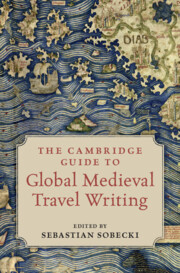
The Middle Ages laid the foundations for the long European and Middle Eastern history of voyaging, colonialism, and expansion: the Papal embassies that took over a year of overland travel to reach Mongolia, Ibn Battuta's thirty years of voyaging to Africa and East Asia, or the arrival of European colonialism in the Americas. With a focus on medieval Europe, this is the first book to cover global medieval travel writing from Iceland to Indonesia, providing unrivalled insight into the experiences of early travellers. Paying special attention to race, gender and manuscript culture, the volume's vast geographical and linguistic range provides expert coverage of Persian, Arabic, Hebrew, and Chinese literature. An essential resource for teaching and research, the collection challenges established views of the Middle Ages and Western ideas of history.
Given the privileged position of anglophone literature, medieval travel writing from England has been covered more extensively than that originating in other literatures and traditions. This chapter will try to balance English and Scottish travel writing, while omitting three writers in particular that feature elsewhere in this volume: Sir John Mandeville, Margery Kempe, and William Wey. There is no shortage of travel writing situated in England and Scotland: Ohthere, The Stacions of Rome, or the General Prologue to The Canterbury Tales are only some instances. English and Scottish pilgrims to the Continent and Palestine have left numerous accounts, the most striking early example of which is Saewulf’s voyage to Jerusalem in 1102. This chapter will offer an overview of several central and remarkable English and Scottish travel texts. Furthermore, I will look at texts for which travel is central yet that have not been typically considered as travel writing. In this sense, I continue the theme of this volume in embracing a capacious definition of ‘travel writing’ as not only texts that make travel their express subject, but that contain and offer accounts of multiple journeys.
In this chapter, I will use the Great Khan’s dreams of the white knight as the starting point to examine the problematic figurations of idolatry, fetishism, orality and whiteness within late medieval travel writing, especially Mandeville’s Travels and Marco Polo’s Le Devisement dou monde. Seemingly unrelated among themselves or to whiteness, these material and performative manifestations of faith nonetheless intersect in important ways in medieval perceptions and representations of the Tartars. The kind of cultural and textual ‘whitening’ of Genghis Khan’s dreams that Hetoum and the Mandeville-author engage in points to the power of artistic manipulations. Geoffrey of Vinsauf, in his Poetria nova, argues that art ‘plays about almost like a magician, and brings it about that the last becomes first … black white, and vile precious’. Jacqueline de Weever argues that such a belief in art’s capacity to transform black into white (nigra candida) is also a belief in the possibility of erasing alterity through whitening. Whitening, in its attempt to mask anxieties and assimilate differences, ignores the origin of alterity. The act of whitening, in fact, posits a new origin.
At the end of the eleventh century, European knowledge of a wider world was emerging from a period of relative ignorance. Patterns of long-distance trade across the Mediterranean, an increased impetus in pilgrimage, and the settlement of previously little-known regions had, by the 1090s, all contributed to a growing awareness of distant lands and peoples. Italians were regularly trading in north Africa and the Levant; Normans had established themselves in southern Italy; French-speaking knights participated in campaigns of Christian conquest in the Iberian peninsula; Scandinavians were a familiar sight in Constantinople, and western knights had even fought with the Seljuqs in Asia Minor. The response to the papal preaching of the First Crusade in 1095, however, stimulated travel to the eastern Mediterranean and Near East on a much larger scale than previously. Most crusaders were experiencing topographies and landscapes that were unfamiliar, and encountering peoples whose appearance, customs, and values challenged their preconceptions about the world.
Violent conflict was a feature of the early papacy as theological factions or Roman families contested the Throne of Saint Peter and as popes responded to the collapse of Roman authority by assuming responsibility for the defense of Rome. By 1000 CE, popes were temporal rulers, and like their secular counterparts they considered military force a legitimate instrument. The papacy participated in the Crusades, principally as propagandist and financier, and engaged militarily in the “Italian Wars” (1494–1559). Subsequently, papal military capabilities declined and during the Napoleonic Wars the papacy offered little resistance against French armies that twice seized Rome. Under Pius IX, serious efforts to improve the papal military were insufficient to prevent the absorption of Rome and the Papal States into the kingdom of Italy. Reduced to a handful of palace guards, subsequent pontiffs abandoned any martial posture, although these household guards protected the Vatican during World Wars I and II.
In the twelfth century AD, European elite warriors, knights, finding themselves in dire straits during battle, adopted the practice of surrendering themselves to adversaries who then guaranteed the safety of their prisoners. In turn, prisoners promised to pay a ransom to their captors, payment of which would free the prisoners and allow them to take up arms again. This practical transaction was considered honorable, even praiseworthy. Because ransoms could be substantial, it might be necessary for a prisoner to return to his lands to collect the funds. To do so, he would swear on his word of honor, parole d’honneur, to return with the required funds. The practices of honorable surrender, ransom, and parole were established in customary laws of war, and disputes between captors and their captives could be appealed to courts of honor. There were circumstances in which honorable surrender was not permitted. For example, military commanders could forbid their forces to accept surrenders until a battle was decided, lest their men disperse during battle to collect prisoners and ransoms. The recourse to honorable surrender was limited to the elites; common soldiers could be overwhelmed or killed outright in battle or siege.
This article examines sermons for the crusade against the Hussite king of Bohemia, George of Poděbrady, preached by Thomas Harder, an Augustinian canon and parish priest in Klosterneuburg, in the summer of 1467. These texts give us a direct insight into how preachers in fifteenth-century parishes might have dealt with the general commission to publicize the crusade, as they incorporate the crusade agenda into the pastoral content. Like his twelfth and thirteenth-century predecessors, Thomas Harder knew how to exploit the penitential and edifying potential of the crusade, combined with concerns for individual religious improvement and moral reform. Through an analysis of intertextual links, this study shows that he also systematically gathered, processed and disseminated topical information relevant to the fight against Bohemian heresy. Although he followed in the footsteps of high medieval crusade preachers in the themes he addressed, he also drew on more contemporary and local sources to inform his discourse and provide explanation of the immediate political circumstances.
Europe across the period from 1000–1500 was characterised by a multiplicity of polities, but the majority were unified by membership of the Catholic Church. Indeed Latin Christendom (those polities that recognised papal authority and followed the Latin liturgy) doubled in size by the end of the twelfth century, as frontiers were pushed forward in the Holy Land, Sicily, the Iberian peninsula and the Baltic. This was generally achieved by extraordinary multi-polity coalitions loosely under the direction of the papacy, which confronted enemies of another faith and culture who seemed to present a military and existential threat to Christendom itself. Inter-polity conflict was nevertheless waged within Latin Christendom throughout the period, and especially after the collapse of Latin power in the Holy Land in 1291. As rulers focused more attention on nearby adversaries, they increasingly raised armies by contract for pay, aided by systems of credit, enabling the professionalisation of armies, to a limited extent. Meanwhile, throughout the period, securing divine support was considered important as military means in achieving strategic goals. The strategy and means of political–military elites are revealed through an increasing abundance of sources, notably chronicles and, particularly from the turn of the thirteenth century, an abundance of government records.
One can divide sources regarding Byzantine strategy into three main categories: sources dedicated to the exposition of strategy, tactics and logistics, i.e. military manuals and administrative documents;' Byzantine historical narratives; and non-Byzantine historical accounts written in various dialects such as Slavic, Arabic and Armenian. Still, there is an ongoing debate whether military manuals reflected current tactical and strategic practise. Equally uncertain is the extent to which Byzantine historians employed military manuals or idealised biographies as models in order to present favoured figures in an ideal light. The emperor was usually the one who set priorities and objectives, assisted by advisers as well as by treatises on strategy and logistics. Sometimes, however, high-ranking military officers, the strategoi, local commanders who executed military and political authority over their districts, also took the initiative to undertake operations. The Byzantines faced various peoples: Slavic and Turkish peoples and polities threatened and occupied its Balkan frontier; Arabs, Turks and Armenians dominated the eastern frontier (Asia Minor, Syria, Mesopotamia and Armenia), and the Normans, Crusaders and various pirates threatened Greece, Thrace and the islands of the Aegean and the Ionian Gulf. The objectives of the Byzantines varied according to the period. Defence and survival were among the dominant ones; others included retaliation, devastation of the enemy’s potential through raiding and acquisition of booty, marching deep and showing the flag in order to achieve more favourable treaties, the reconquest of lost key cities and fortresses, and, rarely, the total elimination of enemy polities. The Byzantines relied greatly on money and diplomacy to achieve their goals. When these were not enough, they would mobilise their army and navy comprising indigenous professional and semi-professional troops, as well as foreign and allied troops. The main priority in terms of strategy was to conduct military operations, as far as possible, on only one front at a time. The latter was chosen with various goals in mind: the control of major cities, fortresses, routes and mountain passes; the establishment of a client ruler; acquiring of a quick victory in order to enhance the emperor’s image; and acquiring an acknowledgement of the emperor’s overlordship in order to adhere to Byzantine political ideology which saw the emperor as the supreme ruler of the world and the legitimate claimant to the Roman Empire. It is interesting to note that religion seems to have played a lesser role than realpolitik and political ideology. When fighting their wars, the Byzantines mostly adhered to the advice found in military treatises, but there were also occasions when the neglect of such matters brought devastating defeats.
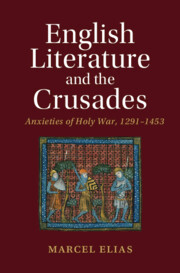
The introduction sets the book’s agenda: to offer a novel account of crusade culture from the Mamlūk reconquest of Acre (1291) to the Ottoman siege of Constantinople (1453) drawing on Middle English romances and their contexts in various literary, historical, and legal documents (in English, French, Occitan, German, and Latin). The political culture to which post-1291 crusade romances belonged, I argue, was ambivalent, self-critical, and riddled with anxieties. These anxieties were about issues as fundamental and diverse as God’s endorsement of the crusading enterprise, the conversion of crusaders to Islam, sinfulness and divisions within the Christian community, and the morality of violence. After situating the book’s key claims within debates on Edward Said’s Orientalism and crusade literature, I present its methodology: engaged historicism, attention to how romance writers adapted their sources, and analysis of emotional rhetoric. The book’s contributions to the history of emotions and Middle English studies are discussed, as are the new insights it provides into the historical dimensions of the genre of romance.
The period from the Mamlūk reconquest of Acre (1291) to the Ottoman siege of Constantinople (1453) witnessed the production of a substantial corpus of Middle English crusade romances. Marcel Elias places these romances in dialogue with multifarious European writings to offer a novel account of late medieval crusade culture: as ambivalent and self-critical, animated by tensions and debates, and fraught with anxiety. These romances uphold ideals of holy war while expressing anxieties about issues as diverse as God's endorsement of the crusading enterprise, the conversion of Christians to Islam, the sinfulness of crusaders, and the morality of violence. Reinvigorating debates in medieval postcolonialism, drawing on emotion studies, and excavating a rich multilingual archive, this book is a major contribution to the cultural history of the crusades. This title is part of the Flip it Open programme and may also be available open access. Check our website Cambridge Core for details.
This chapter witnesses the Crusades and forced conversions of Jews, disputations and expulsions, as well as blood libel charges. Even though Jews also disparaged Christianity, viewing it as idolatry, there were also periods of relatively easy Jewish–Christian coexistence, such as in Spain.
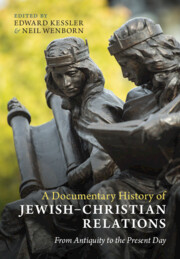
Jews and Christians have interacted for two millennia, yet there is no comprehensive, global study of their shared history. This book offers a chronological and thematic approach to that 2,000-year history, based on some 200 primary documents chosen for their centrality to the encounter. A systematic and authoritative work on the relationship between the two religions, it reflects both the often troubled history of that relationship and the massive changes of attitude and approach in more recent centuries. Written by a team leading international scholars in the field, each chapter introduces the context for its historical period, draws out the key themes arising from the relevant documents, and provides a detailed commentary on each document to shed light on its significance in the history of the Jewish–Christian relationship. The volume is aimed at scholars, teachers and students, clerics and lay people, and anyone interested in the history of religion.
From its beginnings in the eleventh century through its decline in the early modern period, the movement of Christian holy war known as the crusades was sustained by the enthusiasm and willing participation of the European military aristocracy. Despite this, historians have yet to explain the continuing value of crusading and the maintenance of the crusading frontier for the aristocracy. This article argues for a fundamental re-evaluation of the nature of crusading, as it was perceived and experienced by European elites. Rather than large-scale military expeditions with global geo-political objectives, smaller more frequent tours of the frontier world constituted the normative crusading experience for aristocrats. These noble sojourns allowed for the acquisition of cultural capital through controlled and staged performances and interaction with the elites, landscape, and fauna of the crusading East. The study of these independent crusading expeditions requires engagement with an altogether different body of source material than usually is consulted in crusade historiography and a different set of questions to be asked of these sources, which in turn leads us to consider a different range of behavior, including tournament-going, hunting, and courtly life, as constituting the typical aristocratic crusading experience. It was through these activities that visiting aristocrats acquired the precious cultural capital that defined their social status in a period of hardening class distinctions. While aristocracy maintained crusading, crusading maintained distinction, and hence the entire European regime of lordship itself.