To save content items to your account,
please confirm that you agree to abide by our usage policies.
If this is the first time you use this feature, you will be asked to authorise Cambridge Core to connect with your account.
Find out more about saving content to .
To save content items to your Kindle, first ensure no-reply@cambridge.org
is added to your Approved Personal Document E-mail List under your Personal Document Settings
on the Manage Your Content and Devices page of your Amazon account. Then enter the ‘name’ part
of your Kindle email address below.
Find out more about saving to your Kindle.
Note you can select to save to either the @free.kindle.com or @kindle.com variations.
‘@free.kindle.com’ emails are free but can only be saved to your device when it is connected to wi-fi.
‘@kindle.com’ emails can be delivered even when you are not connected to wi-fi, but note that service fees apply.
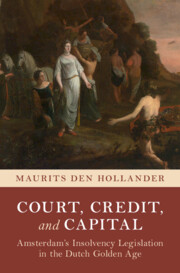
Seventeenth-century Amsterdam was a city of innovations. Explosive economic growth, the expansion of overseas trade, and a high level of religious tolerance sparked great institutional, socioeconomic and legal changes, a period generally known as 'the Dutch Golden Age.' In this book, Maurits den Hollander discusses how insolvency legislation contributed to the rise of a modern commercial order in seventeenth-century Amsterdam. He analyzes the procedure and principles behind Amsterdam's specialized insolvency court (the Desolate Boedelskamer, 1643) from a theoretical perspective as well as through the eyes of citizens whose businesses failed. The Amsterdam authorities created a regulatory environment which solved insolvency more leniently, and thus economically more efficiently, than in previous times or places. Moving beyond the traditional view of insolvency as a moral failure and the debtor as a criminal, the Amsterdam court recognized that business failure was often beyond the insolvent's personal control, and helped restore trust and credit among creditors and debtors.
This chapter describes the daily functioning of the Desolate Boedelskamer. It examines the Amsterdam insolvency procedure through the eyes of the actors involved. How did the court evolve over time, and where is it possible to discern the influence of its staff on such changes? Social and cultural attitudes towards overindebtedness and the insolvents themselves softened during the seventeenth century. While one might expect that such developments were detrimental to the position of creditors, they actually went hand in hand with important changes to Amsterdam’s legal institutions that also sought to protect the creditors’ interests. This chapter discusses to what extent the introduction of the Desolate Boedelskamer had an impact on the management of the insolvent estates that were placed in its care. Through a careful combination of formal work instructions and archival evidence from the daily practice, it analyzes the functioning of the court as part of its broader legal and institutional context.
Recommend this
Email your librarian or administrator to recommend adding this to your organisation's collection.