Refine search
Actions for selected content:
6 results
Enlightening: Adorno’s and Kant’s Contrasting Answers to the Question “How to Write About the Enlightenment?”
-
- Journal:
- Kantian Review , First View
- Published online by Cambridge University Press:
- 19 February 2026, pp. 1-25
-
- Article
-
- You have access
- Open access
- HTML
- Export citation
Reason and Language in Kant and Hamann
-
- Journal:
- Kantian Review / Volume 30 / Issue 1 / March 2025
- Published online by Cambridge University Press:
- 01 September 2025, pp. 117-136
- Print publication:
- March 2025
-
- Article
- Export citation
Chapter 1 - Republics, Monarchies and the Philosophy of Human Society
-
- Book:
- Herder and Enlightenment Politics
- Published online:
- 30 March 2023
- Print publication:
- 06 April 2023, pp 31-62
-
- Chapter
- Export citation
10 - Dioscuri
- from Part III - Jacobi and the Revival of Socraticism: The Muenster Circle and Existentialism
-
-
- Book:
- Friedrich Heinrich Jacobi and the Ends of the Enlightenment
- Published online:
- 09 February 2023
- Print publication:
- 16 February 2023, pp 176-199
-
- Chapter
- Export citation
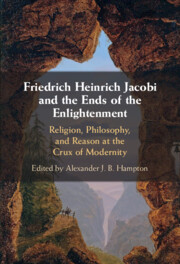
Friedrich Heinrich Jacobi and the Ends of the Enlightenment
- Religion, Philosophy, and Reason at the Crux of Modernity
-
- Published online:
- 09 February 2023
- Print publication:
- 16 February 2023
Chapter 2 - From the Symposium to the Seminar
-
- Book:
- Feeling and Classical Philology
- Published online:
- 28 February 2020
- Print publication:
- 05 March 2020, pp 48-71
-
- Chapter
- Export citation
