To save content items to your account,
please confirm that you agree to abide by our usage policies.
If this is the first time you use this feature, you will be asked to authorise Cambridge Core to connect with your account.
Find out more about saving content to .
To save content items to your Kindle, first ensure no-reply@cambridge.org
is added to your Approved Personal Document E-mail List under your Personal Document Settings
on the Manage Your Content and Devices page of your Amazon account. Then enter the ‘name’ part
of your Kindle email address below.
Find out more about saving to your Kindle.
Note you can select to save to either the @free.kindle.com or @kindle.com variations.
‘@free.kindle.com’ emails are free but can only be saved to your device when it is connected to wi-fi.
‘@kindle.com’ emails can be delivered even when you are not connected to wi-fi, but note that service fees apply.
This chapter returns to the convent of Santa Maria di Monteluce, situating MS 410 within the liturgical and civic life of Perugia. It focuses on the Assumption feast as both a devotional and communal event, linking its liturgy with the contemplative practice prescribed by the Meditations on the Life of Christ. The manuscript would have activated associations between the convent and Mount Zion, where the Virgin Mary was believed to have spent her final days, thereby reinforcing the convent’s significance as the focal point of Perugia’s annual Assumption procession. While the contemplation encouraged by MS 410 was interior and solitary, the chapter argues that it also carried communal and civic significance, as reflected in the imagery of the nuns’ choir. Contemplative practice is thus understood not only as a spiritual discipline but also as a contributor to the construction of shared religious and civic identity.
The Virgin Mary was a multifaceted figure in Byzantine theology. She played a central role in the incarnation of Christ since she provided him with his human nature. Her virginity, before, during, and after the birth bore witness to his ongoing divinity. Although Mariological doctrine did not receive systematic treatment in the Byzantine theological tradition, it was elaborated in liturgical texts. The Theotokos was described with the help of metaphorical and typological language, which associated her symbolically with creation, humanity, and a transfigured paradise, that is, spaces that were potentially receptive to God’s presence. As recent scholarship has shown, however, Byzantine Christians also encountered Mary as a female human person. Her maternal qualities, which came to be celebrated especially during and after the period of Iconoclasm (ca. 730–843), included tenderness, mercy, and sorrow – as displayed at the foot of the cross during Christ’s crucifixion. Historical accounts and miracle stories provide evidence of individual Christians’ visions of the Virgin Mary at shrines and churches in Constantinople. At both symbolic and personal levels, Mary, the Theotokos, remained accessible to Christians while representing the ideal model of the deified human person.
The Byzantine Rite today transcends confessional, geographical, linguistic and cultural barriers. It is the ritual expression of millions of believers, both Orthodox and Catholic, throughout the world. This essay looks at the Byzantine Rite as it is practised in the Greek and Slavonic traditions, notes some observable differences between the two, then continues with a discussion of the Greek Catholic tradition, and ends with a discussion about movements of renewal and reform.
This chapter examines the Byzantine Rite Divine Liturgy at Hagia Sophia, the Great Church of Constantinople, roughly in the period after the end of Iconoclasm after 843 until the fall of Constantinople in 1453. The beginning of this period coincides with the liturgical texts of the Divine Liturgy in the oldest extant Byzantine euchologion that serve as the basis for the synchronic and thematic analysis of the preparatory rites, the reading of Scripture, the moments of consecration and the reception of communion. Along with the texts of the prayers of the Divine Liturgy from the euchologion, the diataxis (book of rubrics) of Philotheos Kokkinos and Demetrios Gemistos and liturgical commentaries by St Germanos of Constantinople, Nicholas of Andida, Nicholas Kabasilas and St Symeon of Thessalonike are brought together to present a more complete picture of the Byzantine Divine Liturgy. Nevertheless, this is the perspective of the clergy—and not the faithful—since by this time the prayers were recited inaudibly. For a better understanding of what the faithful experienced during the Divine Liturgy, questions of hymnography, mystagogy, movement and participation are briefly examined. Overall, the Divine Liturgy expressed the theology of the Church as a vision of the glory of God and the celebration of the passion, death, burial and resurrection of Christ. Thus, the church became the dwelling place of God—whether in the Great Church of Constantinople or anywhere the Byzantine Rite was celebrated.
This chapter argues that women played significant and varied roles in the church of the Byzantine Empire. I examine the roles of women in four categories: women at church; female saints, martyrs and monastics; Empresses; and hymnographers. In the early Byzantine period, two ecclesial positions were set aside for women: deaconess and widow. Their responsibilities included some limited liturgical involvement, prayer for the church and training of other women in the faith. Throughout the life of the Empire, there were also significant and different female models of faith and piety. In discussing ‘holy’ women, I briefly explore the cult of female saints and the reality of celibate and monastic lives for women in the period, before then turning to Empresses and their varied roles as mothers of the faith, models of virginity and protectors of icons. Finally, this chapter introduces Kassia, the ninth-century abbess and hymnographer, as an example of female hymn-writers of Byzantium.
When Constantinople was first laid out by emperor Constantine as a new imperial city in 330 it possessed only a small community of Christians with a bishop responsible to the provincial metropolitan. By the death of emperor Heraclius in 641, it had become the sole imperial capital of the Roman empire with an ‘ecumenical patriarch’ whose jurisdiction covered Thrace, most of Asia Minor and the Caucasus. Christianity had become the religion of the Roman emperor and people. Constantinople was replete with churches and monasteries, had defined its orthodox doctrinal position through a series of church councils, had its operations and even beliefs reinforced by imperial law, and had established a distinctive liturgy and ecclesiastical calendar that combined local and universal events. What marked out Constantinople was the unique relationship of emperor and bishop, emperor and people, facilitated by the physical proximity of palace, church and patriarchate. This chapter traces the development of all these foundation stones of the Byzantine church from the fourth to the seventh century.
This chapter explores how lay people participated in liturgical singing in the fourth through sixth centuries. Unlike Byzantine writers who explained or analysed particular emotions, liturgical poets situated singers within, beside and against the feelings animating a particular biblical event and its ritualisation. Three types of liturgical singing are the focus of this investigation: 1) psalmody in Jerusalem, as described by the late-fourth-century pilgrim Egeria and prescribed a fifth-century book of ritual instructions (known today as the Armenian Lectionary); 2) sixth-century hymns composed by Romanos the Melodist for specific feast days in Constantinople; 3) a Jerusalem chantbook, which survives in Georgian translation, which expands on biblical odes sung as part of daily lay worship. Although the melodies of these songs are lost, their lyrics provide valuable insights into lay people’s emotions in early Byzantine Jerusalem and Constantinople. With closer attention to performative dimensions of these songs, historians may better understand the emotional experiences of lay congregations.
Representations of Heaven and Hell were of paramount importance in Byzantine monumental art to help the faithful visualise the eternal consequences of their actions. This chapter will explore the synergy between liturgy and the representations of Heaven and Hell within the space of the Byzantine church. Together they alerted all the senses and created a lasting impact on the faithful congregation, an ‘image’ which they could carry with them outside the spatial confinements of the church to enhance their chances in their quest of Paradise. To achieve this, the chapter will engage four case studies dated to the late Byzantine period: the Chora monastery in Constantinople (terminus ante quem 1321), a monument that epitomises Palaiologan art, and three examples from Venetian Crete, a former Byzantine territory that remained religiously and culturally closely attached to the dying empire until 1453. These examples present distinctly different moments in reaching Paradise: Church of St John the Baptist, Deliana (c. 1300?), where the gates of Paradise are depicted hermetically closed; Chora Monastery and Church of the Holy Apostles, Kavousi (first decade of the fifteenth century), where St Peter is about to open the gates of Paradise; and Church of St John the Baptist, Axos (1390s), where the gates of Paradise are open.
Chapter 5 assesses the patronage and use of books in the late ninth and early tenth centuries. The following case studies are discussed: two earlier Anglo-Saxon prayerbooks (the Book of Cerne and Book of Nunnaminster) to which new material was added, a new volume of Latin hagiographies (Paris, Bibliothèque nationale de France, lat. 5574), and a Carolingian manuscript to which several additions were made by English-trained scribes (London, British Library, Cotton Vespasian D. xiv, fols. 170–224). Engagement with these books took place in diverse settings, some of which were more informal than one might expect. The motivations for such activity are assessed too. These case studies pave the way for a holistic assessment of the contemporary manuscript corpus. Physical qualities, texts and languages are considered, as are the possible settings in which books were produced and used. Attention is drawn to the evidence for female book use, and to the importance of international networks. Continuities with earlier decades are acknowledged, as are new developments, including a more pronounced association between books and bishops. The chapter closes with a call to remain open-minded about this book culture’s range of social contexts and participants.
Chapter 6 is the first of four chapters to consider one element of the Dominican liturgy, focussing here on the thirteenth-century development of the calendar of saints’ feasts. This chapter draws on the sanctoral cycles from books for the mass and office that survive from the earliest years of the Dominican order and from the initial revision of the Dominican liturgy by a commission of four friars. It compares these with the sanctoral cycle of Humbert of Romans’ final revision of the liturgy, as recorded in three exemplars: Rome, Santa Sabina, XIV L 1; London, British Library, Add. 23935; and Salamanca, San Esteban, SAL.–CL.01. Five distinct stages are identified, including a previously unknown period of unofficial revision prior to the commission of the four friars. Various trends are identified regarding the types of feasts that were added to, removed from, promoted and/or relegated in the Dominican calendar over the course of the revision. The final portion of the chapter examines how certain tell-tale corrections to Santa Sabina XIV L 1 coincide with points at which changes were made to the saints celebrated by the Dominicans.
Taking the biblical parable of the Prodigal Son (Luke 15:11–32) and the “penitential Psalms” as sites for late antique and early medieval investigations of the effect of sin on the self, this chapter proposes that exegetes saw the self as malleable and permeable. Commentaries and sermons framed the self as sinful but salvageable. Changing views of agency, responsibility, and remedies produced shifts in representations of communal interests and penitential interpretations of well-known scriptural texts. Protections against the penetrations and deformations of sin were erected in liturgical rituals and communal prayer. The universal stain of sin fostered a porous relation between the individual and the community, each bound to the other in a metaphysical, corporate entity encasing all selves. Christian views of individual autonomy created as well a spatial expanse of the individual interior in which the soul could wander, even become lost. Emerging from that grim void to salvation was to grasp a lifeline of the penitential words of others, sung in concert, in an activation of universal memory, to transform the self into a citizen of the heavenly Jerusalem.
This Element describes the most common educational processes of religious communities in the late antique period. Through a combination of historical analysis and examples, it provides an overview of the methods used to teach the alphabet and basic rhetoric, which were central to Jewish and Christian – including Manichaean – knowledge production. It also explains how this knowledge was disseminated through liturgy. Rather than viewing the material remains of these communities in isolation, this Element examines them together, overcoming the usual scholarly focus on differences between religious communities and between religious and secular education. Instead, it highlights the dynamics created by mutual exchange and ambition. Since evidence of education is generally scarce, the synopsis demonstrates that, for example, while one religious community may have a surviving textbook with exercises, another community may only have the final products of those exercises.
Discussion of the relationship between art and liturgy is nearly as old as the Church itself. At root it is a matter of the theological seriousness of the liturgy, balanced against the distinctive aesthetic demands of art making and those individuals gifted with the ability to produce works of art. Notwithstanding a glorious heritage of sacred art and music in the Church, tensions have historically manifested, and still do. Equally, the stipulation that art must serve the liturgy can engender a sense that it is an addendum: helpful, even beautiful, but ultimately subservient. In this essay, I set aside more familiar arguments as to why the Church and art need each other. Instead I consult three important twentieth-century figures: Jacques Maritain (1882–1973), Joseph Ratzinger (1927–2022), and David Jones (1895–1974), who provide a range of complementary reasons why the two spheres should be intimately connected. For Maritain, who holds an expansive view of Christian art, liturgy is a transcendental archetype. Ratzinger insists that art and music should apprehend and portray the cosmic significance of Christ in the liturgy; and Jones gives an anthropological basis to the uniquely work-making character of the person – supremely articulated in sacramental action.
This chapter gives fruitful attention to the role of the sacraments in the Confessions. It delineates the ways in which the sacrament of baptism structures the autobiographical books, with baptism foregrounded in the first book (Augustine’s baptism postponed), the central or hinge book (Book 5, in which Augustine’s baptism is again deferred), and the climactic book (Book 9, in which Augustine’s baptism is recounted, along with many other baptisms, quite a few of which did not take place within the chronological scope of Book 9). The Eucharist, which was for Augustine the other sacrament of initiation and for which baptism itself was a prerequisite, comes into clear view at the end of Book 9 and in Book 10. The exegetical books then treat Genesis as “a model for all of Christian life, and especially that of the church,” a life inaugurated in baptism and sustained by the Eucharist. Contrary to the view of some scholars, who see very few Eucharistic allusions in the Confessions, the chapter shows that many of Augustine’s images – especially of food and of milk – have Eucharistic overtones.
This article examines the Tangchaodun bema—a liturgical structure dating to the Gaochang Uyghur Kingdom in Xinjiang—as a regional manifestation of the architectural and theological tradition of the Church of the East, shaped over centuries of transmission and adaptation. Through comparative analysis of archaeological remains and liturgical texts from Syria, Mesopotamia, and Central Asia, the study argues that the Tangchaodun bema follows the ‘eastern-type bema’ model rooted in the East Syrian tradition. Its spatial configuration and ritual function reflect established Mesopotamian patterns, particularly in the mirroring of bema and sanctuary, while also incorporating localised features shaped by visual adaptation and intercultural contact. Bilingual inscriptions and iconographic traces further attest to this integration of tradition and regional context.
Rather than existing in isolation, the Tangchaodun bema forms part of a broader historical development in East Syriac ecclesiastical architecture. By positioning the site within this extended line of transmission, the article shows how sacred space operated as a medium of both theological continuity and cultural dialogue across Asia. In so doing, it offers new perspectives on the role of Christian architecture in the Tang to Yuan Dynasties and contributes to a more integrated understanding of the Church of the East in its easternmost reaches.
Ch. 8 Jewish liturgy offers us a concise summary of Jewish theology. It gives us theological propositions, speech-acts, and testimonies about God. Liturgy offers a practical and dynamic Jewish theology that negotiates the contradiction of the God of Being and God as person.
Throughout the long history of Christianity, Christians have celebrated their faith in a myriad of ways. This Companion offers new insights into the theological depths of the liturgical mysteries that are the essence of Christian worship services, rituals, and sacraments. It investigates how these mysteries order time and space, and how they permeate the life of the Churches. The volume explores how Christian liturgy, as a corporeal and communal set of activities, has had a profound impact on spiritualities, preaching, pastoral engagement, and ecumenical relations, as well as encounters with religious others. Written by an international team of scholars, it also explores the intrinsic connections between liturgy and the arts, and why liturgy matters theologically. Ultimately, The Cambridge Companion to Christian Liturgy demonstrates the inextricable link between theology and liturgy and provides incentives for critical and constructive reflections about the relevance of liturgy in today's world.
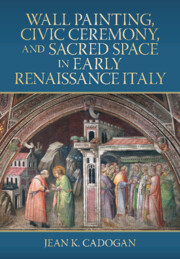
Wall Painting, Civic Ceremony and Sacred Space in Early Renaissance Italy investigates how mural paintings affirmed civic identities by visualizing ideas, experiences, memory, and history. Jean Cadogan focuses on four large mural decorations created by celebrated Florentine artists between 1377 and 1484. The paintings adorn important sacred spaces- the chapel of the Holy Belt in the cathedral of Prato, the monumental cemetery in Pisa's cathedral square, and the cathedral of Spoleto -- yet extoll civic virtues. Building on previously unpublished archival documents, primary sources, and recent scholarship, Cadogan relates the architectural and institutional histories of these sites, reconstructs the ceremonies that unfolded within them, and demonstrates how these sacred spaces were central to the historical, institutional, and religious identities of the host cities. She also offers new insights into the motives and mechanics of patronage and artistic production. Cadogan's study shows how images reflected and shaped civic identity, even as they impressed through their scale and artistry.
The theology of Leviticus is also deeply concerned with holiness in time and setting a liturgical rhythm for the people of Israel. The focus on cultic calendars and seasonal festivals is important in understanding how Leviticus views holiness. The rhythms of the people are directed by God’s creation in Genesis and his salvific works in Exodus. These are tied into seasonal harvest and celebrations for the flourishing of God’s people.
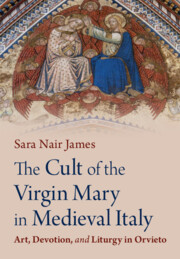
Late medieval Italy witnessed the widespread rise of the cult of the Virgin, as reflected in the profusion of paintings, sculptures, and fresco cycles created in her honor during this period. The cathedral of papal Orvieto especially reflects the strong Marian tradition through its fresco and stained-glass window narrative cycles. In this study, Sara James explores its complex narrative programs. She demonstrates how a papal plan for the cathedral to emulate the basilica of S. Maria Maggiore in Rome, together with Dominican and Franciscan texts, determined the choices and arrangement of scenes. The result is a tour de force of Marian devotion, superior artistry, and compelling story-telling. James also shows how the narratives promoted agendas tied to the city's history and principal religious feasts. Not only are these works more interesting, sophisticated, and theologically rich than previously realized, but, as James argues, each represents the acme in their respective media of their generation in central Italy.