To save content items to your account,
please confirm that you agree to abide by our usage policies.
If this is the first time you use this feature, you will be asked to authorise Cambridge Core to connect with your account.
Find out more about saving content to .
To save content items to your Kindle, first ensure no-reply@cambridge.org
is added to your Approved Personal Document E-mail List under your Personal Document Settings
on the Manage Your Content and Devices page of your Amazon account. Then enter the ‘name’ part
of your Kindle email address below.
Find out more about saving to your Kindle.
Note you can select to save to either the @free.kindle.com or @kindle.com variations.
‘@free.kindle.com’ emails are free but can only be saved to your device when it is connected to wi-fi.
‘@kindle.com’ emails can be delivered even when you are not connected to wi-fi, but note that service fees apply.
Mostly based on research done by others, this chapter goes through some of the important insights about antisemitism in the socialist and communist tradition and also looks briefly at their relationship to the early social democratic tradition on the Jewish Question. It starts by exploring the idea of the Jews as a symbol of huckstering, money and finance, as we find it in Marx’s thought, and continues by looking at the crucial developments in attitudes to Jews in the last three decades of the nineteenth century. Of particular interest is the influential thinking of Karl Kautsky, which laid much of the foundations for a Bolshevik synthesis of the idea of Jews and Zionism in a Marxist understanding of race and nation. Kautsky’s analysis of antisemitism and Zionism starts with a criticism of the concept of race. The Zionists wanted a state for the Jews because they felt that they would never be in a position to trust the solidarity of their proletarian comrades who were not Jews, an attitude that is a betrayal of Communist understanding of class and history.
The Introduction sets out the question and the scope of this book, and its theoretical and methodological framework. Drawing on historical materialism, it explains the anti-fetishist understanding of information taken by this book, which treats information as embedded in and constitutive of social relations and implicated in the distribution of power and order-making. Based on this historical materialist understanding of information, the Introduction sets out the book’s critique on the liberal treatment of information and its main argument that human rights and free trade have jointly and dialectically formed a hegemonic conceptual framework for the governance of information under international law which obscures the crucial material dimension of information and its connection to power.
This chapter seeks to examine intellectual streams that have shaped Ngugi’s poetics and what such contexts mean for Ngugi’s radical poetics. Is there a linear relationship and how has Ngugi shaped radical poetics on the continent when it comes to issues such the language of publishing and the decolonisation project? It argues that some of the shifts in Ngugi’s aesthetic and political ideology are linked to Ngugi’s tenure at Leeds University. His exposure to the works of Marx and Fanon and the influence of a group of African scholars at Leeds, and exposure to the radical scholar Arnold Kettle, marked a major shift in Ngugi’s aesthetic and ideological practices. Reading Fanon, in particular, must have transformed Ngugi’s views on a number of issues, ranging from violence for liberation to the nature of neo-colonialism. Fanon’s ideas on the nature and role of the national bourgeoisie, and his notion of the ‘native poet’ as the custodian of national culture, find echoes in Ngugi’s fiction and essays.
The chapter focuses on Marx and Young, and on Marshall’s work that exhibits evolutionary flavour. In extending Smith’s DoLop analysis, Marx separated the organisation of manufactures into two fundamental forms, organic/serial and heterogeneous. He also examined the emergence of the modern science of technology. In extending Smith, Young focused on the DoL among industries, especially through industrial differentiation, a process that Marx was also aware of. Thus, as in-firm DoLop extends, operations that share commonalities could be spotted, across firms in the same or different industries, as ‘scattered’ (Marx) or ‘segregated’ (Young). New firms/industries might emerge to cater to the common production needs, achieving technological convergence (Rosenberg) and industrial differentiation. Marshall described this as subsidiary industries arising to meet the ‘special wants’ of firms in other industries, where the firms could be ‘localised’ in a district or nation. In contrast with the marginalist flavour injected into DoLfg analysis, the three illustrated that DoLop analysis entails evolving production complementarities, where the history of development is defined by that evolution.
Demographers have developed several theories or explanations about why and how populations change their size. Many have written about world population growth and decline. In this chapter we consider first the general meaning of the term “population.” Then we review the works of some of the early writers who discussed population and population change. Malthus is the most well-known of the early scholars, and so we discuss him and his writings in some detail. Our discussion of Malthus is contrasted with shorter discussions of Karl Marx and Ester Boserup. We then turn to a detailed discussion of demographic transition theory and its major extensions. Finally, we discuss some of the principal theories and perspectives that demographers have developed that focus specifically and separately on fertility, mortality, and migration. These theories are discussed in greater detail in the chapters devoted to these topics.
I begin by narrowing down the realm of human ‘production’, the requirements it places on our faculties and why humans are essentially productive animals. I then move on to three philosophical accounts of human productivity: those of Aristotle, Marx and Gwen Bradford respectively. Aristotle’s account is marred by class prejudice, Marx’s by a hyper-focus on the conditions rather than the results of ‘labour’, and Bradford’s by an over-formal analysis of production that has too little to say about products. By contrast, I propose a comprehensive account that has substantive things to say about producers, processes of production and products. My account distinguishes two productive ‘poles’, namely: (1) those powers engaged in the producer (productive ‘inputs’); and (2) those powers engaged in the consumer (productive ‘outputs’). Production is good overall to the degree it protects and promotes the perfection of both producers’ and consumers’ powers. I round off Chapter 9 by tackling the ‘anti-work’ critique, arguing that it fails to show work as such is a bad. Indeed, production remains perfective of humans in virtue of their productive nature.
Neruda’s temperament was not theoretical, yet several “canonical” poems of his are infused with Marxist thinking. Although there is no evidence that Neruda read Marxist theory, in his thirties he assimilated its totalizing thought from party activism, from his second wife Delia, and from his friend, Spanish poet Rafael Alberti, each a lifelong communist. As an instance, Neruda’s poem “La United Fruit Co.” brings together four types of corporations, economic control of the state, the transportation of product, and subordination of labor. “The Strike” depicts the role of class conflict in the production process. “Cristóbal Miranda (shoveler-Tocopilla)” is one of fifteen portraits of industrial workers focusing on ordinary folk-history-from-below. “Los dictadores,” with its monster engendered by the wealthy autocrat in his palace, demonstrates the functioning of the dialectic in history. Neruda’s Marxism, though more intuitive than discursive, shapes these and other related poems of his.
Marx’s concept of the Asiatic Mode of Production, characterized by Oriental despotism and isolated Asiatic peasant communes, appears throughout his sporadic writings on Asia. While Marx initially regarded these Asiatic features as barriers to modernity and revolution, in his final decade, he began to see them as possible shortcuts to socialism. His depiction of Asiatic society was informed by British colonial reports on India, as well as German and Russian Romantics’ portrayals of the countryside as communal societies untouched by capitalist industry. These Romanticist views later influenced a variant of twentieth-century dependency theory that idealized premodern Asian rural society and sought to recreate a hyper-modern version of Oriental despotism through rural collective farms. Such theories contributed to large-scale catastrophes and atrocities in Asian communism. Although recent research has largely debunked this romanticized view of the Asian countryside, it persists within some dominant academic theories on Asian peasants.
In Undoing the Demos: Neoliberalism’s Stealth Revolution, Wendy Brown argues that neo-liberalism has undermined democracy in a hitherto unprecedented form. To be specific, neo-liberalism has undermined what is at the heart of democracy: popular sovereignty, the demos – it has, in a word, undone the demos and, hence, democracy. Analysing neo-liberalism and its relationship to democracy, Brown draws on the works of Michel Foucault and Karl Marx. The exchange here between the three reviewers – Mitchell Dean, Alen Toplišek and Anne Barron – and Wendy Brown focuses on a number of issues: the use and usefulness of Michel Foucault’s notion of governmentality and Karl Marx’s analysis of capitalism for analysing neo-liberalism; the way that neoliberalism ‘economises’ everything including politics and democracy; the nature of the state and of sovereignty, and how the left should relate to these; and the nature of critique in its different forms (Kantian, Foucauldian, Marxist and others). These are issues that are important not only for the specific argument of Undoing the Demos, but more generally for social and political theory today.
In the ‘Coda’ to Part III, I reflect on the relationship between late medieval religious and economic practices, brought together through the theme of alchemy.
Although not explicitly a socialist, in his political philosophy Kant provides arguments that can be deployed by socialists to argue for radically different forms of social and economic organisation. In this article I contrast Karl Marx’s criticism of capitalist property relations with the general theory of property which Kant outlines in his Doctrine of Right. I demonstrate that Kant’s concept of property provides a sounder ethical basis for the regulating and reform of capitalist economic organisations than Marx’s historical materialist view of economic and social development. Kant’s theory of property relations may fall short of Marx’s in terms of the sociological and historical insights it affords but Kant’s theory more than makes up for this is with its greater moral and political astuteness.
The Conclusion offers a brief recapitulation of the book’s main argument, highlighting its critical and reconstructive components. First, the criticism of the liberal reading that has come to dominate Hegelian scholarship is reiterated. The rational state envisioned in the Philosophy of Right, grounded in a dialectical synthesis of the particular and the universal dimensions of human freedom, is irreducible to the liberal state found today in most democratic nations. Second, the chapter insists on the need to move beyond Hegel’s own political and economic choices in order to bring out the true implications of his views. As argued throughout the book, only a fully democratic state, in which political and economic power are shared among all the citizens, can be deemed rational, in Hegelian terms. Finally, it is suggested that this alternative reading is not only more faithful to Hegel’s philosophical vision, but also more relevant for contemporary critical theory.
Chapter 5 discusses the economic structure of a rational state. Anticipating Marx’s critique of capitalism, Hegel associates the maximization of self-interest promoted by the modern market to an inconsistent and ultimately irrational conception of freedom. He argues that the elevation of freedom to a rational form requires not merely a readjustment of the economic sphere, but a change of paradigm, and this change is entrusted to a system of professional corporations in which competition is replaced by cooperation and trust. Yet although these groups can help mitigate capitalism’s worst excesses, they are not up to the conceptual role Hegel wants them to play. This does not mean, however, that his associative strategy cannot be successfully revived. The chapter’s final section shows that a rational economic sphere implies not only the common ownership of society’s productive resources, but also the democratization of the productive sphere. Drawing on the market socialist tradition, it is suggested that the corporations can be fruitfully reconstructed as worker-directed enterprises, capable of recapturing their communal spirit while avoiding their main limitations.
If commodities furnish the backgrounds of literary texts, they are far from trivial details. The cups of tea in Austen, the calico curtains in Gaskell, the lumps of coal in Dickens: each of these objects speaks to us about the material worlds in which texts circulate. While some commodities feature as elements of the setting, included for the purposes of realism, others play a more active role in literary narratives by driving the desires of characters and the trajectories of plots. The pursuit of whale oil, for example, motivates the events of Moby-Dick, just as ivory and opium shape those of Heart of Darkness and Sea of Poppies, respectively. Yet whether commodities appear as background details or as protagonists in their own right, their presence invites us to connect the desires and domestic intimacies detailed in the text to the wider networks of production and circulation that frame them.
The breakdown of liberal hegemony, the rise of the New Right, and the violent realignment of world order have been accompanied by a retreat from traditional humanist concerns in critical international theory, including emancipation, political subjectivity, social totality, universal history, and the anticipatory-utopian dimension of critique. Scholars have identified numerous shortcomings in first-generation and contemporary critical International Relations (IR), and our discipline still questions its purpose and object of study. This article proposes a more radical and realistic approach to critical international theory based on a reappraisal of Andrew Linklater’s oeuvre. It frames the critical project in IR as a Lakatosian research programme and calls for a progressive problem shift that foregrounds what Linklater, drawing from Kant and Marx, calls the necessarily tripartite structure of critical theory. I argue that by tracing an alternative path through classical sources of the tradition, pivoting from Hegel and the deep social relationalism that follows, while integrating a tripartite commitment with a more rigorous reflexive methodology, we can revitalise the emancipatory approach to IR and provide renewed purpose and direction to the discipline. Grounded in a left-Hegelian tradition of thought, the argument aspires to resonate with other critical theoretical traditions both within and beyond IR.
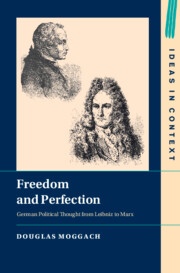
Leibniz, this study argues, is the genuine initiator of German Idealism. His analysis of freedom as spontaneity and the relations he establishes among freedom, justice, and progress underlie Kant's ideas of rightful interaction and his critiques of Enlightened absolutism. Freedom and Perfection offers a historical examination of perfectionism, its political implications and transformations in German thought between 1650 and 1850. Douglas Moggach demonstrates how Kant's followers elaborated a new ethical-political approach, 'post-Kantian perfectionism', which, in the context of the French Revolution, promoted the conditions for free activity rather than state-directed happiness. Hegel, the Hegelian School, and Marx developed this approach further with reference to the historical process as the history of freedom. Highlighting the decisive importance of Leibniz for subsequent theorists of the state, society, and economy, Freedom and Perfection offers a new interpretation of important schools of modern thought and a vantage point for contemporary political debates.
The chapter traces the emergence of the ‘Promethean’ conception of knowledge and history in the long nineteenth century in France. First, it describes the environment in which Vichian ideas were resurrected. It explains why a reinvented Vico’s philosophy might have become indispensable in a bustling new epoch of inventions, political transformations, and industry. Then it focuses on Marx’s reading of Vico and Marx’s earlier formulation of ‘praxis epistemology’. Finally, it explores the philosophical synthesis of the French engineer Georges Sorel, who connected Vico, Marx, and the American pragmatists to formulate a new ‘praxis epistemology’ where human and natural sciences could find a convenient and consistent integration.
Karl Marx's criticism of religion, as applied to afterlife belief, needs to be taken seriously by Christian theologians. After outlining that belief, the author examines a picture of heaven implicit in much Christian belief and practice which is susceptible to that critique. he sets out an alternative eschatology, centred on the Kingdom of God and the resurrection of the body, which is somewhat less susceptible. He then explores whether a doctrine of the intermediate state can be sustained in the light of Marx's criticisms. He goes on to examine the politics of remembrance in the light of Marxist criticism, and to ask whether Christianity can help compensate for the tragic character of Marxism. A constant theme is that Christian theology should exist in tension with Marx's criticisms, never assuming that it has overcome them completely.
English Play Development under Neoliberalism, 2000–2022 is the first study of the institutionalising of English play development practices in the twenty-first century. It identifies the ways in which support for playwrights and text development increased beneficially during the 1990s and 2000s. It assesses bureaucratic institutional dynamics in key English producing houses as they were surveyed by two reports in 2009, and how these were experienced and transformed in the 2010s. The Element identifies in new play development innovations in the commodification and marketisation of new writing, the bureaucratisation of literary management, the structuring and restructuring of dramaturgy according to Fordist, then post-Fordist, conditions, and the necessity for commissioned artists to operate as neoliberal subjects. It concludes with attention to a liberatory horizon for play development in the English context. This title is also available as Open Access on Cambridge Core.