To save content items to your account,
please confirm that you agree to abide by our usage policies.
If this is the first time you use this feature, you will be asked to authorise Cambridge Core to connect with your account.
Find out more about saving content to .
To save content items to your Kindle, first ensure no-reply@cambridge.org
is added to your Approved Personal Document E-mail List under your Personal Document Settings
on the Manage Your Content and Devices page of your Amazon account. Then enter the ‘name’ part
of your Kindle email address below.
Find out more about saving to your Kindle.
Note you can select to save to either the @free.kindle.com or @kindle.com variations.
‘@free.kindle.com’ emails are free but can only be saved to your device when it is connected to wi-fi.
‘@kindle.com’ emails can be delivered even when you are not connected to wi-fi, but note that service fees apply.
Emerson’s aesthetics addresses fundamental philosophical questions on the reality of beauty, experience, and the nature of art and creativity. A central thread running throughout his aesthetic views is the love of beauty, which celebrates a felt appreciation for the diverse beauties found in nature and society in and for themselves. The experiential self as it exists in a connatural relationship with its surroundings has the potential to enjoy such deep folds of qualitative significance. Emerson, moreover, theorizes the existence of an absolute form of beauty having a metaphysical primacy. Beauty exists as the ultimate ideal of human conduct and thought and as the primordial ground or first cause of the universe. In this aesthetic cosmology, art through its imaginative symbolic appropriations of its environment shares in the greater metamorphic processes of a creatively polyphonous and open universe.
This article argues for a possible route by which Thomism might affirm the goodness of physical deformity as an aid to abstraction. Recent scholarship has shown how Aquinas can speak positively of bodily diversity as part of God’s providential order, without treating physical defect as a loss of dignity. I extend this line by asking whether Aquinas can also give physical deformity an intrinsic epistemic role. For Augustine, the cosmos is an intelligible whole ordered by eternal Forms in the Word, mediated by rationes seminales, so that even physical defects remain diminished likenesses of their exemplars and can serve the good of the whole. Aquinas rejects this strong Platonic imaging: he retains divine ideas as extrinsic measures determined by God’s will, treats cosmic unity as an ordo communis under providence, and identifies goodness with the actualisation of natural potency. I therefore locate physical deformity as a mixed case of David Oderberg’s notion of ‘goodness by approximation’. The paper states conditions under which a mixed case can clarify a ratio and sharpen the universal: intelligible species are entia rationis grounded in substantial similarity, and atypical cases can remove misleading accompaniments so that what belongs per se becomes more evident.
The Comedy’s recantation of an error determines Paradiso’s role. The poem recants Convivio’s rationalism, not for the sake of faith but for philosophy properly understood. Dante initiates that change when, in Convivio IV, he pivots from a metaphysical impasse to investigating the meaning of nobility, a focus on human affairs that persists in the Comedy. Because wisdom must be sought, understanding the ground from which the search begins is crucial to its justification and, once it’s undertaken, to forestall passion-induced distortions. As a guide, Dante looks to Aristotle, the genuine Aristotle, not the derivative versions of his contemporaries.
But Dante’s path to the question of happiness, which animates philosophy, differs from Aristotle’s. To defend the philosophic life, Dante must liberate philosophy from subordination to faith. I here sketch the way in which the Comedy’s form aids him in this effort. In thus prosecuting political philosophy’s central task, the defense of the philosophic life, Paradiso fulfills its role not as the poem’s telos but as the portal to that life “figured” in Purgatorio’s Earthly Paradise.
Chapter 1 begins by addressing how faith was central to Augustine’s theology, reading of Scripture, and Christian experience. Although Augustine understood faith as intellectual, this fit within his classical understanding of the human person. Moreover, though faith is intellectual, it is never without some motivating affection, is deeply interpersonal, and frequently has the sense of personal trust. Three early works ground and foreshadow his mature thinking on justification by faith. In de vera religione (True Religions), faith emerges as theological because it truly relates one to God through the incarnation; it is not merely pedagogical and instrumental, as in Neoplatonism. In de utilitate credendi (The Advantage of Believing), Augustine appeals to the necessity of faith in the case of students and friends to demonstrate how faith is virtuous. Lastly, de fide et symbolo (Faith and the Creed) shows how faith is fundamentally ecclesial through the inseparable relationship between the faith animating the believer and the faith received from the Church.
This chapter explores Augustine’s intellectual formation and conversion to Christianity in the context of late antiquity’s philosophical, religious, and political transformations. Tracing his journey through Manichaean dualism, Neoplatonism, and finally Pauline Christianity, the chapter highlights Augustine’s struggles with the nature of evil, the limits of human will, and the role of divine grace. Drawing on the Confessions, it examines Augustine’s dialogue with Platonism, particularly Plotinus, whose hierarchy of being and emphasis on inner ascent deeply influenced him – but could not resolve the question of the incarnation. Augustine’s embrace of Christ as both divine and human offered a radically new model of wisdom grounded in humility and love (caritas), unavailable in pagan philosophical traditions. The chapter contextualizes Augustine’s thought within Roman imperial history, the codification of Christian scripture, and the evolving notion of philosophy as a way of life. Ultimately, it shows how Augustine’s life and writings forged a new intellectual synthesis, in which classical reason and biblical faith coalesced into a powerful vision of human transformation, one that would shape Christian anthropology, literary practice, and theological reflection for centuries.
One of the conversion stories related to Augustine in the run-up to his own conversion was that of the philosopher and orator Marius Victorinus, who had translated the “books of the Platonists” that Augustine encountered in Book 7. What he does not tell us, however, is how important Victorinus was, not only as an exemplar of boldness in confessing Christ, but in shaping Augustine’s own reading of Plotinus. This chapter compellingly lays out Victorinus’ influence on Augustine’s Trinitarian theology as expressed in a brief and bewildering passage in Book 13. It shows that wherever Augustine departs from Plotinus, he does so in a way that he found in Victorinus; Victorinus also taught Augustine distinctions and arguments from Platonic and Aristotelian metaphysics that he could not have known from other Latin texts available to him. Through Augustine, then, Victorinus had a much larger influence on the history of metaphysics than has been appreciated up to now. Moreover, we find that “Augustine’s common designation as ‘Platonist’ would be more precise if it were revised to ‘Victorine Neoplatonist.’”
Chapter 4 begins by tracing some reappearances and interconnections of Emersonian themes, in what Goodman calls paths of coherence in Emerson’s philosophy: not a complete system, but ways that his thoughts hang together. The chapter focuses on “Nominalist and Realist,” where Emerson sets out the competing metaphysics of particulars and universals without reconciling their opposition. Near the end of the essay, he draws a skeptical lesson from his epistemology of moods. “I am always insincere,” he writes, “as always knowing there are other moods.” This might be cause for despair, but Emerson’s tone in this final paragraph is more in tune with ancient skepticism and Montaigne. He ends “Nominalist and Realist” by withdrawing from the dispute, but this does not mean that he gives up inquiring. Skepticism can be both a withholding of final judgment, and, as Herwig Friedl observes, “a constant looking around, without any attempt at closure.”
A range of sciences was taught in the Platonist schools of late antiquity (third to sixth centuries) with the purpose of leading the human soul up to a divine life. This curriculum constituted so to speak a ladder of the sciences. The ways in which these sciences were newly interpreted in this context have not, however, been fully appreciated. This volume brings together selected essays, some translated into English for the first time, which show how a new vision of these disciplines and sciences was reached as part of a Platonist philosophical education. They cover a wide range of topics, from rhetoric, ethics and politics to mathematics, music and metaphysics, and discuss the work of various philosophers. Dominic O'Meara is considered one of the foremost scholars of Platonism and this book provides readers with an indispensable tool for accessing his most important scholarship in this area.
The book concludes with a reflection on one of the main features of the joy of love, its unreality: joy is or feels like it is out of this world. For many of the authors surveyed in this book, joy’s unreality does not suggest its naivety or foolishness but its very power to bridge phantasm and reality, the transcendent and the immanent. The conclusion opens up onto the European Renaissance: while the language of phantasmatic love’s joy is taken up by Petrarchist poetry, it is in seventeenth-century metaphysical poetry that is found the continuation of a language of love’s joy as the arresting and expansion of the present moment. John Donne and Thomas Traherne write of a joy that is here and now yet experienced as an everywhere, they write of its power to bring us out of ourselves and to reveal the transcendent within human love.
This chapter excavates a conception of autonomy from Olympiodorus’ (495–570) commentary on Plato’s Gorgias. For Olympiodorus, the subject of the dialogue is the ethical principles that lead to constitutional happiness, i.e., the well-being of one who exhibits a proper interior ‘constitution’, psychic arrangement or order. Such a person knows himself insofar as he identifies himself with the rational soul and rules himself accordingly. The principal interlocutors in the dialogue falter and stumble primarily because they do not know themselves, and this self-ignorance renders them heteronomic. The present essay therefore detects in Olympiodorus’ commentary an insistence on self-knowledge as the archaeological ground upon which an autonomous human life is based. By reading the pages of the Gorgias, Olympiodorus aspires to draw forth for his students a notion of freedom that is truly human. This chapter attends to Olympiodorus’ commentary with the hope of accomplishing a similar outcome.
Provides a short epilogue that discusses how the works of Ovid and especially the Metamorphoses were aligned with Platonist and Neoplatonist views of the cosmos in the eleventh and twelfth centuries before making some concluding remarks.
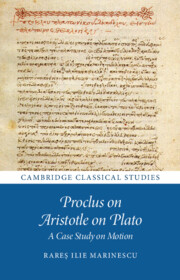
This is a study of Proclus' engagement with Aristotle's theory of motion, with a specific focus on Aristotle's criticism of Plato. It refutes the often-held view that Proclus – in line with other Neoplatonists – adheres to the idea of an essential harmony between Plato and Aristotle. Proclus' views on motion, a central concept in his thought, are illuminated by examining his Aristotelian background. The results enhance our view of the reception and authority of Aristotle in late antiquity, a crucial period for the transmission of Aristotelian thought which immensely shaped the later reading of his work. The book also counteracts the commonly held view that late antique philosophers straightforwardly accepted Aristotle as an authority in certain areas such as logic or natural philosophy.
Abolitionists adopted higher law to oppose the settled law which explicitly recognized chattel slavery in America. Emerson sometimes spoke on higher law but it was not his most comfortable position. Emerson was a Neoplatonist, and it is the gradualism of Neoplatonism that he embraced against the immediatism implied in higher law. But even before Emerson’s 1856 conversion to abolition, starting in 1854 Emerson began moving his self-reliance into Northern-reliance. He was working his way philosophically toward a political activism that he would, finally, enthusiastically embrace. Emerson borrowed from the Neoplatonist Plotinus the word and idea of living “amphibiously,” and that is what he learned to do.
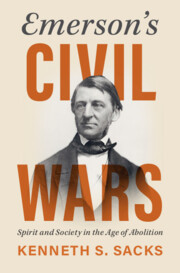
Kenneth S. Sacks explores how America's first public intellectual, determined to live self-reliantly, wrestled with his personal philosophy and eventually supported collective action to abolish slavery. Ralph Waldo Emerson was successful in creating a national audience for his philosophy and enjoyed the material and social rewards of that success. Contrary to most other Emerson scholars, however, Sacks argues that Emerson resisted active abolition and did not become a supporter until events forced his hand. Committing to the antislavery movement was risky and ran against his essential belief in social gradualism. Events in the mid-1850s, though, hastened Emerson's conversion and he eventually became a leader in the movement. A study of an intellectual under the pressure to engage in political action, Emerson's Civil Wars enriches our understanding of Emerson's antislavery activities, life, and career.
This chapter examines the notion of being in the Consolation of Philosophy and contrasts it with modern notions of existence. The notions in the Consolation relevant to this inquiry are those expressed by the verbs esse and exsistere. The chapter argues that the basic notion of exsistere in the Consolation should be understood as “to be manifest,” while the basic notion of esse should be understood as “to be something or other” or “to be intelligible.” Furthermore, the chapter demonstrates that the notion of esse in the Consolation differs from typical modern notions of existence in two significant ways. First, unlike modern notions of existence, according to which there are things that do not exist, the notion of esse or being in the Consolation has no contrary. Everything that can be spoken of or thought about “is” in some way. Second, the notion of esse in the Consolation, as in Aristotle, is “said in many ways.” In this it differs from modern notions of existence, which tend to be univocal. The chapter shows that once the notions of exsistere and esse are properly understood, certain arguments in the Consolation that might initially appear confused turn out to be quite clear and highly plausible.
Reading the Consolatio, it is possible to come away with the impression that the consolation Boethius sought while imprisoned was provided by philosophy as opposed to Christian faith. This impression has led some to doubt Boethius’ commitment to Christianity. The idea that there is a tension between Boethius’ Christianity and philosophy is not new, although scholarly disagreement over its significance has increased over the past hundred years. This chapter reviews the history of the debate concerning Boethius’ Christianity in the Consolatio and argues that the problem of Boethius’ faith must be formulated not in terms of an opposition between Christianity and Greco-Roman philosophy, but as a particular feature of sixth-century Latin Christianity.
The Consolation presents two especially puzzling features that make its exegesis particularly challenging. Literarily, it adopts an uncommon style for a philosophical text, the prosimetrum, which combines prose with poetry. Content-wise, it develops a cogent philosophical message that, perplexingly, is conveyed in a labyrinthine way. These exegetical difficulties disappear if we interpret the Consolation as a form of self-examination grounded in Neoplatonic philosophy. The meandering way in which the text expresses its message illustrates Boethius’ inner conflict brought about by his sudden political fall. The root cause of his conflict is an unresolved tension within the Neoplatonic account of the human soul: the difficulty of reconciling our material self with our divine self. The Consolation’s highly unusual combination of prose and poetry is steeped in some of the basic principles of Neoplatonic pedagogy.
While it is common to compare Boethius’ philosophy with that of his intellectual predecessors and heirs, as far as I know there are no studies comparing Boethius and his most well-known Greek contemporary, Dionysius the Areopagite. Yet both were Christians who were inspired by Plato and deeply influenced by Proclean Neoplatonism. This chapter begins to fill this lacuna in the literature by comparing the way that Boethius in the Consolation of Philosophy and Dionysius in On Divine Names employ key Neoplatonic ideas and metaphors in speaking and thinking about God’s nature and providence. The chapter compares how Boethius and Dionysius employ Neoplatonic sphere and circle metaphors (1) to illustrate how God is both completely simple and yet also has, or rather is, a multiplicity of “attributes” or activities, and (2) to articulate the relationship between God and creatures in terms of remaining, proceeding, and reverting.
Boethius’ Consolation of Philosophy was one of the most influential texts in medieval Europe. Yet it does not receive enough attention in contemporary scholarship on medieval philosophy. This is in part explained by the content and literary form of the Consolation. The direct influence of Plato and late antique Neoplatonism, the dialogue form, the alternating prose and poetry sections, and the wealth of references to classical literature and mythology contrast sharply with the sort of texts most contemporary scholars of medieval philosophy focus on. The essays in this volume tackle these interpretive challenges and reveal some of the rich philosophical insights the Consolation offers. Chapters 1–3 directly address its literary features and their philosophical significance. Chapters 4 and 5 consider the relationship between the Consolation and Boethius’ Christianity. Chapters 6–8 offer three different takes on the philosophy of selfhood, or philosophical anthropology, so central to the Consolation. Chapters 9–13 deal with the more standard metaphysical and theological issues, such as Boethius’ accounts of goodness, being, God, time, eternity, and human freedom.
Recognition of Boethius’ Philosophia as allegorical personification is critical for understanding the positive portrayal given her in the Consolatio. It explains the elaborate identifying markers given in metaphorical reference to the lady as nurse, physician, and teacher. It also helps to explain her ontological status as a source of inspiration for “the prisoner.” This chapter notes her pedagogical strategy in consolation for a patient and compassionate approach, demonstrating feminine qualities that effectively balance the rigorous argument by which she finally moves the prisoner from despair to renewed hope and dignity.