To save content items to your account,
please confirm that you agree to abide by our usage policies.
If this is the first time you use this feature, you will be asked to authorise Cambridge Core to connect with your account.
Find out more about saving content to .
To save content items to your Kindle, first ensure no-reply@cambridge.org
is added to your Approved Personal Document E-mail List under your Personal Document Settings
on the Manage Your Content and Devices page of your Amazon account. Then enter the ‘name’ part
of your Kindle email address below.
Find out more about saving to your Kindle.
Note you can select to save to either the @free.kindle.com or @kindle.com variations.
‘@free.kindle.com’ emails are free but can only be saved to your device when it is connected to wi-fi.
‘@kindle.com’ emails can be delivered even when you are not connected to wi-fi, but note that service fees apply.
In the previous chapter the fragmentation of the modern age has been discussed. In this chapter I will show that for the Romantics this fragmentation is a form of stagnation of time, where the transformative power proper of Becoming is missing and where, therefore, freedom is not deemed possible. How can the transformative power be re-introduced into history without falling into the illusion that the self could be the sovereign agent of such a transformation? The Romantic answer to this question deals with three key concepts: critical thinking, humanity, and utopia. Critical thinking is viewed as a creative act that detects in the present signs of a better future, humanity as the future non-sovereign subject of history, and utopia as the imagination of a possible future that, at the same time, does not imply a concept of history as ‘progress’. Together, as will be analysed at the end of the chapter, they allow us to think the relationship between history and nature neither as opposition nor as identity, providing thought-provoking and original perspectives on the actual debate in environmental philosophy.
Life was conceived by the Romantics as the underlying force of nature, and they sought to identify its norms and rules of transformation. For them, life oscillates between contraction and relaxion, between potentiality and actuality. Life establishes and renews the norms they set. However, these sequences do not only lead to the form of living beings. Life is immanent and its creations flourish in every sphere. As we will see in this chapter, this idea of ‘life’ prompted the Romantics to focus on rhythm and habit, as the way in which life gives itself a dynamic order. Habit is the key for the Romantic reformulation of the political lexicon: it enhances sociability; individualities are not isolated beings but rather carry in themselves the inexhaustible transformative forces of life that deploy in and outside the individual. The individual is therefore always influenced by the context. For this reason, her freedom is not formulated as autonomy but rather as creativity or wisdom. This interpretation of ‘freedom’ bridges the gap between humans and nature and demonstrates that, in order to rethink our relationship with nature, we have to reformulate our political concepts.
The Romantic Self is constituted by otherness, by relations that are in constant transformation. In the preceding pages, this issue has been addressed with a particular focus on the relationship between the self and nature. In this part of the book, we shall see that the same applies to the relationship between the self and history: the I cannot separate herself from, or impose herself on, the historical conditions in which she emerges; rather, these are part of the Romantic Self. In this chapter, in particular, I will show that the ‘defective’ essence of the Romantic Self hinders her to impose her sovereign will on the development of historical events. This is reflected in her incapacity to bring into unity the fragmentation of the modern age (described by Friedrich Schlegel through an opposition to the ancient epoch) and in the impossibility to interpret history as a manifestation of human progress. The absence of a unitary line in history challenges the hermeneutics of the present, too: on this, Schlegel’s genealogical perspective wants to give a solution.
This chapter explains how the Romantic gnoseology goes together with the concept of a dependent subjectivity. Indeed, the Romantics imagine their ontology as based on relationships (rather than on identity) and, consequently, the self as entangled in a mesh of reciprocal dependencies. This perspective on the Romantic gnoseology begins with the notion of ‘experiment’, which for the Romantics is a genetic method through which the subject–object dualism is undermined. Thinking of philosophy as an experiment implied, for them, accepting that the human being does not dominate nature but is instead constantly influenced by it. The deep relationship between the knower and the known is manifested in feeling, which reveals the primordial connection between subject and object and is at the core of the relational idea of the self. The relational ontology underlying the Romantic conception of feeling is even more evident in their analysis of love as a universal force that unites beings to and in the Absolute. Love designates the network of relationships constitutive of Being, of which the self is not the apex.
This chapter focuses on the relationality that constitutes the Romantic Self, highlighting the ethical and political consequences that derive from it. The Romantics refuse the lexicon proper to modern political thought, centred on the concept of sovereignty and autonomy: they highlight the illusory essence of these concepts and the dangers they imply. Consistently, they also dismantle the possibility to write a political theory that pretends to offer universal principles. Relations are not extrinsic elements added to a fully formed subject and to be considered only after the identity of the subject has been defined. Relations are what we are. That is why in its political reflections, Romanticism’s primary polemical target is modern contractualism, founded on the tacit assumption that it is possible to study human beings in their individuality, skating over the interplay among them. This chapter shows how the idea of forces and the priority given to relationships influence the Romantic political concepts. These concepts in particular will be scrutinised: representative, constituent and constituted powers, democracy, individuality, equality, and justice.
Chapter Fourteen explores the relation between poetics and Restoration politics in Germany, France, and Italy. It argues that, similar to earlier aesthetic responses to the failure of the French Revolution, writers sought alternatives to the political and geographic order established at Vienna, imagining works that synthesise the past and the present in order to inspire change. After explaining why the Restoration left Britain largely unscathed, the author looks at examples of literary and political restoration in Novalis, Chateaubriand, Lamenais, and Metternich to show how restoration did not mean a nostalgic return into the past but rather the creation of something new. The chapter then compares the Restoration poetics of Quinet, Hugo and Gautier, suggesting that they advocate the ‘grotesque’ through the recovery of Shakespeare, to imagine a more comprehensive and liberal vision of society than that set forth by Metternich. Balzac’s La comédie humaine serves as a counter-example, ending in a cynicism at odds with the idealism of George Sand. The chapter’s last section compares the political uses of loss, exile, and restoration in two great Italian poets, Foscolo and Leopardi, concluding with a close reading ‘La Sera del dì di festa’ to show how political hope was kept alive.
Jacobi played a determinative role in shaping the landscape from which German Romanticism would emerge. His critique of the philosophies of both Spinoza and Fichte, and his advocacy of transcendent realism, would deeply influence Early German Romantics such as Schlegel, Novalis and Hölderlin and would go on to shape the thought of Samuel Taylor Coleridge.
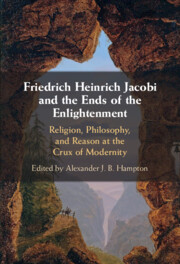
Friedrich Jacobi held a position of unparalleled importance in the golden age of late eighteenth and early nineteenth century intellectual history. Nonetheless, the range and style of his thought and its expression has always posed interpretative challenges that continue to hinder his reception. This volume introduces and evaluates Jacobi's pivotal place in the history of ideas. It explores his role in catalyzing the close of the Enlightenment through his critique of reason, how he shaped the reception of Kant's critical philosophy and the subsequent development of German idealism, his effect on the development of Romanticism and religion through his emphasis on feeling, and his influence in shaping the emergence of existentialism. This volume serves as an authoritative resource for one of the most important yet underappreciated figures in modern European intellectual history. It also recasts our understanding of Fichte, Hegel, Kierkegaard, and others in light of his influence and impact.
This chapter deals with the ‘flip side‘ of Krautrock, exploring which political, social, and cultural developments in West Germany in the 1970s were clearly not reflected in Krautrock. The aim is to show that German pop music in the Krautrock era – contrary to its glorification as progressive, avant-garde, and internationalist – was actually conservative, if not restorative, in essential aspects. The chapter demonstrates that, firstly, feminist tendencies are discernible outside Krautrock (e.g. Inga Rumpf or Claudia Skoda). Secondly, the chapter deals with the vibrant music scene of Turkish migrants, which was ignored by German majority society. Thirdly, the chapter focuses on aspects of the appropriation of national traditions in German pop music of the 1970s. It discusses bands like Novalis and Hölderlin, who took up the tradition of German Romanticism, or Achim Reichel, who used the marginalised language form of Low German for his pop music. The chapter establishes a counter-narrative that challenges the prevailing view of the modernising power of Krautrock. Rather, it suggests that Krautrock was decoupled from the actual modernising trends in 1970s West Germany, such as the women‘s movement and the multicultural diversification of society.
This chapter examines the nature and the origins of what it identifies as a distinctively Romantic view of music. According to this, the purpose of music is to provide non-linguistic knowledge or insight, most usually into one’s inner self or, especially, into the fundamental nature of reality. The chapter starts by charting some key moments in the philosophical background of the 1780s and ’90s. Building on this, it traces the emergence of the Romantic view of music in the works of the two philosophers most closely involved in its earliest formulations: Friedrich Schlegel and Georg Friedrich Philipp von Hardenberg (better known by his pen name Novalis). It concludes with brief examinations of the ways in which this view was elaborated by two now-canonical philosophers of this era, Friedrich Schelling and Arthur Schopenhauer, and with a reflection on the subsequent influence of this view.
Recommend this
Email your librarian or administrator to recommend adding this to your organisation's collection.