To save content items to your account,
please confirm that you agree to abide by our usage policies.
If this is the first time you use this feature, you will be asked to authorise Cambridge Core to connect with your account.
Find out more about saving content to .
To save content items to your Kindle, first ensure no-reply@cambridge.org
is added to your Approved Personal Document E-mail List under your Personal Document Settings
on the Manage Your Content and Devices page of your Amazon account. Then enter the ‘name’ part
of your Kindle email address below.
Find out more about saving to your Kindle.
Note you can select to save to either the @free.kindle.com or @kindle.com variations.
‘@free.kindle.com’ emails are free but can only be saved to your device when it is connected to wi-fi.
‘@kindle.com’ emails can be delivered even when you are not connected to wi-fi, but note that service fees apply.
Students will develop a practical understanding of data science with this hands-on textbook for introductory courses. This new edition is fully revised and updated, with numerous exercises and examples in the popular data science tool Python, a new chapter on using Python for statistical analysis, and a new chapter that demonstrates how to use Python within a range of cloud platforms. The many practice examples, drawn from real-life applications, range from small to big data and come to life in a new end-to-end project in Chapter 11. New 'Data Science in Practice' boxes highlight how concepts introduced work within an industry context and many chapters include new sections on AI and Generative AI. A suite of online material for instructors provides a strong supplement to the book, including lecture slides, solutions, additional assessment material and curriculum suggestions. Datasets and code are available for students online. This entry-level textbook is ideal for readers from a range of disciplines wishing to build a practical, working knowledge of data science.
This chapter introduces Python as a powerful yet beginner-friendly programming language essential for data science. It covers getting access to Python through direct installation or integrated development environments like Anaconda and Spyder. The chapter teaches fundamental programming concepts including basic operations, data types, and key data structures (lists, tuples, dictionaries, sets, and DataFrames). Students learn to write control structures using if-else statements and while/for loops, create reusable functions, and make programs interactive through user input. The chapter also explains how to install and use Python packages, which extend the language’s capabilities for specialized tasks. Throughout, practical examples demonstrate concepts like leap year calculations, temperature categorization, and sales data analysis. The chapter emphasizes Python’s accessibility, extensive package ecosystem, and suitability for data science applications, positioning it as an ideal tool for solving computational and data analysis problems.
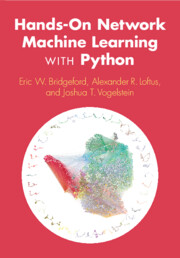
Bridging theory and practice in network data analysis, this guide offers an intuitive approach to understanding and analyzing complex networks. It covers foundational concepts, practical tools, and real-world applications using Python frameworks including NumPy, SciPy, scikit-learn, graspologic, and NetworkX. Readers will learn to apply network machine learning techniques to real-world problems, transform complex network structures into meaningful representations, leverage Python libraries for efficient network analysis, and interpret network data and results. The book explores methods for extracting valuable insights across various domains such as social networks, ecological systems, and brain connectivity. Hands-on tutorials and concrete examples develop intuition through visualization and mathematical reasoning. The book will equip data scientists, students, and researchers in applications using network data with the skills to confidently tackle network machine learning projects, providing a robust toolkit for data science applications involving network-structured data.
Recommend this
Email your librarian or administrator to recommend adding this to your organisation's collection.