To save content items to your account,
please confirm that you agree to abide by our usage policies.
If this is the first time you use this feature, you will be asked to authorise Cambridge Core to connect with your account.
Find out more about saving content to .
To save content items to your Kindle, first ensure no-reply@cambridge.org
is added to your Approved Personal Document E-mail List under your Personal Document Settings
on the Manage Your Content and Devices page of your Amazon account. Then enter the ‘name’ part
of your Kindle email address below.
Find out more about saving to your Kindle.
Note you can select to save to either the @free.kindle.com or @kindle.com variations.
‘@free.kindle.com’ emails are free but can only be saved to your device when it is connected to wi-fi.
‘@kindle.com’ emails can be delivered even when you are not connected to wi-fi, but note that service fees apply.
This chapter provides an examination of the documentary evidence for Charles Ignatius Sancho’s life and career as a servant in the household of the Dukes of Montagu. It is based on archive sources, with particular focus on the archive of the Duke of Buccleuch and the papers of his ancestors, John 2nd Duke of Montagu (1690–1749) and George Duke of Montagu (1712–1790).
Colonial Caregivers offers a compelling cultural and social history of ayahs (nannies/maids), by exploring domestic intimacy and exploitation in colonial South Asia. Working for British imperial families from the mid-1700s to the mid-1900s, South Asian ayahs, as Chakraborty shows, not only provided domestic labor, but also provided important moral labor for the British Empire. The desexualized racialized ayah archetype upheld British imperial whiteness and sexual purity, and later Indian elite 'upper' caste domestic modernity. Chakraborty argues that the pervasive cultural sentimentalization of the ayah morally legitimized British colonialism, while obscuring the vulnerabilities of caregivers in real-life. Using an archive of petitions and letters from ayahs, fairytales they told to British children, court cases, and vernacular sources, Chakraborty foregrounds the precarious lives, voices, and perspectives of these women. By placing care labor at the center of colonial history, the book decolonizes the history of South Asia and the British Empire.
What did it mean to possess something – or someone – in eighteenth-century Britain? What was the relationship between owning things and a person's character and reputation, and even their sense of self? And how did people experience the loss of a treasured belonging? Keeping Hold explores how Britons owned watches, bank notes and dogs in this period, and also people, and how these different 'things' shaped understandings of ownership. Kate Smith examines the meaning of possession by exploring how owners experienced and responded to its loss, particularly within urban spaces. She illuminates the complex systems of reclamation that emerged and the skills they demanded. Incorporating a systematic study of 'lost' and 'runaway' notices from London newspapers, Smith demonstrates how owners invested time, effort and money into reclaiming their possessions. Characterising the eighteenth century as a period of loss and losing, Keeping Hold uncovers how understandings of self-worth came to be bound up with possession, with destructive implications.
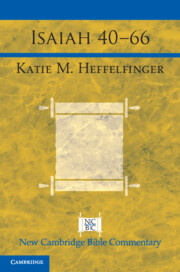
The texts in Isaiah 40–66 are widely admired for their poetic brilliance. Situating Isaiah within its historic context, Katie Heffelfinger here explores its literary aspects through a lyrically informed approach that emphasizes key features of the poetry and explains how they create meaning. Her detailed analysis of the text's passages demonstrates how powerful poetic devices, such as paradox, allusion, juxtaposition, as well as word and sound play, are used to great effect via the divine speaking voice, as well as the personified figures of the Servant and Zion. Heffelfinger's commentary includes a glossary of poetic terminology that provides definitions of key terms in non-technical language. It features additional resources, notably, 'Closer Look' sections, which explore important issues in detail; as well as 'Bridging the Horizons' sections that connect Isaiah's poetry to contemporary issues, including migration, fear, and divided society.
Chapter 7 re-examines the ‘book-farming’ controversy of the late eighteenth century. It first highlights the precarious power of book-knowledge, which offered mastery to an educated landowning class, but was a poor substitute for experience. The analysis distinguishes between a weak and a strong critique of agricultural books. The weak critique expressed by authors themselves condemned an overly theoretical approach or the overly speculative ideas in books. The strong critique was expressed in the reported hostility of working farmers, which was fundamentally suspicious of the value of learning about farming from books and challenged the proclaimed authority of writers. It argues that the strong opposition to book-farming can only be understood by considering the balance of power within agricultural labour relations. Hostility to book-farming was a form of ‘everyday resistance’ to the subordination of customary knowledge and the use of books as tools of management in the running of estates and large farms.
Often associated with urban institutions as coffeehouses and learned societies, the Enlightenment included fascination with outsiders – wild men, feral children, shipwrecked solitaries and local savages, or rustics. The long eighteenth-century theatre showcases this interest in “local savagery” in particular through a huge expansion in the number of plays set in spas, villages and country estates. These plays expand the collective vision of the nation, often celebrating the countryside as the green heart of England, the site of immemorial rights and model of social harmony. Just as frequently however, this pastoral image is threatened or subverted by Irish or labouring-class writers such as Robert Dodsley and Oliver Goldsmith, who highlight the local injustice and imperial violence that holds the rural (and national) hierarchy in place. This chapter maps rural dramaturgy from the Restoration forward to reveal these conflicting representational strategies, as Whigs and Tories fought to claim the nation’s heartland as the symbolic ground of political legitimacy and were followed by increasingly radical outliers whose view of rural society was considerably more critical.
Pope Francis has brought a fresh style of ministry, including his own, to the Catholic Church. This reflects the accounts of ministry in the New Testament, which eschews privilege and position, and focuses on ministry on service and sees ministers as servants and slaves.
Recommend this
Email your librarian or administrator to recommend adding this to your organisation's collection.