To save content items to your account,
please confirm that you agree to abide by our usage policies.
If this is the first time you use this feature, you will be asked to authorise Cambridge Core to connect with your account.
Find out more about saving content to .
To save content items to your Kindle, first ensure no-reply@cambridge.org
is added to your Approved Personal Document E-mail List under your Personal Document Settings
on the Manage Your Content and Devices page of your Amazon account. Then enter the ‘name’ part
of your Kindle email address below.
Find out more about saving to your Kindle.
Note you can select to save to either the @free.kindle.com or @kindle.com variations.
‘@free.kindle.com’ emails are free but can only be saved to your device when it is connected to wi-fi.
‘@kindle.com’ emails can be delivered even when you are not connected to wi-fi, but note that service fees apply.
Modern Hebrew literature has been driven by a call to productivity from its inception. Zionist history was born out of a break with its traditional and religious past, a historical transformation that coincided with the birth and perseverance of the productive Jew. However, even well into twentieth and twenty-first-century Hebrew literature, these tensions remain active. They illuminate not only the ways in which capitalization and secularization are ongoing processes but also latent yet available possibilities of resistance to the demands of productivity. The chapter focuses on the figure of the Shabbat and other forms of inoperativity and nonwork inherent within it in the poetry of Zelda Schneurson. It offers a reading of Zelda’s poetry from a materialist and political-theological perspective to locate her poetry and her depictions of nonwork within the intertwined histories of Zionism, secularism, and capitalism.
The essay reviews the ebb and flow of Jewish conversions to Catholicism, as well as the ambiguous process of categorizing religious identity. It examines the types of accusations launched against conversos, as well as the motivations for such accusals and their gendered nature. The essays discusses the truthfulness of surviving Inquisition records. It compares trials from the Spanish Inquisition’s first decades to those of later years, with particular attention to the presence of Jewish converts from Portugal. These trials demonstrate the complicated, ongoing interactions among Jews, New Christians, and so-called “Old Christians” throughout the Spanish Empire and around the world. The end of the chapter notes the decline of trials for Judaizing in the eighteenth century.
Ch. 10 Climate Change requires Jewish theology to develop its resources for an Eco-Judaism. Shabbat is a celebration of creation of the world as Good. Martin Buber argues for a “prophetic” approach to climate change based on human responsibility and a theology of hope and redemption.
Liborius Olaf Lumma sheds light on the Church’s daily prayer, previously called the Divine Office in the West, now known as the Liturgy of the Hours. He sketches their emergence and historical development in different cultural realms, but not without sounding how intrinsically important the hours are for Christian worship as a whole.
It begins with preliminary matters: an opening section dealing with policy context and related guiding principles, then an outline of the governing legal framework, international and domestic legislation, courts and regulatory bodies, with some references to international reports. This leads into the first of two contemporary case law sections, which examines the state–religion relationship in relation to the most relevant fundamental human rights: the freedoms of religion, assembly/association and expression. The second and largest considers the church–state relationship as it intersects with equality rights in relation to: marriage, family life, divorce and death; healthcare; education; employment; service provision; and security.
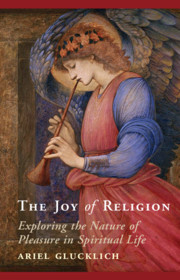
All religions describe spiritual experience as pleasant, and the goal of the religious pursuit as profoundly joyful. But many religions also condemn sensory pleasures and the desire for objects of pleasure. In this book, Ariel Glucklich resolves this apparent contradiction by showing how religious practices that instill self-control and discipline transform one type of pleasure into the pleasures of mastery and play. Using historical data and psychological analysis, he details how the rituals, mystical practices, moral teachings, and sacred texts of the world's religions act as psychological instruments that induce well-being. Glucklich also shows that in promoting joy and pleasure, religion also strengthens social bonds and enhances an individual's pursuit of meaning.
Recommend this
Email your librarian or administrator to recommend adding this to your organisation's collection.