Refine search
Actions for selected content:
23 results
2 - Can Reflective Patriotism Protect Civics from Propaganda and Partisanship?
-
- Book:
- Teaching America
- Published online:
- 01 May 2026
- Print publication:
- 21 May 2026, pp 61-90
-
- Chapter
- Export citation
Preface
-
- Book:
- Teaching America
- Published online:
- 01 May 2026
- Print publication:
- 21 May 2026, pp ix-xviii
-
- Chapter
- Export citation

Teaching America
- Reflective Patriotism in Schools, College, and Culture
-
- Published online:
- 01 May 2026
- Print publication:
- 21 May 2026
French dual constitutionalism, Tocqueville and Algeria: liberal authoritarianism as constitutional technique of liberal imperialism
-
- Journal:
- European Law Open / Volume 4 / Issue 4 / December 2025
- Published online by Cambridge University Press:
- 03 March 2026, pp. 809-823
-
- Article
-
- You have access
- Open access
- HTML
- Export citation
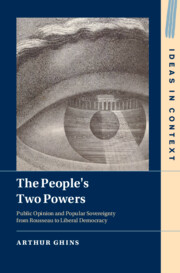
The People's Two Powers
- Public Opinion and Popular Sovereignty from Rousseau to Liberal Democracy
-
- Published online:
- 20 February 2026
- Print publication:
- 19 February 2026
Chapter 7 - The First Theorists of Liberal Democracy
-
- Book:
- The People's Two Powers
- Published online:
- 20 February 2026
- Print publication:
- 19 February 2026, pp 209-244
-
- Chapter
- Export citation
Chapter 6 - Tocqueville’s Democracy
-
- Book:
- The People's Two Powers
- Published online:
- 20 February 2026
- Print publication:
- 19 February 2026, pp 172-208
-
- Chapter
- Export citation
What Is Democracy?
- Part of
-
- Journal:
- Public Humanities / Volume 1 / 2025
- Published online by Cambridge University Press:
- 04 November 2024, e16
-
- Article
-
- You have access
- Open access
- HTML
- Export citation
6 - “As God Rules the Universe”
- from Part II
-
-
- Book:
- When the People Rule
- Published online:
- 23 November 2023
- Print publication:
- 09 November 2023, pp 113-138
-
- Chapter
-
- You have access
- Open access
- HTML
- Export citation
3 - The Fact of Fiction
- from Part I
-
-
- Book:
- When the People Rule
- Published online:
- 23 November 2023
- Print publication:
- 09 November 2023, pp 57-72
-
- Chapter
-
- You have access
- Open access
- HTML
- Export citation
7 - Tocqueville’s Machiavellianism
- from Part II - Machiavelli’s Fortuna
-
- Book:
- Machiavelli's Effectual Truth
- Published online:
- 07 September 2023
- Print publication:
- 21 September 2023, pp 247-258
-
- Chapter
- Export citation
The Non-Fungible Value of Local Associations and its Invisibility to Law
-
- Journal:
- German Law Journal / Volume 24 / Issue 4 / May 2023
- Published online by Cambridge University Press:
- 26 June 2023, pp. 672-685
-
- Article
-
- You have access
- Open access
- HTML
- Export citation
Conclusion
-
- Book:
- The Power of the Jury
- Published online:
- 25 August 2022
- Print publication:
- 15 September 2022, pp 244-257
-
- Chapter
- Export citation
10 - What of the Future of Local Democracy?
- from Part III - Blocking Local Democracy
-
- Book:
- Creating Local Democracy in Iran
- Published online:
- 07 July 2022
- Print publication:
- 21 July 2022, pp 286-299
-
- Chapter
- Export citation
4 - Debatable Land
- from PART II - Eloquence and the Moderns
-
- Book:
- Words on Fire
- Published online:
- 16 December 2021
- Print publication:
- 16 December 2021, pp 118-157
-
- Chapter
- Export citation
Alexis de Tocqueville and Three Revolutions: France (1789–), Japan (1867–), China (1911–)
-
- Journal:
- International Journal of Asian Studies / Volume 17 / Issue 2 / July 2020
- Published online by Cambridge University Press:
- 21 July 2020, pp. 163-181
-
- Article
-
- You have access
- Open access
- HTML
- Export citation
6 - DeSiloing: Of Civic Associations, Book Clubs, and Taverns
- from Part II - The Democratic First Amendment in the Age of Twitter
-
- Book:
- Our Democratic First Amendment
- Published online:
- 28 May 2020
- Print publication:
- 04 June 2020, pp 119-139
-
- Chapter
- Export citation
Chapter 5 - Raymond Aron and the French Liberal Tradition
-
- Book:
- Raymond Aron and Liberal Thought in the Twentieth Century
- Published online:
- 18 October 2019
- Print publication:
- 07 November 2019, pp 167-206
-
- Chapter
- Export citation
Chapter 6 - Raymond Aron and the Liberal Moment in Late Twentieth-Century French Thought
-
- Book:
- Raymond Aron and Liberal Thought in the Twentieth Century
- Published online:
- 18 October 2019
- Print publication:
- 07 November 2019, pp 207-234
-
- Chapter
- Export citation
1 - Religion and Law in Late Modernity
-
- Book:
- The Possibility of Religious Freedom
- Published online:
- 07 October 2019
- Print publication:
- 17 October 2019, pp 1-31
-
- Chapter
- Export citation
