To save content items to your account,
please confirm that you agree to abide by our usage policies.
If this is the first time you use this feature, you will be asked to authorise Cambridge Core to connect with your account.
Find out more about saving content to .
To save content items to your Kindle, first ensure no-reply@cambridge.org
is added to your Approved Personal Document E-mail List under your Personal Document Settings
on the Manage Your Content and Devices page of your Amazon account. Then enter the ‘name’ part
of your Kindle email address below.
Find out more about saving to your Kindle.
Note you can select to save to either the @free.kindle.com or @kindle.com variations.
‘@free.kindle.com’ emails are free but can only be saved to your device when it is connected to wi-fi.
‘@kindle.com’ emails can be delivered even when you are not connected to wi-fi, but note that service fees apply.
from
Part II
-
Contemporary International Law of Submarines
Natalie Klein, University of New South Wales, Sydney,Kate Purcell, University of New South Wales, Sydney,Jack McNally, University of New South Wales, Sydney
This chapter analyses submarines activities against requirements under the law on the use of force (jus ad bellum). Key actions at issue in this regard are the submerged passage of a foreign-flagged submarine in the territorial waters of a coastal State, as well as coastal State responses against a submerged submarine. We examine when submarine activities may constitute a prohibited threat of the use of force, as well as an unlawful use of force, in violation of Article 2(4) of the UN Charter. Military submarines may be deployed lawfully in response to an armed attack, provided the requirements of the right of self-defence are met. Submarines may also exercise a lawful right of unit self-defence where that response is necessary and proportionate. Responses of coastal States against submarine operations are also assessed within the law on the use of force.
This chapter introduces jus ad bellum: the rules of law determining when states may resort to war or, more broadly, the use of armed force. In order to put the current jus ad bellum rules into perspective, the chapter begins by introducing the concept of collective security and demonstrating how this was applied during the League of Nations era. The following sections set out the relevant rules of the UN Charter on the prevention and regulation of recourse to the use of force, with a particular focus on the prohibition on the threat or use of force. The chapter also discusses the collective use of force, meaning the use of force authorized by the Security Council, and the unilateral use of force in self-defence. Finally, the chapter examines whether new exceptions to the prohibition of the use of force are emerging, in particular humanitarian interventions and the responsibility to protect.
A framing case study describes Russia’s 2022 invasion of Ukraine. Then the chapter provides an overview of law on the use of force. The chapter begins by describing the historical movement to prohibit the use of force. It then discusses the use of force with UN Security Council authorization. Next, it examines the complex topic of self-defense, including how states can respond to armed attacks, whether they can prevent armed attacks, and how they can protect themselves against non-state actors. Finally, the chapter probes whether the use of force is ever legally justified for other reasons, including: protecting nationals abroad; humanitarian intervention and the responsibility to protect; and when states consent to intervention.
This article argues that the scope of the neutrality duties of non-assistance and prevention allows for an exception – a carve-out for assistance given to the victim State of an armed attack. Rather than weighing in on debates as to whether current State practice accepted as law suffices to establish this rule inductively, the article offers a different approach to grounding the argument for this exception in the methodology of the sources of international law, which thus far has been underexplored. The central argument of the article is that the exception or carve-out—and its contours—deductively flows from the structure of international law of peace and security and, in particular, the victim State's right to self-defence. The purpose of that right—enabling the effective termination of the armed attack—must not be undermined through prohibitions of military assistance and duties of prevention. These considerations define the scope of neutrality duties as revealed through systemic treaty interpretation. Such deductive reasoning equally determines the scope of customary neutrality duties, whether discerning that scope is framed as systemic interpretation or as identification of custom.
This chapter considers the criteria for collective self-defence that are shared with individual self-defence. It is uncontentious to say that the same criteria that apply to individual self-defence – armed attack, necessity, proportionality, the reporting requirement, and the ‘until clause’ – also apply to collective self-defence. Indeed, this is an inevitable consequence of the way the concepts appear in Article 51 of the UN Charter. The nature and application of these criteria in the context of individual self-defence have been examined at great length in the existing literature. This chapter therefore does not provide in-depth analysis of all of their aspects. That said, it does provide a brief overview of these requirements to ensure that this book presents a comprehensive picture of the operation of collective self-defence today. The chapter’s main focus, though, is to examine how the operation of these criteria works specifically in the context of collective self-defence actions, which is something that has been largely overlooked in scholarship.
This chapter examines the relationship between collective self-defence and another legal basis for the use of force, which in scholarship is referred to as ‘military assistance on request’ or ‘intervention by invitation’. Analysing the relationship between collective self-defence and military assistance on request is crucial because these concepts are, in some respects, strikingly similar. Indeed, it has been argued that they overlap, and states often blur them in their argumentation. The chapter explores the extent to which the concepts can be differentiated at the ‘doctrinal’ or ‘conceptual’ level. It then turns to the various legal requirements (actual or, in some cases, arguable) for collective self-defence and military assistance on request, with the aim of highlighting similarities or differences, as relevant, when it comes to the operation of these two concepts.
Chapter 6 provides an in depth analysis of the right of self-defence: its essence, dual legal basis and other aspects of its application, including the authorship of an armed attack, the modalities of application of self-defence and the role of the Security Council.
The high ambition of the UN Charter Art. 2:4 to prevent interstate use of force is confirmed by the narrow right to individual or collective self-defence given to states under Art.51 ‘if an armed attack occurs’. States have many times invoked ‘self-defence’ as default justification of interventions and sometimes sought room for interpretations giving them more elbow room to use force in response to hostile acts of gravity. The general right of reprisal has been rejected, but in cases of grave or repeated terrorist attacks responses by armed force have not been criticized even though taken much after the attacks. A right has also been recognized to use force in self-defence where armed attacks are ‘imminent’ (pre-emption), but no such right has been acknowledged where the threat of attack is not imminent (‘anticipatory self-defence’ or ‘preventive’ use of force).
Chapter 8 seeks to untangle various issues in addressing when and how a state might be able to resort to the use of force in self-defence against non-state actors. It firstly raises some important general considerations in relation to self-defence against non-state actors, before moving on to examine the situation of self-defence measures which target both the non-state actors and the host state, as was the case with the United States’s response to the terrorist attacks of 11 September 2001. A distinction needs to be made between self-defence taken against both the non-state actor perpetrators of the attack or those posing a threat and the state within which they are located, and those actions that are more limited in only specifically targeting the non-state actors. The chapter finally addresses the particular phenomenon of so-called targeted killing, which engages not only the jus ad bellum, but also the legal framework of international human rights law and, potentially, international humanitarian law.
Chapter 6 provides an overview of the general aspects of the right of self-defence. It first examines the concept of an ‘armed attack’ as found in Article 51, with the aim of shedding some light on the difficult issues and questions raised by this prerequisite for the invocation of the right of self-defence. It then goes on to provide an examination of the twin customary principles of necessity and proportionality, including a specific look at the controversial concept of armed reprisals, before moving on to examining military action for the protection of nationals who are located abroad. The right of self-defence exists in both individual and collective forms, and the chapter takes a specific look at the right of collective self-defence. Finally, it examines the role of the UN Security Council in the invocation and implementation of the right of self-defence, an aspect of the right which is prominent throughout Article 51.
The purpose of Chapter 7 is to examine the various forms of preventative self-defence, that is whether the right of self-defence can be invoked before an armed attack has been launched, or at least before the physical manifestations of one have begun to occur. Given that there have been no attempts at formal reform of Article 51, the question arises as to how, if at all, might preventative self-defence be reconciled with this key requirement of an armed attack. This chapter therefore examines the three main forms of preventative self-defence: interceptive, anticipatory and pre-emptive. All three have been of central interest in the light of contemporary threats and challenges. In this respect, while there has been a greater acceptance of the possibility to invoke self-defence in the face of the threat of an ‘imminent’ attack, there has been, as explored in this chapter, disagreement as to exactly whether this is restricted to being interpreted in its ordinary temporal meaning or whether it is today necessary to take it into other contextual factors.
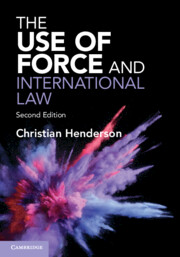
Newly revised, this textbook provides an authoritative conceptual and practical overview of international law governing the resort to force. Following an introductory chapter, with a section on the key issues in identifying the law and actual and potential changes to it, the book addresses the breadth and scope of the prohibition of the threat or use of force and the meaning of 'force' as the focus of this. The book proceeds to address the use of force through the United Nations and regional organisations, the use of force in peacekeeping operations, the right of self-defence and the customary limitations upon this right, the controversial right of humanitarian intervention, and forcible interventions in civil conflicts. Updated to include greater focus on aspects such as cyber operations, the threat of force, and the 'human element' to the use force, as well as the inclusion of recent developments such as the 2022 Russian invasion of Ukraine, it seeks to address the contemporary legal framework through the prism of contemporary challenges that it currently faces.
This chapter examines how a cyberattack that has consequences similar to a kinetic or physical attack – causing serious loss of life or physical damage – could be encompassed within the crimes that may be prosecuted before the International Criminal Court (“ICC”). While it is a very limited subset of cyber operations that might fall within the ambit of the ICC’s Rome Statute, the chapter explains when and how a cyberattack could constitute genocide, crimes against humanity, war crimes, or the crime of aggression. The chapter additionally acknowledges limitations as to which attacks would be encompassed, given, particularly, the ICC’s gravity threshold as well as the hurdle of proving attribution by admissible evidence that could meet the requirement of proof beyond a reasonable doubt. Notwithstanding such limitations, increased awareness of the largely previously overlooked potential of the Rome Statute to cover certain cyberattacks could potentially contribute to deterring such crimes and to reaching the goal of a state of “cyber peace.”
In the recent conflicts there have been a number of controversial issues involving the laws of war including the issue of targeted killing, civilian casualties and the blockade of Gaza. In addition to the public relations aspect, international criminal law is increasingly relevant. In accordance with the principal of universal jurisdiction, any country can prosecute a suspected war criminal even if there is no nexus between the offence and the State concerned. This principle has been used in attempts to bring charges against Israeli politicians and military commanders in a number of European States. To date no prosecutions have taken place and the judicial authorities have tended to see these attempts as a political abuse of legal proceedings. The International Criminal Court has jurisdiction to try war criminals, if the State involved is unwilling or unable to investigate or prosecute the case. Palestine has claimed that Israel committed war crimes in the territory of Palestine and thus the Court has jurisdiction. Israel disputes the claim and the jurisdiction of the Court. The issue has not yet been resolved.
This chapter introduces the jus ad bellum: the rules of law determining when states may resort to war or, more broadly, the use of armed force. These rules must be distinguished from the jus in bello: these are the rules of law that apply in armed conflict (known as international humanitarian law). In order to put the current jus ad bellum rules into perspective, the chapter begins by introducing the concept of collective security and demonstrating how this was applied during the League of Nations era. The following sections set out the relevant rules of the UN Charter on the prevention and regulation of recourse to the use of force, with a particular focus on the prohibition on the threat or use of force. The chapter also discusses the collective use of force, meaning the use of force authorized by the Security Council, and the unilateral use of force in self-defense. Finally, the chapter examines whether new exceptions to the prohibition of the use of force are emerging -- in particular, humanitarian intervention and the responsibility to protect.
Section C examines the law on the resort to the use of force, specifically nuclear force. Accordingly, it contains Rules and Commentaries on the prohibition of the use or threat of nuclear force; the right of individual or collective self-defence, including its limitations; and enforcement measures decided upon by the UN Security Council, including those executed by regional organisations.
Historically, foreign election interference was accomplished through nondigital means. In today’s world, however, these prosaic forms of interference have been replaced with their digital counterparts: the use of email hacking and fraudulent social media presence to influence the public and consequently interference with an election. Because the method of election interference has shifted to the digital domain, there is a strong temptation to view the legality of election interference through the international legal rules governing cyber-attacks. In other words, some would condemn election interference as illegal under international law because it represents a form of cyber-warfare. Other lawyers and politicians will argue the opposite: that election interference does not violate international law because it does not rise to the level of a cyber-war, as if this is the end of the matter in terms of the legal analysis. What unites these two competing conclusions is the assumption that cyber-warfare is the correct framework for judging the legality of election interference. That assumption is profoundly mistaken. This chapter will explain why the assumption is mistaken and why the cyber-war framework is unhelpful.
This chapter analyses the preconditions of invoking self-defence against a malicious cyber operation. After examining the notion of 'armed attack' and under what circumstances a cybersecurity incident may reach the critical threshold, the study focuses on the question of attributing the malicious conduct to a state actor. Depending first on identifying the acting individual whose hacking then needs to be linked to a state via the rules enshrined in the ILC Articles on State Responsibility, the question of the applicable standard of evidence is analysed in detail. Concluding that the technical peculiarities of cyberspace will often prevent states from presenting a sufficient amount of proof of adversarial state involvement in a timely manner, the chapter exposes the inherent difficulties in connection with the doctrine of self-defence in cyberspace.
This chapter analyses the application of jus contra bellum(the law against war) to cyber operations and demonstrates that the vast majority of cyber operations fall below the threshold required for the application of jus contra bellum. It analyses whether cyber operations may reach and cross the three thresholds of jus contra bellum – namely a use of force, a threat of force and an armed attack. It has been observed that no State or international organisation has ever publicly and unequivocally qualified a cyber operation as a use of force, and a fortiori an armed attack. This chapter, however, demonstrates that in some circumstances cyber operations may amount to a use of force, a threat of force or even an armed attack. The conclusion is that most state-sponsored cyber operations fall short of the required thresholds. Hence, they should be considered beyond the legal framework of jus contra bellum.