To save content items to your account,
please confirm that you agree to abide by our usage policies.
If this is the first time you use this feature, you will be asked to authorise Cambridge Core to connect with your account.
Find out more about saving content to .
To save content items to your Kindle, first ensure no-reply@cambridge.org
is added to your Approved Personal Document E-mail List under your Personal Document Settings
on the Manage Your Content and Devices page of your Amazon account. Then enter the ‘name’ part
of your Kindle email address below.
Find out more about saving to your Kindle.
Note you can select to save to either the @free.kindle.com or @kindle.com variations.
‘@free.kindle.com’ emails are free but can only be saved to your device when it is connected to wi-fi.
‘@kindle.com’ emails can be delivered even when you are not connected to wi-fi, but note that service fees apply.
Negligence governs the legal obligations individuals and organisations owe to others to avoid causing harm. Once liability is considered, however, there are defences available that can reduce or even eliminate a defendant’s responsibility. These defences reflect the fact that the blame for that harm cannot – or should not – always be laid solely at the defendant’s feet and that the actions of the plaintiff themselves can affect legal outcomes.
In this chapter, we’ll explore the key defences to negligence, such as voluntary assumption of risk (volenti), the statutory defence provisions that exist in various jurisdictions and contributory negligence. By examining the legal principles and significant cases behind these defences, you’ll gain insight into how the courts deal with these defences and the impact they can have on liability.
In this chapter, the element of breach is covered in four sections. Section 12.1 discusses the nature of breach as an element of the tort of negligence – what it is there for and what it covers. Section 12.2 discusses the standard of care – a question of law. Section 12.3 explains what courts take into account to assess the conduct of a defendant – a question of fact. Section 12.4 discusses the ways in which breach of duty can be proved.
Two sets of ‘Summary points’ summarise the matters that you should take into account when approaching a problem question. They appear at the end of the discussion of the nature and role of breach (section 12.1) and again at the end of the chapter.
Note that these ‘Summary points’ ask you to engage in an active reading exercise: your task is to link each of the summary points with a case in the section.
The rules of state responsibility are set out in the International Law Commission’s (ILC) Articles on the Responsibility of States for Internationally Wrongful Acts. This chapter introduces the basic features of the ILC’s Articles on State Responsibility, beginning with an explanation of what constitutes an internationally wrongful act. It then discusses the circumstances precluding wrongfulness that may be invoked by states seeking to avoid responsibility for an internationally wrongful act. The chapter then covers the aftermath of an internationally wrongful act, which can involve legal consequences, such as reparations, as well as countermeasures. This chapter focuses specifically on the responsibility of states, rather than the responsibility of international organizations or individuals.
Chapter 15 on State Responsibility provides an in-depth exploration of the circumstances under which States can be held responsible for climate change. The author starts by outlining the fundamental principles and conditions for State responsibility under international law. Her analysis bridges the gap between international and domestic law, shedding light on how each legal sphere influences the shape and contours of State responsibility in relation to climate change. Further, she enriches her analysis with insights drawn from key climate cases that have tested the limits of State responsibility. These cases reveal how courts and quasi-judicial bodies are grappling with the challenges of attributing climate harms to State actions and omissions, and the implications of holding States accountable for these harms. In distilling emerging best practice, the author identifies innovative judicial interpretations and legal strategies that have expanded the ambit of State responsibility in climate litigation.
This chapter uses a case-based approach to discuss the electrographic patterns associated with focal cortical lesions in critically ill patients. Focal amplitude attenuation and/or slowing may suggest an underlying physiological dysfunction or a structural lesion. Additionally, epileptiform abnormalities such as sharp waves within the region may suggest increased seizure risk. A focal pattern of higher amplitudes, sharper morphologies, and faster activities is characteristic of breach effect from a craniotomy. Lateralized rhythmic delta activity (LRDA) is a pattern of rhythmic focal slowing that is associated with increased seizure risk. Epilepsia partialis continua (EPC) is an unusual form of focal motor status epilepticus that is often refractory to antiseizure medications. This pattern may be seen in a rare form of focal epilepsy called Rasmussen syndrome among other causes.
Since Xinyu Company v. Feng Yumei was published in the Gazette of the Supreme People’s Court in 2006, a peculiar expression ‘a breaching party’s right to termination’ emerged in China. Though a misunderstood concept, it does reveal problems in the rules on contract termination under the Chinese Contract Law 1999. The main problem is that, the legal protection is insufficiently afforded to long-term contracts. Art. 580 (2) of the Chinese Civil Code 2020 provides a new approach of judiciary termination, which may provide some improvement, but only for cases involving performance of non-monetary obligation. For those involving performance of monetary obligation, this rule is inapplicable. Judicial termination of contract under Art. 580 (2) should be exercised very cautiously. The justification for terminating a contract, from force majeure to change of circumstance and to commercial risk, decreases in sequence.
This chapter provides an introduction to Swiss contract law. It discusses the Code of Obligations as the main source of law, the fundamental principles of Swiss contract law, the notion of an obligation as the effect of the contract, the formation of contracts, including pre-contractual liability, as well as the notions of offer and acceptance. This chapter then turns to the principles applicable to the interpretation of contracts and the principles governing the validity of contracts. This chapter further discusses the notion of agency, general terms and conditions as well as the various categories of contracts found under Swiss law. This chapter moreover explores the significant issues of the performance of the contract and breach of contract. Finally, this chapter analyses the extinguishment of obligations as well as the concepts of the assignment of a claim and the assumption of debt.
This chapter explored the implications of sharing obligations for the determination of shared responsibility, underscoring the relevance of distinguishing between two types of shared obligations throughout this process. After all, the implications of sharing obligations for responsibility relations differ depending on whether the shared obligation breached is of a divisible or indivisible character. Where a breach of an indivisible shared obligation can only result in shared responsibility for a single wrongful act – which entails that the sharing of an obligation that is indivisible always has one inevitable implication for responsibility relations – a breach of a divisible shared obligation has no such automatic implications for the responsibility of states and international organizations concerned. Instead, when a divisible shared obligation is breached, different outcomes in terms of responsibility remain possible. Depending on the circumstances in which the divisible shared obligation is breached, a breach may give rise to shared responsibility for a single wrongful act, shared responsibility for multiple wrongful acts, or may even give rise to the responsibility of only one of the states or organizations that bear the obligation (though it should be noted that, in practice, breaches of divisible shared obligations are likely to occur by multiple duty-bearers).
Chapter 12 relates to the duration, term and renewal of IP licenses and licensing agreements. Distinctions are made between term limited, perpetual and irrevocable licenses and obligations (Warner-Lambert vs. John J. Reynolds). Different events of termination are described, including termination for convenience and for cause. Attention is given to the different parameters surrounding breach of contract, including materiality, notice, cure and excuse, and escrow of disputed sums. Statutory termination rights under copyright law are also addressed. Finally, the effects of termination and survival of particular contractual clauses are discussed, including transition assistance, assignment of sublicenses and transitional licenses.
The rules of state responsibility are set out in the International Law Commission’s (ILC) Articles on the Responsibility of States for Internationally Wrongful Acts. This chapter introduces the basic features of the ILC’s Articles on State Responsibility, beginning with an explanation of what constitutes an internationally wrongful act. The following section discusses the circumstances precluding wrongfulness that may be invoked by states seeking to avoid responsibility for an internationally wrongful act. The chapter then covers the aftermath of an internationally wrongful act, which can involve legal consequences, such as reparations, as well as countermeasures. This chapter focuses specifically on the responsibility of states, rather than the responsibility of international organizations or individuals.
Chapter 2 explores the ILC framework of international responsibility. The aim of the analysis is to identity rules which govern the allocation of international responsibility in a multi-layered structure where sovereignty is shared between different subjects of international law. This study argues that the purpose of both the ARIO and the ARSIWA is to determine whether a subject of international law is internationally responsible. If the question of responsibility arises in the context of a multi-layered structure, such as that of the EU, additional questions arise. The allocation of international responsibility within an international body falls outside the scope of the ARIO framework. Instead, this book suggests looking for guidance in the rules of organisation and the international dispute-settlement practice in which these rules operate.
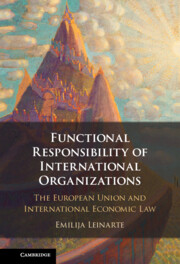
This book provides a novel approach to the allocation of international responsibility in a multilayered structure like the European Union. Introducing a new concept of functional international responsibility, this study finds that in international economic law the focus of international dispute settlement bodies is not on the responsible party, but on a party best placed to bear responsibility. The book offers a comprehensive analysis of international rules of responsibility and international dispute settlement practice, primarily that of the World Trade Organization and investment arbitration. The study offers a practically applicable approach to questions of international responsibility which will assist international adjudicators, EU and Member States' officials and third country government agents who negotiate economic agreements and are involved in international economic disputes. The book is also relevant to those interested in the governance and accountability questions under the new EU-UK Trade and Cooperation Agreement.
The law of occupiers’ liability is a true mix of statutorily-stated principles and common law negligence. Both Acts impact, to some degree, as to whether the occupier owed a duty of care or breached that duty, and the defences available to him; while causation and remoteness are entirely governed by the common law.
This chapter examines the nature of trusteeship and the possible actions for breach that can be brought by the beneficiaries. Breach can arise by commission [actively commiting a breach of trust]or by omission [failing to carry out a duty owed by the trustee]. The duties of a trustee arise either under common law or under statute or under the trust instrument. A trustee is liable for any breach of trust that causes a loss to the beneficiaries and must restore the equivalent value. The trustee will only be liable for a breach that caused the loss to the fund and the claimant must establish a causal link. The liability of trustees is joint but the beneficiaries can choose to only sue one trustee but in some cases the court may indemnify a trustee such as where one trustee has acted fraudulently. The beneficiaries may be able to claim interest as well as compensation from the fund. Trustees may be able to rely on an exemption clause which will exonerate them from liability. If there is no exemption clause trustees may be able to rely on other defences such as consent of the beneficiaries or the statutory defence under s.62 Trustee Act 1925.
In this chapter I discuss the responsibility of international organizations for human rights violations as a matter of substantive law. The central rules concerning the attribution of conduct to international organizations are analyzed, as are the relevant rules on indirect responsibility (complicity). Four potential sources of human rights obligations for international organizations are also identified: the constitutions and secondary law of the organizations themselves, treaty law, customary law, and general principles of law.
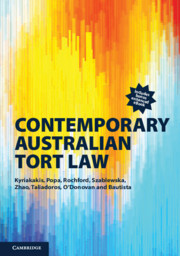
Contemporary Australian Tort Law is an engaging, accessible and student-friendly introduction to the law of torts in Australia. This unique text covers the foundational topics of tort law in a logical structure, covering duty of care, breaches, negligence, damages and defences, and also branching into higher-level topics such as defamation and offences in public office. Each chapter is supported by tools for self-assessment and self-reflection: review questions at the end of each subheading; case boxes that delve into important historical cases; multiple-choice questions and longer, narrative problems that challenge students to apply the principles they've learnt in the chapter to 'real world' scenarios. This print and eBook combination is an indispensable resource for law students taking their first course in tort law.