Refine search
Actions for selected content:
8 results
The origin of opal-bearing listvenite from the Tokat region (northern Turkey)
-
- Journal:
- Mineralogical Magazine , FirstView
- Published online by Cambridge University Press:
- 19 November 2025, pp. 1-18
-
- Article
-
- You have access
- Open access
- HTML
- Export citation
Similarities and differences among selected gemmological varieties of chalcedony: chemistry, mineralogy and microstructure
-
- Journal:
- Mineralogical Magazine / Volume 88 / Issue 2 / April 2024
- Published online by Cambridge University Press:
- 16 February 2024, pp. 136-146
-
- Article
-
- You have access
- Open access
- HTML
- Export citation
Crystallite growth kinetics in nanocrystalline quartz (agate and chalcedony)
-
- Journal:
- Mineralogical Magazine / Volume 73 / Issue 4 / August 2009
- Published online by Cambridge University Press:
- 05 July 2018, pp. 551-568
-
- Article
- Export citation
-
Crystallite growth in natural agate samples has been investigated at temperatures of 350—550°C and 100 MPa pressure in the presence of water vapour. Initial crystallite coarsening is accompanied by the transformation of moganite to α-quartz that is apparently inhibited by residual moganite when the crystallite sizes reach ~50 nm. At 350—500°C the coarsening kinetics can be described by an empirical law developed to describe Zener pinning which incorporates the maximum crystallite size prior to growth inhibition:
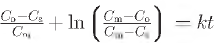 . C o = initial crystallite size, C s = crystallite growth after time t, C m = the maximum size achieved before inhibition and k is the rate constant that includes the activation energy which was found to be 51(±9) kJ mole—1. A more conventional isothermal growth rate law,
  = kt with n = 6.5, only applies at 550°C. Limited growth was obtained when small agate cubes were heated in an open furnace up to 122 d at 550°C, demonstrating that water vapour was essential for continued crystallite coarsening. The crystallite size and moganite content of agates formed under normal earth surface conditions from hosts aged 13 Ma to 3.5 Ga have also been determined. The high temperature crystallite growth rate law does not describe natural agate growth quantitatively but a qualitatively similar pattern is observed.
 .
.  =
= Metamorphic effects on agate found near the Shap granite, Cumbria, England: as demonstrated by petrography, X-ray diffraction and spectroscopic methods
-
- Journal:
- Mineralogical Magazine / Volume 71 / Issue 4 / August 2007
- Published online by Cambridge University Press:
- 05 July 2018, pp. 461-476
-
- Article
- Export citation
Agate and chalcedony from igneous and sedimentary hosts aged from 13 to 3480 Ma: a cathodoluminescence study
-
- Journal:
- Mineralogical Magazine / Volume 70 / Issue 5 / October 2006
- Published online by Cambridge University Press:
- 05 July 2018, pp. 485-498
-
- Article
- Export citation
Characterization and genesis of horizontal banding in Brazilian agate: an X-ray diffraction, thermogravimetric and electron microprobe study
-
- Journal:
- Mineralogical Magazine / Volume 77 / Issue 3 / April 2013
- Published online by Cambridge University Press:
- 05 July 2018, pp. 227-248
-
- Article
- Export citation
A re-examination of water in agate and its bearing on the agate genesis enigma
-
- Journal:
- Mineralogical Magazine / Volume 81 / Issue 5 / October 2017
- Published online by Cambridge University Press:
- 02 January 2018, pp. 1223-1244
-
- Article
- Export citation
Uranium and uranyl luminescence in agate/chalcedony
-
- Journal:
- Mineralogical Magazine / Volume 79 / Issue 4 / August 2015
- Published online by Cambridge University Press:
- 02 January 2018, pp. 985-995
-
- Article
- Export citation
