To save content items to your account,
please confirm that you agree to abide by our usage policies.
If this is the first time you use this feature, you will be asked to authorise Cambridge Core to connect with your account.
Find out more about saving content to .
To save content items to your Kindle, first ensure no-reply@cambridge.org
is added to your Approved Personal Document E-mail List under your Personal Document Settings
on the Manage Your Content and Devices page of your Amazon account. Then enter the ‘name’ part
of your Kindle email address below.
Find out more about saving to your Kindle.
Note you can select to save to either the @free.kindle.com or @kindle.com variations.
‘@free.kindle.com’ emails are free but can only be saved to your device when it is connected to wi-fi.
‘@kindle.com’ emails can be delivered even when you are not connected to wi-fi, but note that service fees apply.
Although there is one law, there are many motivations for complying with it. This was one of the key findings of the Roots of Restraint in War study published in 2018 by the International Committee of the Red Cross (ICRC). Building on this insight, this article examines a few recent accounts of international humanitarian law (IHL) violations and two general categories of psychological states which may have given rise to them. It then explores the modern-day value of warrior codes and martial notions of honour, and reviews the ICRC’s recent work to find convergences between IHL and various religious or traditional value systems. The article offers some important caveats which should be kept in mind when undertaking work which compares morality, ethics and the law, before finally presenting some implications of this work for IHL integration and dissemination activities. Civilian IHL practitioners do not need to embed themselves into military life in order to understand military perspectives on IHL, but it would be helpful for them to consider the many ways in which troops internalize norms and how to incorporate extra-legal concepts into IHL integration and dissemination activities in an appropriate way.
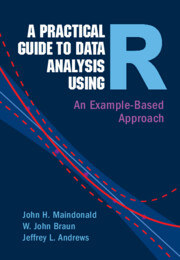
Using diverse real-world examples, this text examines what models used for data analysis mean in a specific research context. What assumptions underlie analyses, and how can you check them? Building on the successful 'Data Analysis and Graphics Using R,' 3rd edition (Cambridge, 2010), it expands upon topics including cluster analysis, exponential time series, matching, seasonality, and resampling approaches. An extended look at p-values leads to an exploration of replicability issues and of contexts where numerous p-values exist, including gene expression.Developing practical intuition, this book assists scientists in the analysis of their own data, and familiarizes students in statistical theory with practical data analysis. The worked examples and accompanying commentary teach readers to recognize when a method works and, more importantly, when it doesn't. Each chapter contains copious exercises. Selected solutions, notes, slides, and R code are available online, with extensive references pointing to detailed guides to R.
The chapter ’Meow and More’ lead us to the sociolinguistic concepts of code, code-switching, bilingualism, and multilingualism. It describes transnational communication, polylanguaging, translanguaging, and networked multilingualism by using cat-related examples, going over the technological aspects of computer-mediated communication to show how technology affects multilingual online discourse. The chapter also illustrates how we use language to construct our identity in the cat-related digital spaces.
Responsibility is a key moral concept but it is often used ambiguously, such as a firm being considered a responsible part of the community, having corporate social responsibility, or being responsible for harms. This chapter provides a clear framework that distinguishes between the different ways the term is used and shows how it can be applied in practical terms. It starts with an exposition of the Volkswagen diesel scandal to illustrate the various meanings of the term, contrasting notions of legal liability from moral wrongs. The relationship of cause, blame, and fault to moral responsibility is evaluated. It is noted that people may adopt institutional values when working in a role, and whether that approach remains valid even when someone else takes responsibility. The nature of company and institutional codes and compliance issues are discussed, and positive acts are contrasted to deliberate avoidance. The doctrine of double effect is evaluated, where an outcome is foreseeable but unintended. The concluding case deals with the tragic loss of Boeing 737 MAX airplanes and the attempt to shift blame from the company to individuals, especially foreign pilots.
In Chapter 1, we introduce the subject of pragmatics and cover some basic concepts, definitions, and topics that will be central to the ideas discussed in the rest of the book. We begin with some definitions of pragmatics, and a key distinction is made between approaches which focus on social factors, and those which take a more theoretical approach. We move on to think about the role that context plays in interpretation. This leads us to a key distinction between sentences and utterances, with utterances as the focus of pragmatics. We then consider two different ways in which meaning may be communicated: via code and via inference. As we will see, inference plays a central role in the interpretation of utterances. Next, we discuss the idea that the identification of intention lies at the heart of utterance interpretation. This leads to a discussion of the cognitive abilities that are thought to underlie inferential processes, including mindreading, metarepresentation, and theory of mind. We look at what it means to be able to have thoughts about other people’s thoughts and why this is key for pragmatic processing.
“A text that revolutionised the Shāfiʿī school of law” is the best way to characterise the law book Minhāj, the central subject of this chapter. Soon after it was written in Damascus in the thirteenth century, it acquired an immense popularity among Shāfiʿī jurists, to the extent that no other text of the school ever achieved. In the following centuries, it not only influenced but also framed the very ways in which they discoursed about their school. It inspired generations of jurists in their legal-textual praxis, leading to the production of a copious amount of commentaries, supercommentaries, abridgements, poetic renderings, etc., and that continues to today. Its story presents an interesting phenomenon in the histories of Islamic law, law and Islam at large. This chapter explores its inception and trajectories. It asks why so many jurists engaged with the text and what made it so idiosyncratic that it influenced the textual discourses of such a large community across centuries. Embedded in the larger commentarial mode of juridical advancements of the time, it argues that Nawawī codified the school’s diverse opinions while synthesising the existing divisions. His own detailed engagements with the broader textual corpus of the school in his other works provided material for him to bring out a concise, comprehensive and coherent work that would address larger pedagogical and juridical requirements.
Responding to critics who argue that telegraphy is an analogy for style (or at least for realism) in Victorian fiction, in this chapter David Trotter argues conversely that it is in fact inimical to style. Telegraphic communication, while hard to represent, or distasteful in its crudeness, could not be ignored. The novelists understood that it could be essential to human intercourse and, on occasion, oddly romantic. Daniel Deronda is the example par excellence.
The suggestion has been made that future advanced artificial intelligence (AI) that passes some consciousness-related criteria should be treated as having moral status, and therefore, humans would have an ethical obligation to consider its well-being. In this paper, the author discusses the extent to which software and robots already pass proposed criteria for consciousness; and argues against the moral status for AI on the grounds that human malware authors may design malware to fake consciousness. In fact, the article warns that malware authors have stronger incentives than do authors of legitimate software to create code that passes some of the criteria. Thus, code that appears to be benign, but is in fact malware, might become the most common form of software to be treated as having moral status.
This chapter rounds off the volume in two ways. It deals with, first, the more sporadic interaction between jurists and philosophers in the early imperial period, and second, with the influence of the late Republican interaction on law and philosophy as they are both practised today.
We introduce finite probability distributions and their use as a model of an ecological community. We define Shannon entropy, give examples, and establish its basic properties. We interpret Shannon entropy in terms of both coding and diversity, and prove that it is uniquely characterized by the chain rule.
Objective: Delve into programming logic and flow, VBA syntax, and debugging tools. Become familiar with code structure, communication with spreadsheets, dynamic data storage, conditional statements and loops, calling worksheet functions, and creating user-defined ones.
The notion that comparison is not the search for similarities but the systematization of differences leads to the question of which shared set of concepts and assumptions might be employed to explore this notion. Comparative analysis should at once reduce the complexity of data in the service of comparison and yet still reference the uniqueness and specificity of local values and ideas. Three types of comparison potentially fulfill these criteria. Claude Lévi-Strauss traces the transformations of oppositions and codes across cultural boundaries without claiming to compare societies as such. Louis Dumont contrasts systems of values that represent societies-as-wholes by analyzing their structuring into hierarchical levels. Niklas Luhmann’s theory of autopoietic systems enables the comparison of relationships between social systems and their environments, without assuming societies as units of comparison – examples being the making of ethnic identities and boundaries. A synthesis of the three approaches provides avenues of comparison in a globalized world, as is exemplified by the author’s own work in upland Southeast Asia.
Harmonizing corporate governance systems can potentially level the playing field for businesses, as it would increase financial and economic interconnections, including market integration, between countries. Although harmonization at the regional level such as the EU seems challenging because systems are so diverse, the reverse is the case at the national level. A critical issue in the harmonization effort is whether to adopt the “comply or explain” approach or the mandatory compliance approach. Although mandatory compliance is necessary in certain circumstances, particularly in cases of corporate pseudo-reporting that occasions corporate failures, the predominant approach involves “comply or explain”. Given competing interests in the business community, the inclination for flexibility and the regulatory authority's disposition for an oversight function, this article argues that a hybrid approach should be followed, which will internalize the merits of both the “comply or explain” and mandatory compliance approaches while eschewing their disadvantages.
Our behaviour in informational environments is governed by new mechanisms of control. Technological environments do not simply enable or constrain specific behaviours, but are instead instrumented so that rational choices of agents are directed towards pre-specified goals. This type of engagement with the informational world is under-theorised in law. This chapter argues that we need to transcend the separation between physical and informational and work on building appropriate techno-legal mechanisms. It suggests we can think about these emerging environments, and the legalities that are implemented into them, as emerging jurisdictions that do not undermine law, but rather give it another form of expression.
In this chapter the reader creates if statements, which include elif and else statements, and learns about nesting statements together. They become familiar with conditional operators such as greater than, less than and equal to along with comparison operators such as and, or and not as they build upon the knowledge they have acquired in the first chapter to program solutions for the eight given challenges.
Mock Code Training is an exercise designed to develop competency in emergency responsiveness. The objectives for this educational intervention were: (1) demonstrate basic airway maneuvers (2) demonstrate basic life support-cardiopulmonary resuscitation (BLS-CPR); (3) demonstrate when and how to call a Code; (4) recognize life-threatening cardiac arrhythmias; (5) initiate relevant cardiac monitoring; and (6) initiate relevant resuscitation based on algorithms.
Methods:
Drills were conducted monthly on various inpa-tient and outpatient nursing units at the University of Wisconsin Hospital and Clinics. The following data was collected: (1) chime sounded; (2) basic patient assessment; (3) universal precautions; (4) compressions; (5) automated external defibrillator (AED) arrival; (6) unit emergency cart arrival; (7) oxygen administration; (8) code team arrival; (9) Advanced Cardiac Life Support (ACLS) Guidelines; (10) presence of recorder; (11) monitor initiation; (12) advanced airway; (13) intravenous (IV) access; (14) medications; (15) and time resuscitation ended.