Refine search
Actions for selected content:
1 results
Small-time asymptotics and the emergence of complex singularities for the KdV equation
-
- Journal:
- Journal of Nonlinear Waves / Volume 2 / 2026
- Published online by Cambridge University Press:
- 05 March 2026, e6
-
- Article
-
- You have access
- Open access
- HTML
- Export citation
-
While real-valued solutions of the Korteweg–de Vries (KdV) equation have been studied extensively over the past 50 years, much less attention has been devoted to solution behaviour in the complex plane. Here we consider the analytic continuation of real solutions of KdV and investigate the role that complex-plane singularities play in early time solutions on the real line. We apply techniques of exponential asymptotics to derive the small-time behaviour for dispersive waves that propagate in one direction, and demonstrate how the amplitude, wavelength and speed of these waves depend on the strength and location of double-pole singularities of the initial condition in the complex plane. Using matched asymptotic expansions in the limit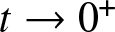 $t\rightarrow 0^+$, we show how complex singularities of the time-dependent solution of the KdV equation emerge from these double-pole singularities. Generically, their speed as they move from their initial position is of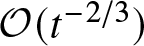 $\mathcal{O}(t^{-2/3})$, while the direction in which these singularities propagate initially is dictated by a Painlevé II (P $_{\mathrm{II}}$) problem with decreasing tritronquée solutions. The well-known $N$-soliton solutions of KdV correspond to rational solutions of P $_{\mathrm{II}}$ with a finite number of singularities; otherwise, we postulate that infinitely many complex-plane singularities of KdV solutions are born at each double-pole singularity of the initial condition. We also provide asymptotic results for some non-generic cases in which singularities propagate more slowly than in the generic case. Our study makes progress towards the goal of providing a complete description of KdV solutions in the complex plane and, in turn, of relating this behaviour to the solution on the real line.


