To save content items to your account,
please confirm that you agree to abide by our usage policies.
If this is the first time you use this feature, you will be asked to authorise Cambridge Core to connect with your account.
Find out more about saving content to .
To save content items to your Kindle, first ensure no-reply@cambridge.org
is added to your Approved Personal Document E-mail List under your Personal Document Settings
on the Manage Your Content and Devices page of your Amazon account. Then enter the ‘name’ part
of your Kindle email address below.
Find out more about saving to your Kindle.
Note you can select to save to either the @free.kindle.com or @kindle.com variations.
‘@free.kindle.com’ emails are free but can only be saved to your device when it is connected to wi-fi.
‘@kindle.com’ emails can be delivered even when you are not connected to wi-fi, but note that service fees apply.
Chapter 1 traces the emergence of the social wife in late Qing diplomacy, showing how concubines became the earliest Chinese women to assume this role. By focusing on chahui, an important form of Western social gathering typically hosted by officials’ wives, it demonstrates how Qing diplomats observed the significant role of the social wife in the West. It begins with the first well-known case of an official, Guo Songtao, bringing his concubine abroad and attending public functions with her during their stay in London (1877–1879). Ambassador Guo was criticized by conservative factions at the Qing court and later recalled as punishment, partially for breaching Confucian gender propriety. It then examines how other diplomats, such as Guo’s successor, Zeng Jize, and his family adjusted to the expectation of a social wife’s presence in diplomatic functions in Europe. Finally, it shows how chahui and its gender-related etiquette were adapted to suit the cultural contexts of late Qing China to entertain Western dignitaries, enabling Chinese officials’ wives to attend without violating the Confucian norm of gender separation.
Chapter 2 continues to explore the ways that, both at home and abroad, shifting Chinese mores demanded that politicians appear in public with their wives. As this change took hold in the new Republic, courtesans and entertainers-turned-concubines emerged as some of the few contemporary women with the social skills and experiences to interact with male strangers. The chapter first presents a case study of Li Benwei, a courtesan who became the concubine of Li Yuanhong, who served twice as President of China. Then, it focuses on Zhou Shunqin, the concubine of Zhou Ziqi, a high-ranking Beiyang official, to illustrate that when a concubine’s social origin was as a courtesan/entertainer, a traditionally degraded category, her public presence could cause unprecedented tensions and sensitivities, especially on the international stage. Finally, it examines the lives of public concubines after the deaths of their husbands. It shows that Li Benwei’s role as a social wife brought societal expectations of her continuous demonstration of wifely virtues after Li’s death, but could not provide her, a sonless concubine, real-life protection against her weak legal status and social prejudices.
In addition to playing the role of a social wife, concubines engaged in other public activities during the Republican period. Chapter 4 examines their presence in two types of communal spaces: public schools and progressive women’s organizations. These institutions witnessed the buildup and precarious resolution of tensions and conflicts surrounding attempts to exclude concubines from membership. Major incidents were publicized in contemporary newspapers, garnering broader social attention and providing an essential source for uncovering attempts to exclude concubines and for analyzing how the issue was framed, debated, and resolved (or not). The chapter first examines incidents in public schools, where strikes were organized to protest against those students and administrators who were concubines. These incidents reveal deep anxieties about the concubine’s tainting influence and the politics of women’s virtue within campus communities. Next, it analyzes the debates and conflicts surrounding concubine membership in progressive women’s organizations, revealing previously overlooked divisions rooted in class hierarchy and sexual morality within Chinese women’s liberation movements.
Chapter 3 focuses on a new eye-catching social phenomenon that emerged during the Republican period: Some “female students”( nü xuesheng) became concubines, either through force or of their own volition. Unlike the concubines who were former courtesans or entertainers, these women graduated from modern public schools, rarely came from stigmatized social classes, and otherwise closely resembled the modern “new women.”Due to their modern education and social skills, they became the preferred choice of politicians and military men, serving as their indispensable social wives and as domestic helpers who lived separately from the main wives. The chapter first examines the various reasons behind the phenomenon and the social criticisms it generated. Next, it presents a case study of a female student, Guo Dejie, who became the concubine of Li Zongren, a prominent military official. It shows that by playing this novel gender role, some of these concubines, such as Guo, were emboldened to seek, in their modernity and through public recognition, to elevate their domestic status to that of a main wife despite their supposedly subordinate position within the traditional familial hierarchy.
The Epilogue highlights the many contradictions around the existence of concubines in Republican China. The new civil code aimed to eliminate concubines. Yet concubines not only flourished but also became highly visible and controversial players in China’s rapidly evolving public sphere. Seen from the perspective of individual concubines’ lives, their status was complex: They lived in a state of flux that an “overall”argument cannot easily summarize. Each woman’s life was shaped by her specific situation and personal circumstances. Secondly, the Epilogue recapitulates the range of intertwined historical forces that the existing literature on efforts to abolish concubinage has largely overlooked. The increasing visibility and influence of women in Republican social and diplomatic functions is a topic deserving further study. Thirdly, it extends the discussion on the social wife to “wife diplomacy”in Mao’s era and contemporary China. Finally, it demonstrates that, during the Mao era, former concubines resurfaced in public and political spheres, though this time primarily as targets of re-education, political struggle, and persecution.
The Introduction first provides an overview of concubinage in Chinese history. It then traces the rise of modern social women in Republican China, a significant historical development that contributed to shaping the stories told in this book. Next, it focuses on the institution of concubinage in Republican China, analyzing three broad and intertwined developments that serve as the larger context for the case studies in this book: (1) The increasing social stigmatization of the concubine and the rise of her domestic status; (2) the emergence of modern-educated concubines and their active but controversial public presence; and (3) the democratization of concubinage and the emergence of the Anti-Concubinage Movement. Although some scholars have noted these changes, none have connected these issues and given them concentrated treatment, investigating the broader impact of concubines’ public presence on the society, culture, and gender politics of Republican China. This book weaves these trends together to present a new picture of an important phenomenon and its implications for modern Chinese history. Finally, it introduces the sources, methodology, and structure of the book.
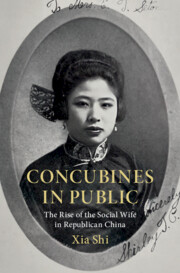
Moving beyond familiar narratives of abolition, Xia Shi introduces the contentious public presence of concubines in Republican China. Drawing on a rich variety of historical sources, Shi highlights the shifting social and educational backgrounds of concubines, showing how some served as public companions of elite men in China and on the international stage from the late nineteenth to the mid twentieth century. Shi also demonstrates how concubines' membership in progressive women's institutions was fiercely contested by China's early feminists, keen to liberate women from oppression, but uneasy about associating with women with such degraded social status. Bringing the largely forgotten stories of these women's lives to light, Shi argues for recognition of the pioneering roles concubines played as social wives and their impact on the development of gender politics and on the changing relationship between the domestic and the public for women during a transformative period of modern Chinese history.
The Old Testament book of Samuel is an intriguing narrative that offers an account of the origin of the monarchy in Israel. It also deals at length with the fascinating stories of Saul and David. In this volume, John Goldingay works through the book, exploring the main theological ideas as they emerge in the narratives about Samuel, Saul, and David, as well as in the stories of characters such as Hannah, Michal, Bathsheba, and Tamar. Goldingay brings out the key ideas about God and God's involvement in the lives of people, and their involvement with him through prayer and worship. He also delves into the mystery and complexity of human persons and their roles in events. Goldingay's study traces how God pursues his purpose for Israel and, ultimately, for the world in these narratives. It shows how this pursuit is interwoven with the realities of family, monarchy, war, love, ambition, loss, failure, and politics.
analyzes events immediately following the death of the eleventh Imam with no apparent offspring. In spite of his strong claim as son of the tenth Imam, Jaʿfar “the Liar” ultimately failed to succeed to his father. Opposing camps generated anti-Jaʿfar propaganda which survives in our sources and can be used to reconstruct key events and early discourses. It is argued that within twenty-four hours of the eleventh Imam’s death, several events of central symbolism for future understandings of the Occultation had occurred, including funerary rituals for the dead Imam; the claim that one of his concubines was posthumously pregnant with his child; and the dispute over the inheritance of the Imam’s property. These events were related to claims for Imamic mediation including claims made for the mother of the dead Imam, Ḥudayth; servants within the household of the Imam; and the concubine pregnant with the Imam’s child.
This chapter explores the intersection of gender, sex, and slavery in the medieval dar al-islam (“the lands of Islam). A background survey is provided for sexual ethics, male social reproduction, and female sexual slavery in these societies that illustrates how Islamic sexual ethics, derived from the Quran, and the Islamic legal understanding of legitimacy were very different from those of Roman law, Christianity, late antique Judaism and seventh century Zoroastrianism. Two central questions of the chapter are how was the status of an enslaved woman defined and whether or not the child of an enslaved woman was born with slave-status. In classical Islamic law, the rule of umm al-walad (“mother of child”) meant that an enslaved woman who bore her Muslim owner a child gave birth to a free born person. The status of umm al-walad thus provided enslaved women with limited opportunities to assert their agency.
Recommend this
Email your librarian or administrator to recommend adding this to your organisation's collection.