To save content items to your account,
please confirm that you agree to abide by our usage policies.
If this is the first time you use this feature, you will be asked to authorise Cambridge Core to connect with your account.
Find out more about saving content to .
To save content items to your Kindle, first ensure no-reply@cambridge.org
is added to your Approved Personal Document E-mail List under your Personal Document Settings
on the Manage Your Content and Devices page of your Amazon account. Then enter the ‘name’ part
of your Kindle email address below.
Find out more about saving to your Kindle.
Note you can select to save to either the @free.kindle.com or @kindle.com variations.
‘@free.kindle.com’ emails are free but can only be saved to your device when it is connected to wi-fi.
‘@kindle.com’ emails can be delivered even when you are not connected to wi-fi, but note that service fees apply.
In recent years, as material culture has become more central to the study of all aspects of the ancient Mediterranean and new materialism has gained greater traction across a variety of academic disciplines, growing numbers of scholars have begun to explore how material objects and notions of materiality feature in Pindar’s work. This chapter offers an introduction to some of the main tendencies of such work. It discusses Pindar’s propensity to speak about his songs in terms normally applied to material crafts, such as weaving or carpentry; the role of tools and instruments in Pindar’s conception of composition and creation, both as applied to song and in a broader sense; the materials of the built environment; Pindar’s relationship with the contexts of his musical performances, real and imaginary; and the earth itself as a significant facet of Pindar’s conception of the material world.
This concluding chapter draws together several strands and original dimensions of Leroi-Gourhan’s technology. Alongside his palaeontological and archaeological research, Leroi-Gourhan also addressed two seemingly contradictory dimensions of techniques: the machine and the artisan. Given his long-standing interest in machines and mechanical devices, including photography, film and also computers, Leroi-Gourhan’s quasi-cybernetic understanding of prehistoric flintknapping is less surprising. Moreover, such a broadly positive attitude towards modern techniques needs to be understood in relation to philosophical and intellectual debates emerging during the post-war years of economic and social reconstruction. While thinkers like Jacques Ellul emphasized the risks of disruption and loss of control associated with modern techniques, Leroi-Gourhan retained, on the whole, his technophile confidence in the cumulative and incremental continuity of techniques, as demonstrated (in his view) across prehistory. This approach also derived from his distinctive Catholic faith and his affinities with the thoughts of Jesuit-palaeontologist Teilhard de Chardin. It embodied his belief in the long-term redemptive capacities of techniques, as evidenced by the plenitude achieved by the artisan of all times who ‘thinks with his fingers’, a crafting Homo faber present in each and every one of us.
This chapter invites consideration of Bloomsbury as the Biography group. It details Bloomsbury’s founding and defining contributions to the “New Biography,” particularly in theoretical and creative works by Harold Nicolson, Virginia Woolf, and the most influential British biographer of the past century, Lytton Strachey. Focusing its attention most carefully on the latter two, it explores how both Woolf and Strachey, as “spiritual” writers of the modernist age (Woolf, “Modern Fiction”), understood biography as a means of revealing personality, while diverging on some essential matters. Woolf, whose initial understanding of biography as an art evolved into a more subdued description of it as (mere) craft, anticipated that this aim might be accomplished through archival assiduity over time by a succession of fact-bound biographers, each bringing a different perspective to facts, old and new. Strachey, for his part, who always considered biography an art form, thought such an aim might be accomplished in the present, using fictional means to reveal both the personality of the nominal biographical subject and the personality of the biographer. This chapter finally reads Strachey as the most important progenitor of biographical fiction.
This chapter seeks to relate the toolmarks observable on sculpted objects to the ways of making and understanding that sustained ancient marble carving as a generative strand of cultural production. The discussion concentrates on the carved lines and planes that came to constitute Athenian stelai as standard material supports for inscribed texts, sculpted figurations, or combinations thereof. It begins by highlighting the contradiction between human creativity and material determinism in previous literature on Greek sculpture and the opportunities that enactive notions of knowledge present for evaluating ancient craft in cross-disciplinary debates about human technicity. The two subsequent sections examine how grooves were carved into planes and what this procedure might reveal about the epistemic affordances of linear marks. The conclusion connects the finished carvings with their origin in quarry-bedded marble blocks to bring out the broader arc of cultural knowledge involved in accommodating natural fissures in stone into the spatial projections of Athens’ evolving monumental landscapes. The exploration was made possible through collaborative replication experiments with a contemporary stone carver, which aimed to foreground lines and planes as mutually dependent phenomena, creating varying ontological conditions for telling things with stone.
Chapter 4 unpacks the complex ways in which claims to craft emerge in speechwriters’ metadiscursive accounts of their work. As theoretical background Mapes considers the ways in which more ordinary instances of language play are necessarily distinct from the “exceptional” creativity which defines speechwriters’ work (see Swann and Deumert 2018). Relatedly, she turns to poetics (e.g. Jakobson 1960) to examine how speechwriters exemplify a spectacular, institutionalized expression of the aesthetic or artistic dimensions of language. The subsequent analysis draws primarily on speechwriter memoirs and interviews to investigate the the microlinguistic choices which characterize speechwriters’ claims to artistry; their emphasis on persuasion as creative practice; and their proclivity for formulating themselves as distinctly neoliberal “bundles of skills” (e.g. Holborrow 2018). This chapter thereby demonstrates how poetics/creativity are used as key status-making strategies by which speechwriters shore up their privilege vis-à-vis peers and other language workers.
Ever since the beginning of opera, the scenografo’s role has fluctuated between invention and execution, conceptual creation and manual realisation. Initially considered an art in the old, Latin sense of the word – a craft or trade – the profession gradually gained social and aesthetic respectability, shedding its associations with the technical skills of artisans and acquiring the prestige of modern artistic expression. By the early 1800s, prominent scenografi were hailed as ‘men of genius’, although their ennoblement was never quite as complete as some renowned commentators seemed to suggest. Indeed, while we may be tempted to view the scenografo’s transformation from craftsman to artist as an uninterrupted, linear development, the debates on operatic staging that accompanied the 1930s Maggio Musicale Fiorentino challenge this inclination.
This article examines the role and status of operatic scenografi in 1930s Italy, with a particular focus on Florence and the intersection between cultural and institutional histories of the profession. What was Italian operatic set design at the time? What did this theatrical art mean, represent, produce in Tuscany’s foremost Renaissance city? Is it possible to develop a specifically urban approach to the history of set design before World War II, and where might this leave our understanding of opera production labour both during the Fascist period and today?
This article seeks to challenge existing understandings of good work. It does so through a critical exploration of recognitive and craft conceptions of work, which are among the richest and most philosophically nuanced of extant accounts. The recognitive view emphasises work’s recognitive value through the social esteem derived from making a valuable social contribution. But by making recognition foundational, it is unable to appreciate the irreducible ethical significance of the objective quality of one’s work activity. The ‘craft ideal,’ by contrast, promises to provide a powerful basis for understanding the importance of rich, rewarding, and morally educative activities, but is undermined by a laudable but misdirected egalitarian impulse which prevents it from being able to properly distinguish good from bad work. One underlying aim of our discussion is to provoke deeper reflection from business ethicists regarding what we might want from an account of good work.
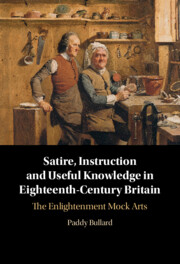
Long before the Industrial Revolution was deplored by the Romantics or documented by the Victorians, eighteenth-century British writers were thinking deeply about the function of literature in an age of invention. They understood the significance of 'how-to' knowledge and mechanical expertise to their contemporaries. Their own framing of this knowledge, however, was invariably satirical, critical, and oblique. While others compiled encyclopaedias and manuals, they wrote 'mock arts'. This satirical sub-genre shaped (among other works) Swift's Gulliver's Travels, Sterne's Tristram Shandy, and Edgeworth's Belinda. Eighteenth-century satirists and poets submitted to a general paradox: the nature of human skilfulness obliged them to write in an indirect and unpractical way about the practical world. As a result, their explorations of mechanical expertise eschewed useable descriptions of the mechanical trades. They wrote instead a long and peculiar line of books that took apart the very idea of an instructional literature: the Enlightenment Mock Arts.
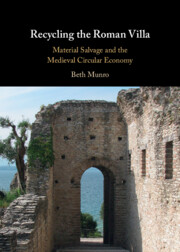
Though abandoned between the third and seventh centuries CE, many Roman villas enjoyed an afterlife in late antiquity as a source of building materials. Villa complexes currently serve as a unique archaeological setting in that their recycling phases are often better preserved than those at urban sites. Building on a foundational knowledge of Roman architecture and construction, Beth Munro offers a retrospective study of the material value of and deconstruction processes at villas. She explores the technical properties of glass, metals, and limestone, materials that were most frequently recycled; the craftspeople who undertook this work, as well as the economic and culture drivers of recycling. She also examines the commissioning landowners and their rural networks, especially as they relate to church construction. Bringing a multidisciplinary lens to recycling practices in antiquity, Munro proposes new theoretical and methodological approaches for assessing architectural salvage and reprocessing within the context of an ancient circular economy.
This chapter examines how movable renderings of animals contributed to sociopolitical experience in Minoan Crete, with close attention to zoomorphic vessels. Beginning in the Prepalatial period, we examine a group of clay body-form vessels that could stand independently. While typically labelled “anthropomorphic,” the vessels’ identities are more complex: their forms do not neatly suggest a particular species, and their affordances as objects are integral to what they are and how they are experienced. Through analysis of their unique corporeal characters and depositional circumstances, I argue that these figures could have been experienced as distinct productive agents, who participated in cultivating community space between Prepalatial tombs and settlements. Next, looking forward, we consider how animalian vessels continued to contribute to Cretan social venues, while subtle changes to how they embodied animals could imply profound shifts in their presence and performance. From the late Protopalatial, we see rhyta rendered as bodiless animal heads, most bovine. Unlike the Prepalatial vessels, these appeared dramatically dependent on living people to become productive, placing emphasis on human action. I contextualize these rhyta with a problematization of palatial-era politico-environmental developments and changes in social performance and “cattle culture.”
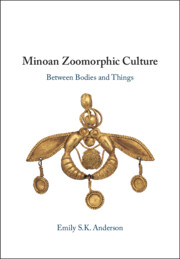
Since the earliest era of archaeological discovery on Crete, vivid renderings of animals have been celebrated as defining elements of Minoan culture. Animals were crafted in a rich range of substances and media in the broad Minoan world, from tiny seal-stones to life-size frescoes. In this study, Emily Anderson fundamentally rethinks the status of these zoomorphic objects. Setting aside their traditional classification as 'representations' or signs, she recognizes them as distinctively real embodiments of animals in the world. These fabricated animals-engaged with in quiet tombs, bustling harbors, and monumental palatial halls-contributed in unique ways to Bronze Age Aegean sociocultural life and affected the status of animals within people's lived experience. Some gave new substance and contour to familiar biological species, while many exotic and fantastical beasts gained physical reality only in these fabricated embodiments. As real presences, the creatures that the Minoans crafted artfully toyed with expectation and realized new dimensions within and between animalian identities.
In ‘Aristotle on the Stages of Cognitive Development’, Thomas Kjeller Johansen examines Aristotle’s contributions to our thinking about concepts from a different perspective, namely in connection to Aristotle’s psychology. He revisits Aristotle’s account of how we acquire universal concepts mainly on the basis of Metaphysics A.1, Posterior Analytics 1.31 and 2.19, and the De Anima. The chapter begins by articulating the following puzzle. On the one hand, Aristotle points out (An. Post. 1.31, 2.19) that we perceive the universal in the particular. On the other, he suggests (Metaph. A.1) that it is only when we have craft and science that we grasp the universal, while perception, memory, and experience all are concerned with the particular. Building on the widespread view that, according to Aristotle, the universal grasped in craft and science is the universal cause, Johansen argues that we should understand perception, memory, and experience teleologically, as stages in the ordering of perceptual information that allows this causal concept to emerge.
In this Element we build on our previous work conceptualizing a craft learning model for governing police discretion. We envision a model for harnessing patrol officers' craft knowledge and skills, learned through experience handling similar street-level encounters over time, to the development of standards for evaluating the quality of their decision-making. To clarify the logic of this model and its potential for police reform, we situate it within the context of other systems of discretion control, including law, bureaucracy, science, and the community. We also consider obstacles. We conclude that police organizations need to balance the different strategies for channeling and controlling discretion toward the goal of advancing more transparent and principled decision-making. The challenge is finding a balance that helps prevent arbitrary, pernicious, or uncompromising uses of police authority, but that also empowers and rewards officers for using the skills of perception and resourcefulness that contribute to wise judgment.
Human beings become scarcer than before in the simile world of the Aeneid, contributing to a tale about the loneliness and sorrow of human beings who struggle to connect with each other or to affect the world around them. Both Aeneas and the characters in the simile world are marked by solitude and isolation. The human characters in the simile world of the Aeneid share few strong ties with other creatures, and they often fail to affect the world around them in ways that their fellows in Greek epic would take for granted. In the story world, similes highlight moments of furor, the overpowering rage that underlies both love and war and threatens not simply Aeneas’ mission to found Rome but also the existence of a rational world order. Similes draw out isolation and overwhelming passion as two poles of emotion in the poem with little in between. They use new storytelling techniques that appear rarely or not at all in the similes of earlier epics, and they often lack an exit expression joining a simile to the story. These features weaken the conventional distinctions between similes and other components of epic narrative.
The simile world of Homer’s Odyssey is teeming with human connections, and family relationships play a central role. This distinctive aspect of the simile world of the Odyssey helps to tell the poem’s tale of human relationships, the burden of sorrow when they are disrupted, and the heroic task of keeping relationships alive through danger, separation, and loss. The Odyssey is not just about Odysseus’ homecoming but also homecoming itself. How do we know when we are truly “home”? What if we reach our home, but we cannot return there? What are the costs of a long absence, both for the person who returns and for those who remain at home? In what way can homecoming be considered a form of heroism? What complex mixture of feelings accompanies a long-awaited return home? The intertwined gladness and sorrow that defines the Odyssey’s tale of homecoming arises from the characters and incidents of the simile world at least as much as from the story of Odysseus and from the process of integrating the two more than from either sort of narrative individually.
Edited by
David Weisburd, Hebrew University of Jerusalem and George Mason University, Virginia,Tal Jonathan-Zamir, Hebrew University of Jerusalem,Gali Perry, Hebrew University of Jerusalem,Badi Hasisi, Hebrew University of Jerusalem
Evidence-based policing (EBP) is perhaps the most significant police reform movement of the last 30 years. Most notable for identifying what does or does not work, and for trying to integrate science into policing, much of EBP’s focus remains on program evaluation methods and investigating crime prevention strategies. This vision for policing often characterizes the craft of police work as an obstacle rather than a useful contributor to science. This is changing, as proponents of EBP begin to embrace a wider variety of methods to assess a broader range of outcomes, and to treat both science and experience as necessary elements of successful police reform. In this chapter, we recommend that EBP focus more attention on assessing the choices that patrol officers make in their everyday encounters with the public. Drawing on a case study of a neighbor dispute, we show how EBP could benefit from listening to practioners and learning what their rich experiences have taught them about how best to respond. We also suggest ways that research might help generate knowledge on the essential normative or moral questions that characterize street-level discretion, and thus combine knowledge about what works with knowledge about doing the right thing.
The products of Artefaction are not just made things but making things. Included in this class are tangible things with a capacity for rhetorical performance – for example a statue or a flag – as well as intangible things, of which the preeminent example is the word. Where words combine in sentences and in speech, they can attain monumental status and influence. Contemplating Edmund Burke’s Reflections on the Revolution in France, in which Burke argued that a word like ‘freedom’ is only as good as the use to which it is put, Richard Dawson observes that for Burke, words are ‘evolving cultural artefacts that shape us and are shaped by us as we use them’. This serves as an excellent definition of the Making Sense informing the term ‘Artefaction’ as it is used in this chapter, as does James Boyd White’s idea (as summarized by Dawson) that language is ‘an evolving cultural artefact for making and remaking ourselves and our world – the real world’. In defence of ‘underwater basket weaving’, this chapter turns to material culture to consider the relationship between the weaving of words and such handcrafts as the weaving of baskets.
Jeffrey Gore’s entry on technē offers a survey of diverse workers throughout Shakespeare’s writing: artisans, lawyers, medical doctors, and educators. It situates the Greek word technē – meaning “technical expertise,” “craft,” or “skill” – within Aristotle’s intellectual virtues in the Nicomachean Ethics as both a pedagogical model (“the craft analogy”) and a marker of social class among different laborers, from “leather apron” craftspeople to elite Latin learners and modern teachers of the liberal arts. In brief accounts of Hannah Arendt’s and Alasdair MacIntyre’s writings on Aristotle, the entry addresses how technē was often believed incompatible with some ancient and early modern notions of citizenship and demonstrates how many of Shakespeare’s characters – such as the “rude mechanicals” in A Midsummer Night’s Dream – challenge us to understand the role of craft in facilitating artistic expression and strengthening political community.
Drawing from Michel Foucault’s reading of Immanuel Kant’s essay “What is Enlightenment?,” and specifically his definition of ascesis, we associate maturity with a capacity for, and interest in, forming the self. On the basis of an empirical study of making vinyl records following the successful commercialization of digital media, we identify micro-disciplinary techniques of self-forming that emerge as enthusiasts steadily learn the craft of vinyl record manufacturing. It is, we argue, through technology, rather than against it, that organizational immaturity can be resisted. Craftwork involves testing and transforming, rather than just acquiring, traditional skills. Maturity involves an ongoing struggle of selectively and reflectively engaging with technologies via attempts to be the subject of one’s own subjection. The former contributes to the latter.
Offering an intimate history of how small things were used, handled, and worn, this collection shows how objects such as mugs and handkerchiefs were entangled with quotidian practices and rituals of bodily care. Small things, from tiny books to ceramic trinkets and toothpick cases, could delight and entertain, generating tactile pleasures for users while at the same time signalling the limits of the body's adeptness or the hand's dexterity. Simultaneously, the volume explores the striking mobility of small things: how fans, coins, rings, and pottery could, for instance, carry political, philosophical, and cultural concepts into circumscribed spaces. From the decorative and playful to the useful and performative, such small things as tea caddies, wampum beads, and drawings of ants negotiated larger political, cultural, and scientific shifts as they transported aesthetic and cultural practices across borders, via nationalist imagery, gift exchange, and the movement of global goods.