To save content items to your account,
please confirm that you agree to abide by our usage policies.
If this is the first time you use this feature, you will be asked to authorise Cambridge Core to connect with your account.
Find out more about saving content to .
To save content items to your Kindle, first ensure no-reply@cambridge.org
is added to your Approved Personal Document E-mail List under your Personal Document Settings
on the Manage Your Content and Devices page of your Amazon account. Then enter the ‘name’ part
of your Kindle email address below.
Find out more about saving to your Kindle.
Note you can select to save to either the @free.kindle.com or @kindle.com variations.
‘@free.kindle.com’ emails are free but can only be saved to your device when it is connected to wi-fi.
‘@kindle.com’ emails can be delivered even when you are not connected to wi-fi, but note that service fees apply.
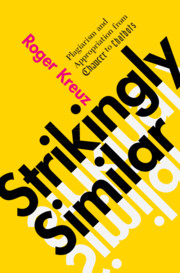
Plagiarism and appropriation are hot topics when they appear in the news. A politician copies a section of a speech, a section of music sounds familiar, the plot of a novel follows the same pattern as an older story, a piece of scientific research is attributed to the wrong researcher… The list is endless. Allegations and convictions of such incidents can easily ruin a career and inspire gossip. People report worrying about unconsciously appropriating someone else's work. But why do people plagiarise? How many claims of unconscious plagiarism are truthful? How is plagiarism detected, and what are the outcomes for the perpetrators and victims? Strikingly Similar uncovers the deeper psychology behind this controversial human behavior, as well as a cultural history that is far wider and more interesting than sensationalised news stories.
Is it possible to appropriate the words or ideas of others without realizing it? Some authors, such as Robert Louis Stevenson, accused themselves of committing plagiarism (he came to believe he had appropriated much of “Treasure Island” from other authors). But some who have been accused of plagiarism, including Helen Keller, have pushed back strongly against such a charge, offering up unconscious appropriation as an excuse. Musicians have also been accused of this, and the famous case of ex-Beatle George Harrison is described in detail. Relying on a previous ruling known as the subconscious copying doctrine, the judge in Harrison’s case ruled that his copying had been done without conscious awareness but that he was still culpable. Experimental psychologists have been able to induce research participants into appropriating the responses of other participants without conscious awareness, suggesting that this phenomenon is real and not just a defense offered up by those accused of plagiarism. This can be explained as a failure of source monitoring, in which ideas that originated in the minds of others become confused with the products of one’s own cognitive processes.
Recommend this
Email your librarian or administrator to recommend adding this to your organisation's collection.