To save content items to your account,
please confirm that you agree to abide by our usage policies.
If this is the first time you use this feature, you will be asked to authorise Cambridge Core to connect with your account.
Find out more about saving content to .
To save content items to your Kindle, first ensure no-reply@cambridge.org
is added to your Approved Personal Document E-mail List under your Personal Document Settings
on the Manage Your Content and Devices page of your Amazon account. Then enter the ‘name’ part
of your Kindle email address below.
Find out more about saving to your Kindle.
Note you can select to save to either the @free.kindle.com or @kindle.com variations.
‘@free.kindle.com’ emails are free but can only be saved to your device when it is connected to wi-fi.
‘@kindle.com’ emails can be delivered even when you are not connected to wi-fi, but note that service fees apply.
July 1914 escalates because of a deterrence failure. Germany and Russia were playing a game of chicken. The kaiser stood firm; he believed that Russia was not prepared for war and would therefore back down. The tsar likewise stood firm; he vowed not to back down again after the Bosnian Crisis – and he thought that Germany would ultimately back down because it would not want to fight the combined power of Russia, France, and the United Kingdom. With neither side yielding, the crisis continued to escalate. A second dynamic contributed to escalation as well. At some point – probably on July 30 – the actors changed strategy. Instead of using coercion to deter their opponent, they started taking coercive measures to increase the likelihood that they would win a war, if one began. Each side mobilized, and mobilization led to war. Beneath all this lay rivalry and the repetition of crises between the major states. Finally, once war broke out between Germany and Russia, the alliance structure caused the war to spread rapidly. From this crisis, we learn many lessons, including that a balance of power and relatively equal military capabilities are associated with war onset; they do not prevent war.
The Munich conference notoriously symbolizes appeasement and its failure. The issue under dispute concerns territory – specifically, the Sudetenland. This territorial dispute was initially internal to Czechoslovakia, a disagreement between the Sudetenland Germans and the central government of Czechoslovakia. Eventually, however, the nationalistic element to the dispute brought in the German government. The major powers avoided war because the French and British prime ministers – Daladier and Chamberlain, respectively – forced the Czechoslovakian president, Benes, to accept the peaceful transfer of the Sudetenland to Germany, based on the norm of nationalism (or self-determination). As this case shows, when actors widely agree on the norms through which territory can change hands, the probability of war declines. Nevertheless, this peace was short-lived. Indeed, the afterword to the chapter describes how Hitler invaded Prague shortly thereafter. The Danzig–Poland crises then followed. By that point, Britain and France had abandoned appeasement and shifted to balancing against Hitler; they allied with Poland and gave Hitler an ultimatum to try to stop his invasion. This conventional deterrence failed, and the Second World War began in Europe.
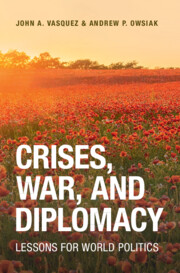
Why do some international crises between major states escalate to war while others do not? To shed light on this question, this book reviews fifteen such crises during the period 1815–present, including the Crimean War, The Franco-Prussian War, the Cuban Missile Crisis, and the 2022 Russia-Ukraine War. Each chapter places the crisis at hand in its historical context, provides a narrative of the case's events that focuses on the decision-makers involved, theoretically analyses the case's outcome in light of current research, and inductively draws some lessons from the case for both scholars and policymakers. The book concludes by exploring common patterns and drawing some broader lessons that apply to the practice of diplomacy and international relations theory. Integrating qualitative information with the rich body of quantitative research on interstate war and peace, this unique volume is a major contribution to crisis diplomacy and war studies.
Recommend this
Email your librarian or administrator to recommend adding this to your organisation's collection.