To save content items to your account,
please confirm that you agree to abide by our usage policies.
If this is the first time you use this feature, you will be asked to authorise Cambridge Core to connect with your account.
Find out more about saving content to .
To save content items to your Kindle, first ensure no-reply@cambridge.org
is added to your Approved Personal Document E-mail List under your Personal Document Settings
on the Manage Your Content and Devices page of your Amazon account. Then enter the ‘name’ part
of your Kindle email address below.
Find out more about saving to your Kindle.
Note you can select to save to either the @free.kindle.com or @kindle.com variations.
‘@free.kindle.com’ emails are free but can only be saved to your device when it is connected to wi-fi.
‘@kindle.com’ emails can be delivered even when you are not connected to wi-fi, but note that service fees apply.
A view of corruption as disembedded from society and history is predominant today. In this view, corruption is basically the same thing everywhere and inherently a bad thing because it gets in the way of proper processes. In opposition to this view, we argue for understanding corruption as socially and historically embedded. While there are many viable ways to embed corruption, we advocate a comparative historical sociology of corruption in particular. This approach has in mind a view of corruption as “a moving object,” that is, as subject to variation across social space and transformation over time. It focuses on the processes through which a course of action is worked out in relation to historically specific structural conditions. By tracing these processes and embedding “corrupt” practices in the situations where they were developed and make sense, we gain a deeper understanding of these practices and are in a better position to evaluate them.
This chapter analyses the presentation of space in relation to the story narrated in the two Homeric epics. Tsagalis’ study is divided into two parts: in the first, he explores simple story space, i.e. how the narrator views the space in which the plot is unravelled in both the Iliad and the Odyssey. In the second part, he treats embedded story space, i.e. the way characters, functioning as thinking agents with stored experiences, perceive what is taking place in the story-world. The structure of this chapter locates and highlights for the readers the similarities and differences between the Iliad and the Odyssey with respect to these two categories of space and suggests the ways in which these categories could be taken up and manipulated by later proponents of the genre.
Edited by
Fiona Kelly, La Trobe University, Victoria,Deborah Dempsey, Swinburne University of Technology, Victoria,Adrienne Byrt, Swinburne University of Technology, Victoria
In recent decades, a number of jurisdictions have moved towards more open practices in donor conception, including legislating for the rights of donor-conceived people to trace their donor. In such contexts, the donor’s role is ambivalent. They are not expected to enact a parental role in relation to people conceived from their donation. However, they are expected to ‘be available’ for some form of relationship. Our UK-based research found that donors typically navigate these dual obligations by articulating a moral commitment to ‘following the lead’ of the families they help to create and particularly the people conceived from their donation. In this chapter, we illustrate how sperm and egg donors imagine and enact this commitment but also show that it is easier to say than to do. The embedded nature of donors’ personal lives and relationships create challenges in letting others decide their role in relation to recipient families.
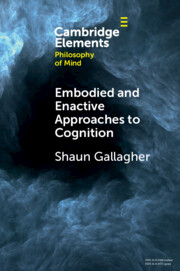
This Element discusses contemporary theories of embodied cognition, including what has been termed the '4Es' (embodied, embedded, extended and enactive cognition). It examines diverse approaches to questions about the nature of the mind, the mind's relation to the brain, perceptual experience, mental representation, sense making, the role of the environment, and social cognition, and it considers the strengths and weaknesses of the theories in question. It contrasts embodied and enactive views with classic cognitivism, and discusses major criticisms and their possible resolutions. This element also provides a strong focus on enactive theory and the prospects for integrating enactive approaches with other embodied and extended theories, mediated through recent developments in predictive processing and the free energy principle. It concludes with a brief discussion of the practical applications of embodied cognition. This title is also available as Open Access on Cambridge Core.
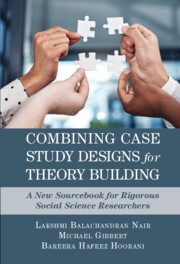
Case study research is a versatile approach that allows for different data sources to be combined, with its main purpose being theory development. This book goes a step further by combining different case study research designs, informed by the authors' extensive teaching and research experience. It provides an accessible introduction to case study research, familiarizes readers with different archetypical and sequenced designs, and describes these designs and their components using both real and fictional examples. It provides thought-provoking exercises, and in doing so, prepares the reader to design their own case study in a way that suits the research objective. Written for an academic audience, this book is useful for students, their supervisors and professors, and ultimately any researcher who intends to use, or is already using, the case study approach.
In the Anthropocene, earth system governance must be effective both within and across identities, and the inescapable equivocality of democratic governance means that discussions can never be closed but merely transformed as old problems and concerns give way to new.The experimental quality that effective environmental governance must possess cannot be a transient quality but, rather, must be a permanent feature of the landscape of democratic decision-making, in which success is realized in a context of identity politics.To take place without distortion and without posing systemic disadvantage, and for intergroup differences to be accommodated, substantial equality of access to decision-making and equitable allocation of fundamental capabilities are essential prerequisites.Institutional arrangements must provide for empowerment of those whose identities are otherwise ill-favored and the embeddedness of environmental decision-making in the communities of fate where people actually determine their shared life experiences.
More than just democracy in the form of aggregation of votes, deliberative democratic practice makes possible the learning, local knowledge, and engagement required by enlightened environmental governance under the conditions associated with the concept of the Anthropocene.
In thispaper we find many families in the product space ℍ2×ℝ of complete embedded, simply connected, minimal and surfaces with constant mean curvature H such that |H|≤1/2. We study complete surfaces invariant either by parabolic or by hyperbolic screw motions. We study the notion of isometric associate immersions. We exhibit an explicit formula for a Scherk-type minimal surface. We give a one-parameter family of entire vertical graphs of mean curvature 1/2. We prove a generalized Bour lemma that can be applied to ℍ2×ℝ,𝕊2×ℝ and to Heisenberg’s space to produce a family of screw motion surfaces isometric to a given one.
Recommend this
Email your librarian or administrator to recommend adding this to your organisation's collection.