To save content items to your account,
please confirm that you agree to abide by our usage policies.
If this is the first time you use this feature, you will be asked to authorise Cambridge Core to connect with your account.
Find out more about saving content to .
To save content items to your Kindle, first ensure no-reply@cambridge.org
is added to your Approved Personal Document E-mail List under your Personal Document Settings
on the Manage Your Content and Devices page of your Amazon account. Then enter the ‘name’ part
of your Kindle email address below.
Find out more about saving to your Kindle.
Note you can select to save to either the @free.kindle.com or @kindle.com variations.
‘@free.kindle.com’ emails are free but can only be saved to your device when it is connected to wi-fi.
‘@kindle.com’ emails can be delivered even when you are not connected to wi-fi, but note that service fees apply.
This Chapter emphasizes the centrality of voice and ear in the oral cultures and theatrical enterprises of early modern England. It further demonstrates that the sound of the voice and the act of listening are especially important in the works of William Shakespeare. To prepare the reader for an in-depth exploration of the significance of voice and vocality in five of Shakespeare’s late plays, the Chapter reviews important work in the fields of sound studies and ethical criticism. It then provides an introduction to the philosophical thought of Emmanuel Levinas and Adriana Cavarero, whose work provides the theoretical basis for the analysis that follows.
Breaking new ground in Shakespearean sound studies, Kent Lehnhof draws scholarly attention to the rich ethical significance of the voice and vocality. Less concerned with semantics, stylistics, and rhetoric than with the sensuous, sonorous, and somatic dimensions of human speech, Lehnhof performs close readings of five plays – Coriolanus, King Lear, Pericles, The Winter's Tale, and The Tempest – to demonstrate how Shakespeare's later works present the act of speaking and the sound of the voice as capable of constructing, deconstructing, and reconstructing interpersonal relationships and obligations. By thinking widely and innovatively about the voice and vocality, Lehnhof models a fresh form of philosophically-minded criticism that resists logocentrism and elevates the voices of marginalized groups and individuals including women, members of societal “underclasses”, racialized persons and non-humans.
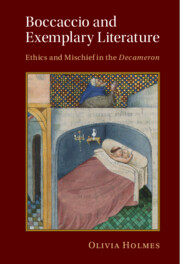
This is the first monograph to provide a comprehensive interpretation of the Decameron's response to classical and medieval didactic traditions. Olivia Holmes unearths the rich variety of Boccaccio's sources, ranging across Aesopic fables, narrative collections of Islamicate origin, sermon-stories and saints' lives, and compilations of historical anecdotes. Examining the Decameron's sceptical and sexually permissive contents in relation to medieval notions of narrative exemplarity, the study also considers how they intersect with current critical assertions of fiction's power to develop empathy and emotional intelligence. Holmes argues that Boccaccio provides readers with the opportunity to exercise both what the ancients called 'Ethics,' and our contemporaries call 'Theory of Mind.' This account of a vast tradition of tale collections and its provocative analysis of their workings will appeal to scholars of Italian literature and medieval studies, as well as to readers interested in evolutionary understandings of storytelling.
Recommend this
Email your librarian or administrator to recommend adding this to your organisation's collection.