To save content items to your account,
please confirm that you agree to abide by our usage policies.
If this is the first time you use this feature, you will be asked to authorise Cambridge Core to connect with your account.
Find out more about saving content to .
To save content items to your Kindle, first ensure no-reply@cambridge.org
is added to your Approved Personal Document E-mail List under your Personal Document Settings
on the Manage Your Content and Devices page of your Amazon account. Then enter the ‘name’ part
of your Kindle email address below.
Find out more about saving to your Kindle.
Note you can select to save to either the @free.kindle.com or @kindle.com variations.
‘@free.kindle.com’ emails are free but can only be saved to your device when it is connected to wi-fi.
‘@kindle.com’ emails can be delivered even when you are not connected to wi-fi, but note that service fees apply.
Chapter 4 explores the construction and performance of poetic selfhood in Keats’s letters – and argues that it is in part through letter-writing itself that John Keats becomes a poet. It is in and through letters as much as through the writing of poems that Keats invented for himself a poetic identity (a ‘poetical Character’, as he would call it). The chapter begins by examining Keats’s construction of a poetic self in a number of letters written between April and May 1817 to two mentor-friends, Leigh Hunt and Benjamin Robert Haydon. It then moves to an examination of a cluster of formative letters to and from Keats in the late summer and autumn of 1818, culminating in the presentation of his idea of the poet as ‘camelion’ – as responding to circumstances and changing environments, and ideally as having no ‘identity’ – in a famous letter of October 1818 to Richard Woodhouse.
A wealth of primary sources documents Vasari’s meticulous planning for his posthumous commemoration, his death, and his heirs’ execution of his final wishes. This final chapter explores Vasari’s death and the fate of his earthly remains, as well as the unique place his high altar for the Pieve occupies within the tradition of funerary monuments and chapels made by and for early modern Italian artists and architects. As the largest and principal altar of one of Arezzo’s most prestigious churches and the site of Vasari’s burial, it is nothing less than the most personal work of his long and prolific artistic career. Its alienation in the nineteenth century from the church for which it was made and nearly all of the other works with which Vasari intended it to be seen, however, has long obscured its significance.
This chapter shows how Minerva authors championed the Press, taught readers how to read them and helped to shift the culture in proto-Victorian ways. It collects together the solutions that women authors proposed to the range of domestic, social and political issues they tackled, argues that their iterative imitations created a community of readers, as well as of writers, and evaluates Minerva Press fiction by the Aesthetics of Reuse.
While Ginsberg was certainly influenced by earlier generations of writers stretching back to the Metaphysical Poets, contemporary writers were also instrumental in helping him craft his own poetic vision. Foremost among them was his friend Jack Kerouac, who became a source of inspiration, guidance, and mentorship for Ginsberg throughout his life. This chapter explores the twenty-five years of profound yet tumultuous relationship that developed between the two writers, from their encounter in New York City in 1944 to Kerouac’s death in 1969. While their passionate and sometimes turbulent friendship sparked Ginsberg’s creative energy, Ginsberg drew heavily on Kerouac’s themes and stylistics – including his writing method of “spontaneous prose” – which became central to his own poetical voice. Though their relationship eventually fractured in the 1960s owing to political differences and rivalry, Kerouac continued to play a crucial role in shaping Ginsberg’s growth both as a writer and as an individual.
This chapter examines the Italian humanist discourse on vocation in terms of two intersecting binaries: on the one hand, the competing demands of shame culture (as in Cicero’s De officiis) and guilt culture (as in Augustine’s Confessions); on the other, the interplay between individual humanists and the status and expectations of their families. The result was the first substantive articulation of the concept of secular vocation.
The notion of making it big has different meanings for different people. Sometimes it is a precise moment in time when everything clicks. Other times, it can be a slow process. And sometimes, a big break that took many years can look like an overnight sensation to the outside world. People in this chapter talk about how the creative life isn’t always about fame and acclaim.
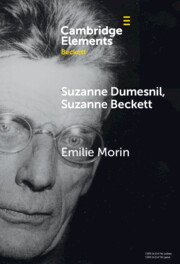
Little has been written about Suzanne Beckett, née Déchevaux-Dumesnil (1900–1989). As Samuel Beckett's lifelong companion, she found herself in a peculiar quandary, owing to the amounts of support required by Beckett's unease with success and with the business of writing, and owing to her deep awareness of the damage that fame can cause to everyday life, friendships, and freedom. This Element offers the first full portrait of this elusive figure. It contextualises the texts she wrote under the name Suzanne Dumesnil, emphasises the significance of her artistic and literary accomplishments, and discusses her steady labour, her uncompromising discretion, and her profound reluctance to ever become a public figure as Beckett's wife.
This short introduction establishes the argument of the book: namely, that “greatness” in American culture is a useful tool to address “change.” The introduction also situates the importance of this history in contemporary discourse and situates the research in the fields of American Studies and Fame Studies.
Americans love to talk about 'greatness.' In this book, Zev Eleff explores the phenomenon of 'greatness' culture and what Americans really mean when they talk about greatness. Greatness discourse provides a uniquely American language for participants to discuss their 'ideal' aspirational values and make meaning of their personal lives. The many incarnations and insinuations of 'greatness' suggest more about those carrying on the conversation than they do about those being discussed. An argument for Abraham Lincoln or Franklin D. Roosevelt over George Washington as America's greatest statesman says as much about the speaker as it does about the legacies of former US presidents. Making a case for the Beatles, Michael Jordan, or Mickey Mouse involves the prioritization of politics and perspectives. The persistence of Henry Ford as a great American despite his toxic antisemitism offers another layer to this historical phenomenon. Using a variety of compelling examples, Eleff sheds new new light on “greatness” and its place in American culture.
War and Empire’ examines Goldsmith’s commentaries on colonial and national conflicts, wars of expansion and disasters in foreign fields, exploring two related concerns: the falling status of the ‘event’ in the historiographical and political imagination, and the decline, as he saw it, of ‘great men’. The chapter provides clear details of the major conflicts which occurred during Goldsmith’s lifetime: the War of the Austrian Succession (1740–8; including the War of Jenkins’s Ear); the Seven Years’ War (1756–63), by far the most important; and finally the mounting crisis in the American colonies, its final trajectory discernible even when Goldsmith died in 1774.
This chapter turns to anxieties about the motivations of crusaders, focusing on the romance of Guy of Warwick. In fourteenth-century Europe, an ideology of “chivalric crusading” that sought to harmoniously combine courtly love, worldly self-advancement, and service to God gained wide popularity, disseminated by works such as Guillaume de Machaut’s La Prise d’Alixandre and the Livre des fais of Marshal Boucicaut. But this ideology was not without its critics: writers including John Gower, Philippe de Mézières, and Henry of Grosmont seized upon the notion of crusading as love-service to articulate complex critiques of the worldly ambitions of crusaders. Guy of Warwick intervenes in this debate by exploring the practical and experiential implications of fighting for worldly love and pious motives.
Chapter Ten analyzes Will Rogers the private individual. Looking at the real person behind the celebrity entertainer and writer, it focuses on several personal qualities that defined his adult life. He manifested a great loyalty to his wife, four children, and the idea of family. He maintained his rural roots, sustaining a lifelong attraction to riding and roping, horses and cattle that culminated in his beloved ranch domicile outside Los Angeles. He developed a cadre of close friends from the worlds of entertainment, journalism, and politics. Possessed of abundant nervous energy, he became addicted to travel, both nationally and globally. A man of common tastes in food, clothing, and entertainent, he nonetheless harbored an intense desire to succeed. At the deepest level, Rogers displayed a certain bifurcated quality: essentially reserved, earnest, moody, and sometimes ill-at-ease in private, but tranforming into a witty, charming entertainer and pundit when dealing with a group. Thus the private man balanced an authentic, common man persona with the popular, down-home, humorous image of "Will Rogers" that he crafted throughout his adult life.
This chapter examines Kerouac’s later novels such as Big Sur, Satori in Paris, Desolation Angels, and Vanity of Duluoz, showing how he developed a “late style” that was a response to the way his image and writing were commodified by popular and literary culture. These late novels portray the author-narrator as out of step with a culture that has passed him by, as Kerouac suggests the ways his fame as the so-called “King of the Beatniks” led to both his increasing alcoholism, and to new ways of looking at himself in his writing.
In ancient Greek culture of all periods, the notion of kleos is linked in a fundamental way to the poet’s voice, and no adequate discussion of that voice could ignore this topic. Itranslate kleos by ’fame’, ’glory’ or ’renown’, but some further glossing of this complex term is immediately necessary. Kleos is etymologically and semantically related to the verb kluo (’I hear’) – kleos is ’that which is heard’, ’a report’, even ’rumour’. So Telemachus, when he returns to Ithaca, asks Eumaeus for the kleos from town. Kleos is applied to what people talk (of), and an object like Nestor’s shield has a ’kleos which reaches heaven’, and heroes’ armour is often described as kluta (’with kleos’, ’talked of’). ’Things, places and persons acquire kleos as they acquire an identity in the human world, as stories are told about them.’
When Ilf and Petrov visited the recently completed Boulder Dam, they took surprisingly little notice of the workers or their working conditions. What troubled them was the fact that no one in America knew the names of those who constructed the “biggest dam in the world.” Chapter 21 argues that this failure to accord the builders their due provided Ilf and Petrov with a means of at once praising American technology and criticizing American capitalism. They contrasted Boulder Dam with an imagined Soviet Boulder Dam that would generate both electricity and heroes of socialist labor. Their tour guide at the dam, GE engineer Charles John Thomson, was well positioned to help them draw such comparisons. In charge of installing the generating turbines at Boulder Dam, he had received the Order of the Red Banner of Labor for doing the same job at Dneprostroi.
Chapter 9 argues that Staël saw a Faustian bargain in Corinne ou l’Italie, took it, and paid the price; its triumphs and failures thus stand or fall together. What Staël gained was mythic power; what she lost was the ability to control its fate. Corinne’s political impact in Europe and America, standing as it does at the birth of modern nationalism, is both real and unquantifiable – witness the coinage nationalité, part of the larger impact of Staël’s ideas on national genius, reflected in Blackwood’s praise of her in 1818 as the creator of the science of nations. The novel’s esthetic impact on a century of readers is both fascinating and somewhat easier to assess, an invitation to future study already made in 1825 by Stendhal in a remark from Racine et Shakespeare: “Je ne vois réellement que Corinne qui ait acquis une gloire impérissable sans se modeler sur les anciens.”
Chapter Six focuses on T-Bone Slim (real name Matti Valentinepoika Huhta), a second-generation Finnish-American hobo who became the IWW’s most popular and influential writer. In hisnewspaper columns and songs, Slim represented the hobo not only as a worker, as Anderson had, but also as the revolutionary vanguard of a post-capitalist society. He parodies mainstream and conservative ideas about work, hobos, and the working class more generally. He challenges the common stereotype of hobos and tramps as being unintelligent through wit and verbal dexterity that assumes intelligence in his transient audience. He uses puns, neologisms and dynamic wordplay to involve his readers in the process of making meaning. In doing so, he creates a mode of literary genius that is communal rather than individualistic, and which in turn allows him to challenge mainstream understandings of literary success. The chapter shows how Slim brings his body and the bodies of his working-class readers into his writing by representing hunger as a defining class experience.
This chapter examines the relationship between Wallace’s writing and works of visual art. Beginning with the many moments of ekphrasis that punctuate the writing, ranging from myths of tapestry-weaving to Leutze’s mural of Manifest Destiny, encompassing Bernini and Escher in Infinite Jest alone, this chapter explores the ways in which Wallace makes use of the language of images in his writing, situating narrative in conversation with visual culture and reaching beyond language to image, color and texture. Reflecting on prior scholarly attention to art positioned in Wallace’s writing, the chapter explores the connections between attention and aesthetic. The chapter also examines the ways in which visual cues appear in other ways in Wallace’s work, from the defecatory art of Brint Moltke in “The Suffering Channel” to the incidence of color as a motif throughout the work, specifically Wallace’s insistent references to clothing. The chapter highlights the materiality of these instances, attending to both the visual and the haptic elements of his narrative deployment of art in fictional worlds. This chapter works in concert with the next, delineating the intermediate nature of Wallace’s writing, poised between language, sense and image, and how his inclusion and occlusion of art recalibrate and reflect the relationships between author and reader.
Examining Hughes’s interest in Ebony magazine as a context informing his approach to writing at mid-century, this chapter explores the intersections aesthetically and politically between the landscape of popular journalism and Hughes’s work for the young. In Famous American Negroes (1954) and Famous Negro Music Makers (1955), Hughes combines photography and narrative to demonstrate the economic, political, and creative accomplishments of Black Americans. Hughes’s approach to the designation of “famous” as a marker of Black accomplishment corresponds to the method of Ebony in deploying public recognition and singularity as signs of civil rights progress, a strategic approach during the Cold War, during which straightforward assertions of dissatisfaction with American ideals could appear dangerous. By focusing on notoriety, Hughes picks up on the mode dominant in Ebony magazine but elaborates and complicates its tendencies. In the books’ depiction of music, Hughes articulates a resistant approach to the singularity of celebrity biography.
A central feature of being a celebrity is experiencing a divide between one's public image and private life. By appealing to the phenomenology of Sartre and Merleau-Ponty, we analyze this experience as paradoxically involving both a disconnection and alienation from one's public persona and a sense of close connection with it. This ‘uncanny’ experience presents a psychological conflict for celebrities: they may have a public persona they feel alienated from and that is at the same time closely connected to them and shapes many of their personal interactions. We offer three ways in which a celebrity might approach this conflict: (i) eradicating the divide between their public and private selves, (ii) splitting or separating their private and public selves, or (iii) embracing the arising tension. We argue that it is only this third approach that successfully mitigates the negative effects of the alienation felt by many celebrities.