To save content items to your account,
please confirm that you agree to abide by our usage policies.
If this is the first time you use this feature, you will be asked to authorise Cambridge Core to connect with your account.
Find out more about saving content to .
To save content items to your Kindle, first ensure no-reply@cambridge.org
is added to your Approved Personal Document E-mail List under your Personal Document Settings
on the Manage Your Content and Devices page of your Amazon account. Then enter the ‘name’ part
of your Kindle email address below.
Find out more about saving to your Kindle.
Note you can select to save to either the @free.kindle.com or @kindle.com variations.
‘@free.kindle.com’ emails are free but can only be saved to your device when it is connected to wi-fi.
‘@kindle.com’ emails can be delivered even when you are not connected to wi-fi, but note that service fees apply.
On 23 August 1939, Hitler and Stalin agreed to a treaty of non-aggression, paving the way for the outbreak of war in Europe. Though this Nazi-Soviet Pact stunned contemporary observers, this chapter argues that the decision for partnership – and the military, economic, and intelligence cooperation it portended – had a long prehistory. Here, the Soviet-German relationship is traced from its inception in 1917 through Germany’s invasion of the USSR in 1941. It focuses on four distinct periods: early contacts during and immediately following the First World War, the Rapallo era of extensive cooperation between 1921 to 1933, the collapse of the Soviet-German relationship after 1933, and the resumption of partnership in 1939 with the Molotov-Ribbentrop Pact. This chapter concludes that the two periods of Soviet-German cooperation were ultimately decisive factors in the breakdown of the post-war European status quo.
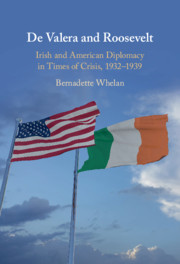
How did Irish and American diplomacy operate in Washington DC and Dublin during the 1930s era of economic depression, rising fascism and Nazism? How did the Anglo–American relationship affect American–Irish diplomatic relations? Why and how did Éamon de Valera and Franklin D. Roosevelt move their countries towards neutrality in 1939? This first comprehensive history of American and Irish diplomacy during the 1930s focuses on formal and informal diplomacy, examining all aspects of diplomatic life to explain the relationship between the two administrations from 1932 to 1939. Bernadette Whelan reveals how diplomats worked on behalf of their governments to implement Franklin D. Roosevelt and Éamon de Valera's foreign policies – particularly when Éamon de Valera believed in the existence of a 'special' transatlantic relationship but Franklin D. Roosevelt increasingly favoured a strong relationship with Britain. Drawing on a wide range of under-used sources, this is a major new contribution to the history of American and Irish diplomacy and revises our understanding of the importance of Ireland to a US administration.
Recommend this
Email your librarian or administrator to recommend adding this to your organisation's collection.