To save content items to your account,
please confirm that you agree to abide by our usage policies.
If this is the first time you use this feature, you will be asked to authorise Cambridge Core to connect with your account.
Find out more about saving content to .
To save content items to your Kindle, first ensure no-reply@cambridge.org
is added to your Approved Personal Document E-mail List under your Personal Document Settings
on the Manage Your Content and Devices page of your Amazon account. Then enter the ‘name’ part
of your Kindle email address below.
Find out more about saving to your Kindle.
Note you can select to save to either the @free.kindle.com or @kindle.com variations.
‘@free.kindle.com’ emails are free but can only be saved to your device when it is connected to wi-fi.
‘@kindle.com’ emails can be delivered even when you are not connected to wi-fi, but note that service fees apply.
Chapter 5 assesses the patronage and use of books in the late ninth and early tenth centuries. The following case studies are discussed: two earlier Anglo-Saxon prayerbooks (the Book of Cerne and Book of Nunnaminster) to which new material was added, a new volume of Latin hagiographies (Paris, Bibliothèque nationale de France, lat. 5574), and a Carolingian manuscript to which several additions were made by English-trained scribes (London, British Library, Cotton Vespasian D. xiv, fols. 170–224). Engagement with these books took place in diverse settings, some of which were more informal than one might expect. The motivations for such activity are assessed too. These case studies pave the way for a holistic assessment of the contemporary manuscript corpus. Physical qualities, texts and languages are considered, as are the possible settings in which books were produced and used. Attention is drawn to the evidence for female book use, and to the importance of international networks. Continuities with earlier decades are acknowledged, as are new developments, including a more pronounced association between books and bishops. The chapter closes with a call to remain open-minded about this book culture’s range of social contexts and participants.
Chapter 6 is the first of four chapters to consider one element of the Dominican liturgy, focussing here on the thirteenth-century development of the calendar of saints’ feasts. This chapter draws on the sanctoral cycles from books for the mass and office that survive from the earliest years of the Dominican order and from the initial revision of the Dominican liturgy by a commission of four friars. It compares these with the sanctoral cycle of Humbert of Romans’ final revision of the liturgy, as recorded in three exemplars: Rome, Santa Sabina, XIV L 1; London, British Library, Add. 23935; and Salamanca, San Esteban, SAL.–CL.01. Five distinct stages are identified, including a previously unknown period of unofficial revision prior to the commission of the four friars. Various trends are identified regarding the types of feasts that were added to, removed from, promoted and/or relegated in the Dominican calendar over the course of the revision. The final portion of the chapter examines how certain tell-tale corrections to Santa Sabina XIV L 1 coincide with points at which changes were made to the saints celebrated by the Dominicans.
Taking the biblical parable of the Prodigal Son (Luke 15:11–32) and the “penitential Psalms” as sites for late antique and early medieval investigations of the effect of sin on the self, this chapter proposes that exegetes saw the self as malleable and permeable. Commentaries and sermons framed the self as sinful but salvageable. Changing views of agency, responsibility, and remedies produced shifts in representations of communal interests and penitential interpretations of well-known scriptural texts. Protections against the penetrations and deformations of sin were erected in liturgical rituals and communal prayer. The universal stain of sin fostered a porous relation between the individual and the community, each bound to the other in a metaphysical, corporate entity encasing all selves. Christian views of individual autonomy created as well a spatial expanse of the individual interior in which the soul could wander, even become lost. Emerging from that grim void to salvation was to grasp a lifeline of the penitential words of others, sung in concert, in an activation of universal memory, to transform the self into a citizen of the heavenly Jerusalem.
This Element describes the most common educational processes of religious communities in the late antique period. Through a combination of historical analysis and examples, it provides an overview of the methods used to teach the alphabet and basic rhetoric, which were central to Jewish and Christian – including Manichaean – knowledge production. It also explains how this knowledge was disseminated through liturgy. Rather than viewing the material remains of these communities in isolation, this Element examines them together, overcoming the usual scholarly focus on differences between religious communities and between religious and secular education. Instead, it highlights the dynamics created by mutual exchange and ambition. Since evidence of education is generally scarce, the synopsis demonstrates that, for example, while one religious community may have a surviving textbook with exercises, another community may only have the final products of those exercises.
Discussion of the relationship between art and liturgy is nearly as old as the Church itself. At root it is a matter of the theological seriousness of the liturgy, balanced against the distinctive aesthetic demands of art making and those individuals gifted with the ability to produce works of art. Notwithstanding a glorious heritage of sacred art and music in the Church, tensions have historically manifested, and still do. Equally, the stipulation that art must serve the liturgy can engender a sense that it is an addendum: helpful, even beautiful, but ultimately subservient. In this essay, I set aside more familiar arguments as to why the Church and art need each other. Instead I consult three important twentieth-century figures: Jacques Maritain (1882–1973), Joseph Ratzinger (1927–2022), and David Jones (1895–1974), who provide a range of complementary reasons why the two spheres should be intimately connected. For Maritain, who holds an expansive view of Christian art, liturgy is a transcendental archetype. Ratzinger insists that art and music should apprehend and portray the cosmic significance of Christ in the liturgy; and Jones gives an anthropological basis to the uniquely work-making character of the person – supremely articulated in sacramental action.
This chapter gives fruitful attention to the role of the sacraments in the Confessions. It delineates the ways in which the sacrament of baptism structures the autobiographical books, with baptism foregrounded in the first book (Augustine’s baptism postponed), the central or hinge book (Book 5, in which Augustine’s baptism is again deferred), and the climactic book (Book 9, in which Augustine’s baptism is recounted, along with many other baptisms, quite a few of which did not take place within the chronological scope of Book 9). The Eucharist, which was for Augustine the other sacrament of initiation and for which baptism itself was a prerequisite, comes into clear view at the end of Book 9 and in Book 10. The exegetical books then treat Genesis as “a model for all of Christian life, and especially that of the church,” a life inaugurated in baptism and sustained by the Eucharist. Contrary to the view of some scholars, who see very few Eucharistic allusions in the Confessions, the chapter shows that many of Augustine’s images – especially of food and of milk – have Eucharistic overtones.
This article examines the Tangchaodun bema—a liturgical structure dating to the Gaochang Uyghur Kingdom in Xinjiang—as a regional manifestation of the architectural and theological tradition of the Church of the East, shaped over centuries of transmission and adaptation. Through comparative analysis of archaeological remains and liturgical texts from Syria, Mesopotamia, and Central Asia, the study argues that the Tangchaodun bema follows the ‘eastern-type bema’ model rooted in the East Syrian tradition. Its spatial configuration and ritual function reflect established Mesopotamian patterns, particularly in the mirroring of bema and sanctuary, while also incorporating localised features shaped by visual adaptation and intercultural contact. Bilingual inscriptions and iconographic traces further attest to this integration of tradition and regional context.
Rather than existing in isolation, the Tangchaodun bema forms part of a broader historical development in East Syriac ecclesiastical architecture. By positioning the site within this extended line of transmission, the article shows how sacred space operated as a medium of both theological continuity and cultural dialogue across Asia. In so doing, it offers new perspectives on the role of Christian architecture in the Tang to Yuan Dynasties and contributes to a more integrated understanding of the Church of the East in its easternmost reaches.
Ch. 8 Jewish liturgy offers us a concise summary of Jewish theology. It gives us theological propositions, speech-acts, and testimonies about God. Liturgy offers a practical and dynamic Jewish theology that negotiates the contradiction of the God of Being and God as person.
Throughout the long history of Christianity, Christians have celebrated their faith in a myriad of ways. This Companion offers new insights into the theological depths of the liturgical mysteries that are the essence of Christian worship services, rituals, and sacraments. It investigates how these mysteries order time and space, and how they permeate the life of the Churches. The volume explores how Christian liturgy, as a corporeal and communal set of activities, has had a profound impact on spiritualities, preaching, pastoral engagement, and ecumenical relations, as well as encounters with religious others. Written by an international team of scholars, it also explores the intrinsic connections between liturgy and the arts, and why liturgy matters theologically. Ultimately, The Cambridge Companion to Christian Liturgy demonstrates the inextricable link between theology and liturgy and provides incentives for critical and constructive reflections about the relevance of liturgy in today's world.
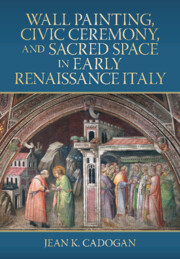
Wall Painting, Civic Ceremony and Sacred Space in Early Renaissance Italy investigates how mural paintings affirmed civic identities by visualizing ideas, experiences, memory, and history. Jean Cadogan focuses on four large mural decorations created by celebrated Florentine artists between 1377 and 1484. The paintings adorn important sacred spaces- the chapel of the Holy Belt in the cathedral of Prato, the monumental cemetery in Pisa's cathedral square, and the cathedral of Spoleto -- yet extoll civic virtues. Building on previously unpublished archival documents, primary sources, and recent scholarship, Cadogan relates the architectural and institutional histories of these sites, reconstructs the ceremonies that unfolded within them, and demonstrates how these sacred spaces were central to the historical, institutional, and religious identities of the host cities. She also offers new insights into the motives and mechanics of patronage and artistic production. Cadogan's study shows how images reflected and shaped civic identity, even as they impressed through their scale and artistry.
The theology of Leviticus is also deeply concerned with holiness in time and setting a liturgical rhythm for the people of Israel. The focus on cultic calendars and seasonal festivals is important in understanding how Leviticus views holiness. The rhythms of the people are directed by God’s creation in Genesis and his salvific works in Exodus. These are tied into seasonal harvest and celebrations for the flourishing of God’s people.
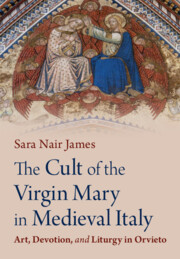
Late medieval Italy witnessed the widespread rise of the cult of the Virgin, as reflected in the profusion of paintings, sculptures, and fresco cycles created in her honor during this period. The cathedral of papal Orvieto especially reflects the strong Marian tradition through its fresco and stained-glass window narrative cycles. In this study, Sara James explores its complex narrative programs. She demonstrates how a papal plan for the cathedral to emulate the basilica of S. Maria Maggiore in Rome, together with Dominican and Franciscan texts, determined the choices and arrangement of scenes. The result is a tour de force of Marian devotion, superior artistry, and compelling story-telling. James also shows how the narratives promoted agendas tied to the city's history and principal religious feasts. Not only are these works more interesting, sophisticated, and theologically rich than previously realized, but, as James argues, each represents the acme in their respective media of their generation in central Italy.
Augustine’s liturgical preaching is integral to his conception of the liturgical celebration as rendering present the unrepeatable saving acts of Christ. During the liturgical season from Lent to Easter, the north African bishop is consistently preoccupied with the present effectiveness of the mysteries of Christ’s death and Resurrection. During Lent, he invites his congregation to fashion a cross for themselves – through prayer, fasting, and alms – for the sake of communion in Christ’s crucifixion. On Good Friday, he invites his listeners to contemplate the suffering of the impassible God and to safeguard the integrity of the Church that is the fruit of his suffering. In the Easter celebrations, he instructs his flock to be strengthened in their Easter faith through participation in the Eucharist and through performance of works of mercy, and to hold fast to the objective content of their faith in the genuine corporeality of the Risen Lord. He guides them into an experience of Easter joy as a proleptic participation in the eternal joy of the Church’s communion in the body of the Risen Lord, which can only be attained through a sharing in his Crucifixion.
The medieval transmission of Augustine’s preaching, in particular that of the Sermones ad populum, has had a significant impact on which parts of his vast homiletic corpus have survived and what state the texts find themselves in after a millennium of being copied by medieval scribes. This chapter will sketch a broad overview of the way Augustine’s sermons were transmitted, focusing in particular on their dynamic organization in sermon collections throughout the Middle Ages. It will discuss the implications of the modes of transmission and the medieval afterlife of Augustine’s preaching for the usability of these sermons as primary sources.
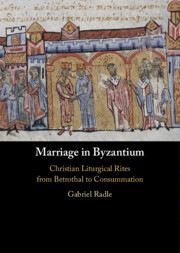
Across cultures, weddings have historically represented some of the most important and extravagant celebrations. This is the first comprehensive study of marriage rituals in the Eastern Mediterranean world of Byzantine Christianity. Using a large corpus of unedited liturgical manuscripts as well as other evidence from jewelry and law to visual representations and theological treatises, Gabriel Radle reconstructs the ceremonies used by the Byzantines to formalize the marriage process, from betrothal to rites of consummation. He showcases the meanings behind rituals of kinship formation and sexual relations and explores how the practice of Byzantine Christianity crossed fluid borders between the church and the domestic sphere. The book situates the development of Byzantine Christian marriage traditions alongside those of other religious communities and, in placing liturgical manuscripts at the heart of this study, paves new methodological paths for the use of ritual sources in the writing of Byzantine history.
Papal ceremonial acted as a language through which the pope and clergy described Catholic identity, history, and moral ideals, establishing a liturgy and ceremonial practice that could be adapted to changing circumstances in Rome and beyond. Topography did not restrict papal ceremonial but enhanced it. Rather than seeing the pope as a prisoner of his ceremonial, as some stereotypes do, this chapter explores papal ceremonial as a language that articulated narratives of authority, responded to crises, and bridged gaps. From late antiquity through the twenty-first century, liturgy, politics, urban administration, and pilgrimage/tourism grew together in cities across the Christian world. As technology has eased communication and travel, the pope has sought more direct ways to speak to Catholics, yet the public maintains an interest in the papacy that grew out of fascination with its premodern ceremonial character.
Chapter 3 traces the history of bowing at the name of Jesus, one of the ritual actions inherited from the medieval church which survived into the post-Reformation period. Although it was included in the 1559 Injunctions, most Elizabethan writers regarded it as a matter of indifference and assumed it would gradually die out of its own accord. Yet in the early seventeenth century it unexpectedly resurfaced as a point of theological debate when some divines argued that it was directly commanded by scripture. The chapter challenges the idea that theological controversy was conducted at a high academic level with little relevance to the lives of ordinary people. The dispute over bowing originated in polemical exchanges between Protestants and Catholics in Westphalia, which were taken up by the Reformed theologian David Pareus at Heidelberg, and then spilled over into the Church of England when Pareus’s writings were translated into English. But while it began in Latin works of religious polemic, it also led to conflict at a parish level, and a study of these parish conflicts shows that the lay opponents of bowing were often very well informed about the theological issues.
This loosely argued manifesto contains some suggestions regarding what the philosophy of religion might become in the twenty-first century. It was written for a brainstorming workshop over a decade ago, and some of the recommendations and predictions it contains have already been partly actualized (that’s why it is now a bit "untimely"). The goal is to sketch three aspects of a salutary “liturgical turn” in philosophy of religion. (Note: “liturgy” here refers very broadly to communal religious service and experience generally, not anything specifically “high church.”) The first involves the attitudes that characterize what I call the “liturgical stance" towards various doctrines. The second focuses on the “vested” propositional objects of those attitudes. The third looks at how those doctrines are represented, evoked, and embodied in liturgical contexts. My untimely rallying-cry is that younger philosophers of religion might do well to set aside debates regarding knowledge and justified belief, just as their elders set aside debates regarding religious language. When we set aside knowledge in this way, we make room for discussions of faith that in turn shed light on neglected but philosophically interesting aspects of lived religious practice.
This Introduction lays the foundation for the book by showcasing the interdisciplinary methods and parameters employed in this study of the marriage process from late antiquity through medieval Byzantium.
This chapter introduces readers to the main source for marriage ritual, namely the Byzantine priest’s service book known as the euchologion. A brief typology of Byzantine euchologia is given, and a discussion of the benefits and methodological limitations in the use of euchologia for the writing of cultural history.