To save content items to your account,
please confirm that you agree to abide by our usage policies.
If this is the first time you use this feature, you will be asked to authorise Cambridge Core to connect with your account.
Find out more about saving content to .
To save content items to your Kindle, first ensure no-reply@cambridge.org
is added to your Approved Personal Document E-mail List under your Personal Document Settings
on the Manage Your Content and Devices page of your Amazon account. Then enter the ‘name’ part
of your Kindle email address below.
Find out more about saving to your Kindle.
Note you can select to save to either the @free.kindle.com or @kindle.com variations.
‘@free.kindle.com’ emails are free but can only be saved to your device when it is connected to wi-fi.
‘@kindle.com’ emails can be delivered even when you are not connected to wi-fi, but note that service fees apply.
El recurso del método (Reasons of State), published in 1974 by Cuban writer Alejo Carpentier, has often been analyzed along with other dictatorship novels focusing on recurring themes, such as violence, rebellion, US imperialism or the dictator’s solitude. This essay introduces a “sensory approach” arguing that Carpentier revisits the traditional hierarchy of the five senses. Thematically, the novel emphasizes the “spectacular” and panoptical dimension of the dictator’s regime; however, this visual (and aural) domination is questioned by the Marxist opposition embodied in the character of the Student. From an intertextual perspective, Carpentier’s use of quotations from Descartes paradoxically undermines the Cartesian cogito, and the protagonist’s behavior ultimately evolves toward an anti-Cartesian and anti-ocularcentric stance, as epitomized by the figure of Mayorala Elmira. Reflecting on these two dimensions of the novel from a sensorial point of view contributes to a more nuanced understanding of Carpentier’s poetics.
In ‘Notes on Writing a Novel’, Elizabeth Bowen addresses the visual angle an author may choose to adopt as a problem in writerly technique: ‘Where is the camera-eye to be located?’ As she was a self-described ‘visual writer’, it follows that an exploration of her visuality offers a useful lens to perceive her work. Talk of lenses leads to thoughts of eyes, glasses, and photography, all of which feature prominently in her fiction. Bowen’s visuality also manifests itself across technical, aesthetic, and thematic levels, through linguistic choice, and in the rendering of perception. Through a selection of novels and short stories, this essay considers Bowen’s visuality under two lens-based categories – the human ‘roving eye’ and the photograph, index of the mechanical ‘camera eye’ – in an effort to apprehend, at least in part, her literary focus, and how she registers, records, and frames impressions and experiences.
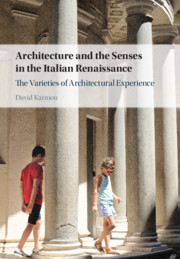
This is the first study of Renaissance architecture as an immersive, multisensory experience that combines historical analysis with the evidence of first-hand accounts. Questioning the universalizing claims of contemporary architectural phenomenologists, David Karmon emphasizes the infinite variety of meanings produced through human interactions with the built environment. His book draws upon the close study of literary and visual sources to prove that early modern audiences paid sustained attention to the multisensory experience of the buildings and cities in which they lived. Through reconstructing the Renaissance understanding of the senses, we can better gauge how constant interaction with the built environment shaped daily practices and contributed to new forms of understanding. Architecture and the Senses in the Italian Renaissance offers a stimulating new approach to the study of Renaissance architecture and urbanism as a kind of 'experiential trigger' that shaped ways of both thinking and being in the world.
Recommend this
Email your librarian or administrator to recommend adding this to your organisation's collection.