To save content items to your account,
please confirm that you agree to abide by our usage policies.
If this is the first time you use this feature, you will be asked to authorise Cambridge Core to connect with your account.
Find out more about saving content to .
To save content items to your Kindle, first ensure no-reply@cambridge.org
is added to your Approved Personal Document E-mail List under your Personal Document Settings
on the Manage Your Content and Devices page of your Amazon account. Then enter the ‘name’ part
of your Kindle email address below.
Find out more about saving to your Kindle.
Note you can select to save to either the @free.kindle.com or @kindle.com variations.
‘@free.kindle.com’ emails are free but can only be saved to your device when it is connected to wi-fi.
‘@kindle.com’ emails can be delivered even when you are not connected to wi-fi, but note that service fees apply.
This chapter examines the origins of the Home Rule movement during the 1870s focusing on Isaac Butt’s pioneering vision of federalism as a constitutional solution to Ireland’s governance. The analysis reveals how Butt’s Irish Federalism (1870) proposed a radical reimagining of the United Kingdom’s structure,creating national parliaments for local affairs while maintaining an imperial parliament for common concerns. The chapter explores the intellectual foundations of this federalist model, showing how it emerged from earlier debates about representation while attempting to reconcile Irish autonomy with the Union. Butt’s federalist framework was fundamentally unionist in intent, seeking to perfect rather than dissolve the imperial connection. However, as the chapter traces, this nuanced constitutional position became obscured as the Home Rule idea was adopted by more radical voices who reinterpreted it along separatist lines. The chapter illuminates this pivotal transitional period when the constitutional experimentation of federlaism gave way to the more rigid nationalist/unionist binaries that would dominate Irish politics by the 1880s.
This chapter explores the intense debate over the proposed parliamentary union between Ireland and Britain in the aftermath of the 1798 rebellion. It examines competing visions of representative government, with unionists advocating for Ireland’s integration into a larger British polity to secure stability and prosperity, while anti-unionists defended the autonomy of the Irish Parliament as a symbol of national liberty. Key themes include the clash over sovereignty, the role of Catholic emancipation in the union debate, and the economic implications of integration. The chapter also analyses the pamphlet war that erupted, revealing how public opinion was mobilized through arguments about political equality, economic benefits and sovereignty. Ultimately, the Union’s passage in 1801, marked by political manipulation and broken promises, set the stage for Ireland’s turbulent relationship with Britain in the nineteenth century, framing subsequent struggles over governance and representation.
This chapter examines the early decades of the Union (1801–1829), focusing on the unresolved tensions surrounding Catholic emancipation and Ireland’s uneasy integration into the United Kingdom. Despite promises of equality, the persistence of penal laws excluding Catholics from political office fuelled discontent, with figures like Daniel O’Connell and Bishop James Warren Doyle arguing that such discrimination violated the principles of the British constitution. The chapter explores debates over Irish ‘character’, the rise of mass Catholic mobilisation through organisations like the Catholic Association, and the clash between reformers advocating gradual inclusion and conservatives defending Protestant supremacy. Key moments include the veto controversy, the influence of millenarian ‘Pastorini’ prophecies and the eventual passage of Catholic emancipation in 1829 - a victory tempered by the disenfranchisement of poorer voters. The chapter reveals how struggles over representation, religious identity and democratic participation shaped Ireland’s political landscape.
This chapter analyses the Repeal movement led by Daniel O’Connell during the 1830s and 1840s, which attempted to undo the Act of Union and restore Ireland’s parliament. O’Connell framed Repeal as a constitutional restoration - a return to Grattan’s Parliament - but infused it with mass mobilization tactics honed during Catholic emancipation. The movement’s tensions are revealed through its ideological factions: O’Connell’s moderate "Old Ireland" favouring gradual reform within British frameworks, and the more radical "Young Ireland," influenced by classical republican ideals. The chapter explores how Young Irelanders like Thomas Davis conceptualised Irish self-government not just as legislative autonomy but as cultural and economic sovereignty, diverging from O’Connell’s pragmatic focus on institutional restoration. The catastrophic Famine (1845–52) deepened these divides, exposing the Union’s failures and radicalizing demands for self-rule. Ultimately, the chapter shows how Repeal became a crucible for competing visions of Irish representation - from O’Connell’s loyalist parliamentarianism to Young Ireland’s revolutionary separatism - laying groundwork for later republican and Home Rule movements.
Moving beyond binary nationalist and unionist narratives of nineteenth-century Irish history, this study instead explores political thought through ideological battles over government. Drawing on neglected pamphlets, political tracts and polemic newspapers, Colin Reid reveals how Irish protagonists - unionists and anti-unionists, Catholic Emancipationists, Repealers, Tories, Fenians, and federalists - clashed over the meaning of representation, sovereignty and the British connection. Reid traces how competing constitutional visions, rather than national allegiances, drove Ireland's political evolution. From the bitter Union debates to the birth of Home Rule, it recovers forgotten arguments about parliamentary reform, the 'Irish question' in imperial context and the fraught experience of a small nation within a multinational polity. With fresh insights into figures such as Daniel O'Connell, Isaac Butt and lesser-known polemicists, this study redefines Irish political thought as a dynamic struggle for representative government. This title is also available as open access on Cambridge Core.
This chapter focuses on some representations of the people in some of the literary productions of the 1640s, the decade of the English Civil Wars. The people were seen by some writers as dangerous, unruly, and driven by passions rather than reason. But they were thought by others to be essential to the politics of the country. The chapter traces the tensions between these contrary representations of the people across courtly dramatic performances, political pamphlets, and in poetry and prose connected to the execution of Charles I.
Focusing on the proliferation of independent African-owned presses in eastern Nigeria in the 1950s and 1960s, this chapter discusses the popular pamphlets known as Onitsha market literature. The chapter asks how the upsurge in local publishing shaped readers’ ideas about literary languages and contributed to authors’ social prestige as intellectuals. The chapter describes the practicalities of pamphlet production, as well as the ways pamphleteers offered fresh conceptualisations of literary inspiration outside dominant western frameworks for works of the imagination.
This introduction to Section 6 of the volume on alternative sources for the study of Islamic law explores how the subject can be approached through material that is not strictly legally-focused, including such diverse genres as biographical dictionaries, licenses to teach and issue legal verdicts (pl. ijāzāt) speeches, pamphlets and novels, as well as including a representative bibliography of recent scholarship on the subject.
Chapter 7 explores the explosion of visual sources about Russia in the second half of the sixteenth century. Most notorious of them were the illustrated pamphlets about Ivan the Terrible’s attack on Livonia during the Baltic wars of the 1560s, where Ivan and his army were often depicted as hated Turks. An entirely different image of Muscovy was projected in costume books of the time, where the “typical dress” of Muscovite men and women resembled that of other Europeans, even if it was somewhat fanciful for lack of eyewitness knowledge. Finally, late sixteenth-century maps of Muscovy provide some illustration as well, often repurposing images from Herberstein’s account and costume books.
This chapter proposes that early modern women essayists invoked anger to negotiate new modes of publicity in the nascent public sphere. By reading the writings of Jane Anger, Rachel Speght, and Margaret Cavendish alongside the history of humanist education, it shows that anger’s original object was not misogyny writ large, but the rhetorical training that limited women’s access to privileged protocols of speaking and writing. By the end of the early modern period, it argues, anger dissipates as the rise of salon conversation and letter writing expand the field in which literacy can be displayed, weakening rhetoric’s grip on the republic of letters.
Swift was one of the most prolific pamphleteers and journalists of his lifetime. One of Swift’s great strengths as a pamphleteer was his keen awareness of what might be described as his target readership. Appreciating that it is easier to confirm rather than alter readers’ opinions, Swift played on the prejudices of his readership. This chapter untangles the numerous and varied polemical strategies that Swift harnessed in his political writing, including ‘parallel history’, hyperbole, and character assassination. The chapter concludes with an extended reading of A Modest Proposal (1729), suggesting that here Swift employed many of the same polemical devices that he had used during his years as a pamphleteer.
This chapter sheds light on how mercenaries of knowledge contributed on behalf of the new King of Portugal’s sovereignty on the European and Mediterranean political stage. Alongside books and manuscripts, they used their access to Portuguese products, musical instruments, and luxury foods to improve their political leverage in Rome. In the hands and letters of mercenaries of knowledge, the diverse materials of bibliopolitics worked as the mute diplomats and political sweeteners of Baroque international relations. Vicente Nogueira’s desire to return to Portugal conditioned his troubled relations during the last part of his stay in Rome and his tormented advocacy on behalf of Portuguese affairs in the city after 1640.
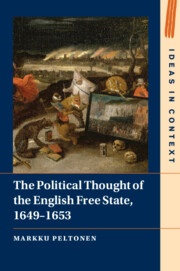
The English free state or republic (1649–53) has always been seen as a failure, which almost no one outside the small coterie of its leaders genuinely wanted or actively supported. Historians have also belittled the importance of the political thought of the republican period. They have explored John Milton’s and Marchamont Nedham’s writings in defence of the republic but have mainly focused on de facto arguments that the free state could demand obedience because it offered peace and security. The Introduction explains how scholars have failed to properly examine the political thought of the period and have underestimated its breadth and depth. It also argues that, once we explore the pamphlet literature published during the free state, we can appreciate the importance of these pamphleteers’ political thinking. The aim is to offer a complete reassessment of the political thought of the English free state and to map the terrain of what it was possible to think.
English republicanism has long been a major theme in the history of political thought, but the years of the English free state are often overlooked. Drawing on a wide range of sources, including the vast political pamphlet literature of the era, The Political Thought of the English Free State, 1649–1653 offers a provocative reassessment of the English Revolution and an original new perspective on English republicanism. Markku Peltonen explores the arguments in defence of the English free state and demonstrates the profound importance of the republican period. The pamphleteers who defended the free state maintained that the people, or their representatives, could alter the form of government whenever they deemed it advantageous, put forward powerful anti-monarchical arguments and widely shared the republican conviction that individual freedom could only materialise in a free state. Peltonen also highlights the unprecedented debate over whether the free state was an aristocracy or democracy and shows how, for the first time in English history, democracy was not only robustly defended but understood as representative.
Chapter 5 examines in the 1745 Jacobite Rising in the context of the expansion of the periodical press and the print marketplace in the mid-eighteenth century. Information about the events of the 1745 Rising was made available to readers in a more continuous and a more pervasive way than during the 1715 Rising. The chapter explores how this expanding circulation of information prompted greater concern not just about the trustworthiness of the genres of the newspaper and the political pamphlet but also about how citizens were consuming information. It next focuses on three genres of printed works produced after the Battle of Culloden (1746) that reworked newspaper reports into their narratives: accounts of the trials and executions of the rebels, “Chevalier” or “Pretender” narratives about the escape of Charles Edward Stuart, and popular histories. With their conscious and unconscious intertextual borrowings, these printed works, like those of the 1715 Rising, inscribe the cultural memory of the 1745 as a series of complicated knots of memory.
The Epilogue considers anonymous pamphlets printed in the later part of King James’s reign that deploy the female voice as a form of political critique: Ester Hath Hang’d Haman, Hic Mulier, Haec Vir, and Muld Sacke. Of the cross-dressing pamphlets, Haec Vir in particular recruits the female voice for its association with militant Elizabethan values and the freedom of the subject, while the pseudonymous author Esther Sowernam ventriloquizes Esther, the biblical heroine who confronts the king. The female voice occupied a unique position in the seventeenth-century political landscape, allowing women writers to critique abuses of male power without compromising their position as dutiful subjects. Unlike the freedoms achieved by male citizens at the expense of women later in the seventeenth century, the “reasonable libertie” sought by men and women in early Stuart England authorized the voice of the wife/subject as a powerful political tool.
Chapter 5 is a key turning point in the narrative of the book. It analyses radical Catholic pamphlets printed in Paris and Lyon c. 1588–89, during a period in which the king was assassinated and the Catholic League controlled Paris and many other French towns. These pamphlets attack a now monstrous figure, the politique, for duplicity and for linguistic and moral flexibility. They confirm that the politique is shadowy and hard to define; this is part of the new politique problem of the late stages of the wars, which did much to create the historiographical legend of the Politique party. In these works, politique shifts from object of knowledge and knowing subject to object of opprobrium – but some qualities of the knowing, linguistically capable politique subject are retained. I argue that longer-term trends and influences are also present in source material as well as the immediate concerns of the crisis of c. 1589. This chapter also brings visual sources to bear on the politique problem, including two of the only known representations of the politique figure, found in Pierre de L’Estoile’s Drolleries collection.
This chapter considers the addressing of persuasive arguments, in oral, handwritten and printed forms and in Scots, English and Gaelic, and identifies rhetorical devices used to represent and express extra-institutional opinions in public communications. The analysis shows how dissidents worked to influence and exploit the views of supporters and how Scotland's rulers sought to manage extra-institutional opinions through a combination of censorship and their own proactive communications. The relative smallness of the Scottish print market and the gradual spread of literacy from elite to middling levels across this period meant that oral and manuscript communications remained important alongside print, producing a distinct communications culture. Though traditional figures like Lady Scotland or Jock Upaland were used to speak for the nation and people, over time collective opinions came to be represented in more literal terms as writers advanced claims about the views of the kirk, the godly and the covenanted nation.
Edited by
Matthew Craven, School of Oriental and African Studies, University of London,Sundhya Pahuja, University of Melbourne,Gerry Simpson, London School of Economics and Political Science
In his 1995 treatise Fairness in International Law and Institutions, Thomas Franck described what he called the ‘reality-altering’ potential of the UN Charter’s system of collective security in these words.
Edited by
Matthew Craven, School of Oriental and African Studies, University of London,Sundhya Pahuja, University of Melbourne,Gerry Simpson, London School of Economics and Political Science