Refine search
Actions for selected content:
8 results
Worlds That Were: The Tendaguru Dinosaurs and the Imperial Past in (Post)Colonial Germany
-
- Journal:
- Central European History , First View
- Published online by Cambridge University Press:
- 11 February 2026, pp. 1-21
-
- Article
-
- You have access
- Open access
- HTML
- Export citation
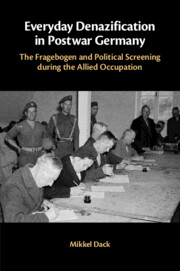
Everyday Denazification in Postwar Germany
- The Fragebogen and Political Screening during the Allied Occupation
-
- Published online:
- 23 March 2023
- Print publication:
- 30 March 2023
5 - Disintegrate
- from Part I - Enemies
-
- Book:
- This Is Not Who We Are
- Published online:
- 19 January 2023
- Print publication:
- 19 January 2023, pp 75-83
-
- Chapter
- Export citation
7 - Deny
- from Part I - Enemies
-
- Book:
- This Is Not Who We Are
- Published online:
- 19 January 2023
- Print publication:
- 19 January 2023, pp 97-114
-
- Chapter
- Export citation
14 - Reform
- from Part II - Saviors
-
- Book:
- This Is Not Who We Are
- Published online:
- 19 January 2023
- Print publication:
- 19 January 2023, pp 202-214
-
- Chapter
- Export citation
7 - Conclusions
-
- Book:
- Empire of Law
- Published online:
- 23 March 2020
- Print publication:
- 02 April 2020, pp 263-272
-
- Chapter
- Export citation
6 - The European Narrative and the Tradition of Rights
-
- Book:
- Empire of Law
- Published online:
- 23 March 2020
- Print publication:
- 02 April 2020, pp 221-262
-
- Chapter
- Export citation
Introduction
-
- Book:
- Allied Internment Camps in Occupied Germany
- Published online:
- 28 October 2019
- Print publication:
- 31 October 2019, pp 1-24
-
- Chapter
- Export citation
