To save content items to your account,
please confirm that you agree to abide by our usage policies.
If this is the first time you use this feature, you will be asked to authorise Cambridge Core to connect with your account.
Find out more about saving content to .
To save content items to your Kindle, first ensure no-reply@cambridge.org
is added to your Approved Personal Document E-mail List under your Personal Document Settings
on the Manage Your Content and Devices page of your Amazon account. Then enter the ‘name’ part
of your Kindle email address below.
Find out more about saving to your Kindle.
Note you can select to save to either the @free.kindle.com or @kindle.com variations.
‘@free.kindle.com’ emails are free but can only be saved to your device when it is connected to wi-fi.
‘@kindle.com’ emails can be delivered even when you are not connected to wi-fi, but note that service fees apply.
This chapter discusses the circumstances of Ginsberg’s arrival and deportation from Czechoslovakia in 1965. Although it is often thought otherwise, Ginsberg did in fact have long-formed plans to travel behind the Iron Curtain, and his expulsion from Cuba only expedited, rather than facilitated, his arrival to Europe. During his stay in Czechoslovakia, Ginsberg had the opportunity to look behind the façade of the Communist Party and observed firsthand that Czechoslovaks lived in an oppressive regime they increasingly tried to challenge through various means, one of them being the publication and performance of Beat poetry. However, he underestimated the surveillance practices of the regime, which only intensified after Ginsberg was elected the King of May in front of a 100,000-strong crowd during May Day celebrations. Ultimately, his often frank discussion of his views and experiences not only placed several of his associates in danger, but also led to his deportation from the country.
The secondary literature on Hannah Arendt and Eric Voegelin’s 1953 debate on totalitarianism is in general agreement that these two thinkers offer fundamentally irreconcilable accounts of the phenomenon. This article adds to the literature on this debate by employing a broader temporal frame of analysis. I argue that, when viewed over the longer arc of their development, these thinkers converge in how they approach some of the moral questions associated with totalitarianism. This is especially evident in their reactions to resurgent questions of “German guilt” that arose in the early 1960s. Arendt’s “reality as such” and Voegelin’s “first reality” converge on what I call “moral reality.” Both ultimately treated totalitarianism as, in part, a moral catastrophe insofar as it entailed a loss of this sense of moral participation.
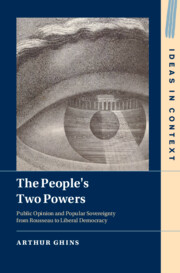
The People's Two Powers revisits the emergence of democracy during the French Revolution and examines how French liberalism evolved in response. By focusing on two concepts often studied separately – public opinion and popular sovereignty – Arthur Ghins uncovers a significant historical shift in the understanding of democracy. Initially tied to the direct exercise of popular sovereignty by Rousseau, Condorcet, the Montagnards, and Bonapartist theorists, democracy was first rejected, then redefined by liberals as rule by public opinion throughout the nineteenth century. This redefinition culminated in the invention of the term 'liberal democracy' in France in the 1860s. Originally conceived in opposition to 'Caesarism' during the Second Empire, the term has an ongoing and important legacy, and was later redeployed by French liberals against shifting adversaries – 'totalitarianism' from the 1930s onward, and 'populism' since the 1980s.
This chapter explores the contributions of social and personality psychologists to the development of Cold War liberal philosophy and social theory. Psychologists helped to define “totalitarianism,” one of the central concepts of Cold War liberalism, as an expression of individual psychopathology – a result of the failure of people in a given society to develop a coherent, healthy sense of self. This state of psychological health, the antidote to totalitarianism, was often referred to as the “productive” character or personality and was defined by an individual’s capacity to express their selfhood in creative work. Cold War liberals identified myriad techniques to promote the productive character and discourage totalitarian psychopathology, including social-democratic policymaking, new childrearing methods, and the practice of both scientific research and spiritual searching. They also sought to develop productive characters in the supposedly psychologically immature societies of the postcolonial world, an elite-driven approach to social and economic development that laid the groundwork for the rise of neoliberalism and neoconservatism in the late twentieth century. The productive, anti-totalitarian personality, argued many Cold War liberal development experts and their neoliberal and neoconservative successors, was an entrepreneurial personality, the psychic wellspring of economic growth.
This epilogue explores the legacy of the idea of liberal democracy in twentieth century French thought and its impact on contemporary (liberal) democratic theory. After being pitted against “Caesarism” during the Second Empire, liberal democracy was redeployed to confront new adversaries: “totalitarianism” in the 1930s (Raymond Aron) and “populism” from the 1980s onward (Claude Lefort). In each of these periods, French liberals employed a two-pronged strategy: they criticized degenerate forms of democracy as corrupting popular sovereignty and manipulating public opinion. At the same time, beginning in the 1950s, French liberals redefined popular sovereignty as an abstraction to make it safe for liberal democracy, all the while championing a free public opinion as the best way to engage citizens in politics beyond elections. Today, democratic theorists in France (Pierre Rosanvallon) and elsewhere (Jürgen Habermas and Nadia Urbinati) continue to defend liberal democracy as the rule of public opinion.
Chapter 3 discusses Johann Gottlieb Fichte’s “philosophical draft” The Closed Commercial State (1800) and its blueprint for a world system of centrally directed, self-sufficient national economies that abandon commercial and political connections but remain interrelated through state-supervised intellectual exchanges. I argue that although not explicitly labeled as Weltliteratur, this design of cultural cooperation among otherwise insular national states is a paradigmatic configuration of world literature that offers an alternative economy of circulation in the form of planning. After outlining the mechanisms driving intercultural circulation in this model, the chapter examines how its underlying cosmopolitan universalism morphs into patriotic cosmopolitanism (and eventually collapses into a sense of German superiority) in Fichte’s later philosophy. I also argue that this design cast a long shadow in the twentieth century as it prefigured the most potent counter-system of “capitalist world literature”, the command economy of socialist internationalism in the Soviet Republic of Letters.
This chapter analyzes why high hopes in 1933 for expanded trade and strategic cooperation were not fulfilled in the following years. It argues that the failures did not stem solely from Joseph Stalin’s evil actions. Presenting a more complex story, the chapter highlights how conservative Americans exaggerated threats of Soviet-instigated communist revolution, how Ambassador William Bullitt’s intemperate diplomacy hampered relations, and how the US Navy obstructed President Roosevelt’s plans for building warships for the USSR. Despite those problems, the descent of the Soviet Union into the Great Terror, and the signing of the Nazi–Soviet pact in 1939, the United States did not break relations with the USSR. As a result, Roosevelt kept open the possibility of a military partnership as war erupted in Europe. Going beyond the strategic and economic dimensions, the chapter highlights how harsh Soviet anti-American propaganda sought to buttress belief in the superiority of socialism over capitalism while Hollywood films ridiculed ascetic, doctrinaire Soviet communists and suggested that they were susceptible to seduction by the consumer pleasures of capitalist countries.
Amid economic crises, rising totalitarianisms, and escalating technological warfare of the 1930s and 1940s, Bloomsbury’s thinkers and artists entered a new phase. They had never thought alike, nor considered themselves a “group,” but, beyond their colorful private sociability, these public-spirited “civilized individuals” carried the banner of their liberal intellectual formation – their critical hope and utopian idealism – into collective arenas. Drawing upon the late art, thought, letters, and conversation of Sigmund Freud, John Maynard Keynes, E. M. Forster, T. S. Eliot, Virginia Woolf, Leonard Woolf, and Vita Sackville-West, this chapter explores late Bloomsbury’s dialectic of enlightenment, as darkening skies tested the hope that European civilization, smashed by the Great War, might be rebuilt on firmer and more lasting ground. As domestic and international crises bore a shrinking world toward an unknowable future, Bloomsbury’s civilized individualism – which, Raymond Williams thought, offered no vision of a whole society – springs into high relief against the existential threat of totalitarian systems on right and left that emerged from radically different national histories. In late Bloomsbury, we glimpse the threats of authoritarianism, racialized imperialism, genocidal violence, all-consuming capitalism, and earth-ravaging technological modernity.
The dominant assumptions positing a linear relationship among individualism, capitalism, competition, and inequality are often rooted in the perspectives of social scientists, whose focus is frequently confined to the West in modern times. I argue that these dominant assumptions have been formulated without sufficient opportunities or willingness to consider societies with cultures and systems different from those of the West. In this regard, this book challenges these dominant assumptions by presenting compelling counter-evidence that (1) competition occurs in every society throughout history whenever humans seek to survive and thrive; and (2) competition does not necessarily lead to inequality, but often serves as a tool to mitigate it, as competitions prevent absolute hegemony and allow individuals to challenge incumbent powers or privileged groups across cultures, systems, and eras. This closing chapter encourages readers to reassess their existing beliefs about the sources and consequences of competition and to strive for a deep understanding of competition arenas that they may choose to enter or inadvertently launch.
Little attention has been paid to competitive dynamics from a political perspective, despite numerous instances of political competition across cultures and systems. In liberal democratic societies, political competition is legalized, allowing citizens to elect leaders who represent their ideas. Conversely, in totalitarian societies, citizens lack voting rights, and political authority is not challenged through democratic means. However, political competitions still occur among ruling elites, often through purges to seize power. This chapter explores political competition, particularly in totalitarian regimes, where purges eliminate rivals among ruling elites. The collapse of such regimes has marked an evolution toward freedom and equal opportunities for all individuals, regardless of background, which aligns with Darwin’s theory of evolution. Highlighting the lack of research on political competitions from an evolutionary psychology perspective, this chapter underscores the need for future research on human emotions and competitive behaviors in the political arena.
The establishment of the Bolshevik communist totalitarian regime in Russia in 1917 was facilitated by the existing institutional genes necessary for totalitarian rule, including the autocratic Tsarist system, the Russian Orthodox Church, and the secretive political organizations. Chapter 7 studies the origins and evolution of these institutional genes and it also examines their role in the failure of the Russian constitutional reforms and the genesis of communist totalitarian ideology and organization in Russia.
Constitutionalism and communist totalitarianism are both foreign ideologies and institutions that were imported into China. The failure of China’s attempts at constitutionalism cleared the path for the rise of communist totalitarianism. This chapter examines the shortcomings of the constitutional reforms and the Republican Revolution, as dictated by China’s institutional genes of the time. It reviews the ineffective Hundred Days’ Reform and the impact of Social Darwinism, which found deep roots in China’s institutional genes and profoundly influenced the later Chinese reception of communist totalitarianism. The text also discusses the unsuccessful constitutional reforms that lacked popular support and chronicles the collapse of the Qing Empire following the Xinhai Revolution. Additionally, the chapter analyzes the failures of the Republican Revolution, attributing them to the absence of those institutional genes necessary for establishing constitutionalism as well as to the enduring institutional gene of “secret societies,” which deeply influenced the revolutionary parties.
Chapter 10 investigates the establishment and growth of China’s Bolshevik Party, the core element in the communist totalitarian revolution and regime, that was orchestrated by the Comintern. The chapter commences with an examination of the inception and operational dynamics of the Chinese Communist Party (CCP) as a Comintern offshoot. It also addresses the reorganization of the Kuomintang (KMT) and the formation of the CCP-KMT alliance as key strategies implemented by the Comintern to bolster the fledgling CCP.
The narrative underscores the essential role the Chinese secret societies played in the development of the CCP’s organizational and military forces, following the directives of the Comintern and their implementation in practice. Additionally, the chapter examines the introduction of totalitarian rules within the CCP and its military branches, which fostered a reign of terror and enabled the rise of a totalitarian leader. It traces the initial establishment of a totalitarian institutional structure within the CCP and assesses the Comintern’s decisive role in fortifying the CCP’s ultimate leadership, suggesting its profound and lasting impacts on the Chinese political landscape.
Totalitarian systems, marked by extreme violence, are fundamentally bound to an ideology, such as Marxism-Leninism, which is instrumental to their creation and persistence, from the Bolshevik revolution in Russia to modern China. The chapter examines the genesis of communist totalitarian ideology in early Christian communal equality, connecting it to Rousseau’s and Babeuf’s anti-property ideals, which ultimately influenced Marxism and its vision of a dictatorial society in the name of absolute equality. The enduring pull towards egalitarianism, when pushed to extremes, can encroach on private property rights, ironically culminating in totalitarian rule and unprecedented inequality.
The final chapter reiterates the challenges posed by totalitarianism. By conducting coherent theoretical and empirical research into the origins and expansion of totalitarianism, this work strives to address these significant challenges that Mises warned about decades ago. This chapter summarizes the key insights drawn from both the empirical evidence and the theoretical framework of institutional genes that constitute a comprehensive methodological approach. The literature review distinguishes this book from other works in the fields of China studies, institutional analysis, and social science methodology. The two most extensive sections of the chapter examine the institutional genes and their evolution in Taiwan and in the former Soviet Union and Eastern Europe (FSU-EE). The former section sheds light on the pivotal role the institutional genes played in Taiwan’s transition from authoritarian rule to constitutional democracy, while the latter section explains the collapse of the totalitarian regimes in the FSU-EE countries and their divergent institutional transformations. The chapter also highlights the implications of the transitions in Taiwan and the FSU-EE countries for China’s future transformations.
Building on the institutional genes of the Tsarist autocracy, the Russian Orthodox Church and the secret political societies analyzed in the previous chapter, this chapter explores the origins of the Bolshevik Party, which was the first communist totalitarian party. It analyzes the Bolsheviks’ transformation from a secretive organization to a ruling totalitarian party characterized by a personality cult and Red Terror. The chapter then outlines the institutional prerequisites for the Bolsheviks’ seizure of power, noting the absence of constitutional backing for the Provisional Government and the appropriation of power under the guise of Soviet authority. Furthermore, the chapter details the consolidation of a comprehensive totalitarian system, including the suppression of opposition through dictatorship of the proletariat, the application of Red Terror tactics, the establishment of total state ownership, and the role of the Comintern in initiating communist totalitarian revolutions internationally, all of which were prerequisites for the creation of the Chinese communist totalitarian regime.
This chapter examines the way in which the Holocaust has been brought into conversation with understandings of the modern world, with a strong focus on historical and sociological accounts (though recognizing the place of the Holocaust in postmodern literary and critical theory.) It shows the multiple ways in which concepts of modernization, modernity, and the modern have been deployed, be it to establish the Holocaust’s paradigmatic or normative character, or the reverse. It illustrates the paradoxical character of efforts to highlight the Holocaust’s distinctiveness while harnessing it to a pervasive and generic “modernity.”
In past decades, the relationship between fascism and communism was of major interest. The theory of totalitarianism viewed them as different versions of the same phenomenon. Communists saw fascism as a function of capitalism, and communism as its only legitimate opponent. Both views marginalized the Holocaust. As the Holocaust came to the fore in Western scholarship, entanglements with communism slipped out of view. This chapter argues that they deserve closer attention. Though its roots were older, after 1917 anticommunism gave the right a new focus, giving radical fringe groups respectability. Communism exerted a “negative fascination” on the right, encouraging mutually escalating extremes. Anti-Marxism legitimated Nazi violence after 1933, drawing support even from the Churches. For their part, even after the adoption of the popular front strategy in 1935, the KPD continued to believe that the SPD was the main enemy, and long remained silent on the persecution of Jews. Since the end of the Cold War, the question of the relationship between communism, Nazism, and the Holocaust has been expressed above all in the culture of remembrance.
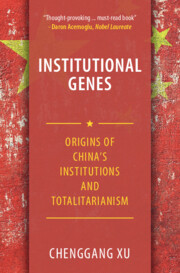
This book explores the origins and evolution of China's institutions and communist totalitarianism in general. Contemporary China's fundamental institution is communist totalitarianism. Introducing the concept of “institutional genes” (IGs), the book examines how the IGs institutional genes of Soviet Russia merged with those of the Chinese imperial system, creating a durable totalitarian regime with Chinese characteristics – Regionally Administered Totalitarianism. Institutional Genes are fundamental institutional elements that self-replicate and guide institutional changes and are empirically identifiable. By analyzing the origins and evolution of IGs institutional genes in communist totalitarianism from Europe and Russia, as well as those from the Chinese Empire, the Chinese Communist Revolution, the Great Leap Forward, the Cultural Revolution, and post-Mao reforms, the book elucidates the rise and progression of communist totalitarianism in China. The ascent of communist China echoes Mises' warning that efforts to halt totalitarianism have failed. Reversing this trend necessitates a thorough understanding of totalitarianism.
Xi Jinping's frequent references to Mao Zedong, along with Xi's own claims to ideological originality, have fueled debate over the significance of Maoism in the PRC today. The discussion recalls an earlier debate, at the height of the Cold War, over the meaning of Maoism itself. This paper revisits that earlier controversy, reflected in arguments between Benjamin Schwartz and Karl Wittfogel, with an eye toward their contemporary relevance.