To save content items to your account,
please confirm that you agree to abide by our usage policies.
If this is the first time you use this feature, you will be asked to authorise Cambridge Core to connect with your account.
Find out more about saving content to .
To save content items to your Kindle, first ensure no-reply@cambridge.org
is added to your Approved Personal Document E-mail List under your Personal Document Settings
on the Manage Your Content and Devices page of your Amazon account. Then enter the ‘name’ part
of your Kindle email address below.
Find out more about saving to your Kindle.
Note you can select to save to either the @free.kindle.com or @kindle.com variations.
‘@free.kindle.com’ emails are free but can only be saved to your device when it is connected to wi-fi.
‘@kindle.com’ emails can be delivered even when you are not connected to wi-fi, but note that service fees apply.
When Elizabeth Maconchy entered the British compositional scene in 1930 with the premiere of her orchestral suite, The Land, she and her fellow composers had an unsettled relationship with the prevailing musical styles of Europe. Whereas continental composers were highly regarded by British critics as cutting edge, their British contemporaries were faulted as derivative, unoriginal, and too steeped in national traditions to contribute to the ‘new’ music. Constant Lambert argued his rival countrymen (and women) had let their moment to be ‘modern’ pass them by. This chapter examines the scope of modernism on the continent and scholars’ difficulties in pinning down a precise functional definition of the so-called ‘modernist’ style. Practitioners of European modernism sought to be sensational or at the very least individual. British modernism, on the other hand, tended toward the juxtaposition of ‘old’ and ‘new’, an eclecticism that is not bound to any specific ideology.
This chapter highlights the parameters of modernity, because democracy today cannot rest on earlier practices created for small cities, like Athens, in the ancient world. Therefore, in 1917 and 1919, the German sociologist Max Weber described two new vocations, of “Science” and “Politics,” as characteristic of societies that grew out of the Enlightenment. “Scientists” used instruments and experiments to discover “knowledge” more reliable than “opinion.” The result is that their work overthrew many traditional beliefs and led to “disenchantment.” “Politicians” arose because, when “subjects” became “citizens” in many Western states, they needed leaders and spokespeople who would help them to organize their sentiments and express their preferences. In which case, politicians, elected on behalf of voluntary support from below, ruled on the basis of “tradition,” “legality,” or “charisma.” Weber’s terms overlooked at least two large problems. Charismatic politicians could break the “iron cage” of “bureaucracy,” but, as “demagogues,” they could also lead voters in undesirable directions. Voters, perhaps advised by scholars, would have to resist being led astray, but Weber said nothing about how they, in effect, should exercise a third new “vocation” in modern societies. Citizens were not present before the Enlightenment; they are everywhere now. What are they supposed to do? Weber did not say.
Chapter 4 pursues the analysis of political belonging and the making of political communities by looking at how validation but also contestation are framed at the local and regional levels. By tracing the competing definitions of the notion of ‘seniority’ across time and actors in chieftaincy disputes, I evidence that seniority is used as a central notion on which power depends. The competing criteria to establish seniority have been used to construct new political communities with alternative allegiances. The most recurring and enduring principles across time and scales to construct political communities appear to be those related to indigeneity, oral tradition and genealogy. In order to emphasize the scalar logic at play, the chapter emphasizes the similarities in the narratives appearing at the regional level (Ewe-speaking southeast Ghana) and the local level (in the dukɔ of Dzodze), and will trace this logic from the 1910s to the 2010s, based on the Commission of Enquiry chaired by Sir Francis G. Crowther in 1912. This chapter will therefore look at power dynamics and disputes between Anloga, Dzodze and other dukɔwo in southeast Ghana in the first half of the twentieth century.
The Ewe-speaking region straddling the border between Ghana and Togo has not been envisioned by much of the scholarship as a viable political community capable of forming a nation-state. Yet this interpretation does not account for the continued identity claims arising from this transnational region. By looking more closely at grassroots perceptions of what constitutes a political community, the diagnostic may be different. This chapter considers how the scalar and genealogical principle underpinning the local indigenous political space, the dukɔ , has come to underpin the transnational Ewe-speaking region to form a larger political community. This is notable in the Ewe Newsletters, which aimed to convene and construct a transnational Ewe nation based on mutual recognition and oral tradition but also today across the border in both oral tradition and the performance of festivals.
What is the biggest challenge for the writing of early Christian history? As Markus Vinzent suggests in this study, it is not the interpretation of material evidence. Rather, it is the interpreter herself or himself. Unlike most historical studies, which aim at keeping to sources, facts, and close readings of texts as objectively as possible, Vinzent here offers a new approach: autobiographical historiography and personal methodological reflection, including test cases that advocate transparency, courage, and willingness to be challenged. He takes the reader on a journey through the notions of 'space', 'space in-between', 'the argument from silence', 'cognitive historiography' and 'evolution', 'time', 'scholarship', 'evidence/fact', 'tradition' and 'future'. Proposing a contemporary, post-postmodern reading of history that goes far beyond the field of Early Christianity, Vinzent's anachronological study interrogates traditional historical approaches and challenges both conservative and progressive scholars and students to contradict, engage with, and argue over established interpretations of events.
A groundbreaking critical introduction to folk music and song focused on questions of identity, community, representation, politics, and popular culture. Written by a distinguished international team of authors, this Companion is an indispensable resource for rethinking the confluence of sound, heritage, and identity in the twenty-first century. A unique addition to the literature, it highlights the fundamentally hybrid and (post)colonial dynamics that have shaped people's cultures around the globe, from the Appalachian mountains to the Indian subcontinent. It provides students with new critical paradigms essential for understanding how and why certain musical traditions have been characterised as 'folk'-and what continues to inspire folkloric imaginaries today. The twenty specially commissioned chapters explore folk music from a variety of perspectives including ethnography, revivalism, migration, race, class, gender, protest, and the public sphere. Among these chapters are four 'Artist Voices' by world-renowned performers Peggy Seeger, Angeline Morrison, Jon Boden, and Yale Strom.
Revival processes appear central to folk musics across different cultural and national traditions. Consequently, this chapter argues that, rather than perceiving revival as the exception, processes of revival and change should thus be perceived as a central feature of tradition. As is outlined here, revival needs to be approached from a much broader perspective. Falling back on case studies from England, Latvia, and Germany, this chapter further analyzes how acts of revival are entangled with themes of authenticity and nostalgia. Utilizing different claims of authenticity as elaborated by Denis Dutton, these waves of revivalism might be described as a defensive mechanism against eras of accelerated global change. Following scholars such as Svetlana Boym and Ross Cole, folk revivalism can thus be understood as an act of imaginative investment in the past and future, a nexus where nostalgia and utopia – as a counterpoint or solution to this sentiment of loss – meet.
This chapter argues that, in order to understand the association between protest song and the modern musical genre known as folk music, we need to contextualize it within a longue durée of protest song and popular politics. It does this by tracing the history of Anglophone and Germanic protest song from the later sixteenth century up to Bob Dylan’s 1965 appearance at the Newport Folk Festival, taking in labourers’ songs, the ballads of seventeenth-century revolutions, the anti-democratic theories of the ancient regime, the emergence of the idealised and self-aware labouring poet in the wake of the French Revolution, and the output of Chartists, Fabians,twentieth-century working-class movements and the Critics Group. These developments are placed within two contexts: the bottom-up struggle for a political voice, and the articulation of an ideology of Volk and folk. The result is to disrupt any implicit affinity between folk as a genre and political protest, introducing instead a more heterodox and responsive understanding of the evolving links between musical style, ideology, and a popular voice.
This chapter explores a genre of activist theatre that has developed in play texts written in the French language in countries of West Africa since 2000. This theatre in Benin, Burkina Faso, and Togo builds on the legacies of performance traditions and picks up the momentum of theatre from the post-independence era starting in the 1960s, and then the activist theatre of the 1990s. This theatre has transitioned from what it was in the twentieth century theatre as it reacts to new realities in Africa and to the redefining of global relations. West African theatermakers have rejected the European models in a literary decolonization effort. By maintaining connections to earlier African forms, contemporary playwrights in Francophone West Africa keep traditional means of storytelling alive and use these influences to write new theatre genres that diverge from those of European theatre. The chapter examines examples of plays from Francophone West Africa to highlight three components of activist playwriting: how it is political, how it is universal, and how it relates to other forms of African theatre. Finally, it approaches theatre as an activist artform in performance, considering who is engaged, and where and when this happens.
This article compares the tactic of trashing genetically modified crops in activist campaigns in Britain and France. In Britain, most crop trashing was carried out covertly, while in France most activists undertook open, public actions. In seeking an explanation for this, the article shows that the analysis of political opportunities, dominant in comparative studies of social movements, can only take us so far. While it helps explain the occurrence of direct action, it is much less useful in explaining the tactical differences between each country. It is argued that a fuller explanation requires an understanding of how action was shaped by different activist traditions. In France, action was staged as a demonstration of serious, responsible, collective Republican citizenship; in the United Kingdom, activists combined a sceptical view of legality developing from anarchist individualism with an explicitly non‐threatening, playful, ethos. The article concludes that a focus on activist traditions can provide an effective bridge between structural and cultural approaches to understanding the determinants of social movement action.
Serving tea, women’s social labor, and the intergenerational problem of negotiating “our culture.” Despite the enjoyment of New Year (Nowruz) ritual social visits, a treasured national holiday respite is a dreaded domestic endurance test, and a quiet war between generations of women. While men quote poetry rhapsodizing over the joys of spring celebrations, women dash between guests, stove, and front door in order properly to serve tea. Woe to the daughter who would prefer to retreat to the more intimate pleasures of the nuclear family achieved through partnership marriage. Unlike religious traditions that some women can challenge through informed argument over proper interpretation, secular social obligations can be experienced as oppressive but nearly inviolable. Hannah Arendt’s theorization of “the social” as a nonnegotiable sphere lacking in possibilities for free action helps explain why it might be easier to rebel against religious norms and laws than dare to defy the accumulated familial and national weight of social tradition, and informs the situation of younger Iranian women at odds with, while trying to remain loyal to, the cultural norms their mothers still uphold.
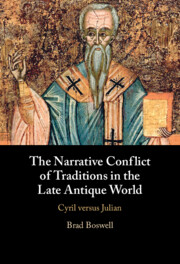
Chapter 1 begins with a selective history of Christian–Hellenic intellectual engagement (including a detailed introduction to Julian and Cyril) in order to show simultaneously (1) the historical uniqueness (thus significance) of Julian’s and Cyril’s polemical projects and (2) the fitness of Alasdair MacIntyre’s insights for making sense of their engagement. The second half of the chapter presents MacIntyre’s analysis of the dynamics when “two large-scale systems of thought and practice are in radical disagreement,” with Julian and Cyril in mind. What I call “narrative conflict” is only one part of the theory that emerges from his argument, the complete scope of which pushes us also to consider whether traditions so engaged might have non-intersecting forms of reasoning. The chapter concludes with a brief consideration of what Julian’s and Cyril’s “narrative conflict” might contribute to how we think about religious and philosophical argument in late antiquity.
Intellectual conflict between Early Christians and pagans was not uncommon during the first centuries of the Christian era, as is amply reflected in writings from this period. In this study, Brad Boswell deepens our understanding of the nature and aims of such conflict through a study of two key texts: Against the Galileans, by Roman Emperor Julian 'the Apostate,' and Against Julian, by bishop Cyril of Alexandria written nearly a century later. Drawing from Alasdair MacIntyre's philosophy of conflict between traditions, he explores how both texts were an exercise in 'narrative conflict' whose aim was to demonstrate the superior explanatory power of their respective traditions' narrative. Acknowledging the shared cultural formation between a pagan like Julian and a Christian like Cyril, Boswell challenges interpretive models emphasizing the points of commonality between the traditions. He offers a fresh approach to Julian's anti-Christian writings, provides the foundational analysis of Cyril's little-studied treatise, and invites reconsideration of the emerging Christian tradition within its intellectual contexts.
In her chapter, Rosie Lavan explores Eavan Boland’s relationship to two post-Revival poets, Padraic Fallon and Sheila Wingfield. These under-studied writers occupy an insecure position with respect to the legacies of the literary revival, particularly the work of Yeats. This was especially true of Fallon who believed Yeats’s influence to be deleterious to poets who followed him. As many critics have pointed out, Boland’s engagement with the Irish poetic tradition, particularly its emphasis on male mastery, is both powerful and ambivalent, for despite the critical gaze she trains on this tradition she is able to recognize and make use of Yeats’s poetic bequest. As Lavan shows, Wingfield provided a counter influence in the sense that her work depicted the struggle with the pressures of time. To resign herself to time, Boland came to understand, is to come to a fuller understanding of how she defines herself as a poet.
In chapter four, Sean Williams illustrates the creative potential of music and dance for the development of revivalism up to the present day. During the early years of the Revival, beginning in the 1890s, Irish dance and music were governed by strict ideas about form and performance promulgated by such groups as the Gaelic League. Music and dance, in different ways, underscore the difficulties of remaining connected to traditional standards while allowing the introduction of modern or non-Irish elements in singing style, dance steps, and instrumentation. At each stage of the development of cultural revivalism, cultural authenticity is vitally important. Despite apparent ruptures in the traditions of music and dance, both have flourished on a world stage with their “Irishness” intact. Because of the inclusion of non-Irish dance and vocal styles, a contemporary spectacle such as Riverdance, while quite different from traditional forms of dance, remain connected to broader revivalist concerns.
In her chapter, Elizabeth Crooke examines the work of nineteenth-century antiquarian scholar George Petrie and the poet and archivist Samuel Ferguson, who were vital to the formation of a modern revivalist movement. The accumulation of knowledge about the Irish past is a condition of freedom, for it stands as a bulwark against false and degrading historical representations and frees Irish institutions to use the recovery of cultural artifacts to support the process of national Bildung. Museums connect the past, through present cultural activity, to the realization of Ireland’s national future. This connection motivates the early designers of museums and other cultural institutions charged with preserving cultural artifacts to regard authenticity as a quality of cultural objects, an aura that transcends historical conditions. During the Decade of Centenaries (2012–2022), Petrie and Ferguson became themselves a part of Ireland’s future in the form of commemorations, the visible signs of institutional memory.
This chapter examines the Supreme Court’s practice, over approximately a century and a half, in developing and applying the “substantive due process” doctrine. The animating premise of that doctrine is that the Due Process Clause confers judicially enforceable protections against substantively unfair infringements of certain “unenumerated” yet fundamental or important rights. After the Court’s embarrassed climb down during the 1930s from a line of decisions enforcing rights to freedom of contract, the Court reembraced the Due Process Clause as a source of “unenumerated” rights in Roe v. Wade (1973) and, later, in decisions protecting rights to engage in private acts of sexual intimacy and extending the unenumerated right to marry to same-sex couples. Although the current Court overturned Roe in Dobbs v. Jackson Women’s Health Organization (2022), the majority opinion avoided a strictly originalist approach by embracing precedents holding that the Due Process Clause protects some fundamental substantive rights that are grounded in “tradition.” The chapter explores the conservative justices’ reasons for adopting that position. It also considers whether substantive due process decisions invalidating prohibitions against sodomy and laws defining marriage as necessarily involving one man and one woman can survive under the rationale of Dobbs.
This chapter surveys Supreme Court decisions involving the Second Amendment right “to keep and bear arms.” Nowhere is the current Court’s approach more originalist. Before 2008, the Court had never held that the Second Amendment protects a personal right to possess weapons unrelated to service in what the Amendment’s preamble characterizes as the need of “free states” for “a well-regulated militia.” This chapter describes events leading to the Court’s turnaround and analyzes its decisions since then. In applying other constitutional guarantees, the Court frequently asks whether restrictions are “narrowly tailored” to important or “compelling” governmental interests. By contrast, it insists that the permissibility of modern regulations of firearms depends exclusively on whether analogous restrictions were historically tolerated. In response to difficulties that the lower courts encountered in determining whether challenged regulations had historical analogues, the Court recently explained that precise factual similarity matters less than whether a modern restriction is “consistent with the principles that underpin our regulatory tradition.” Applying that test poses formidable challenges. But if the Court’s majority views its prescribed approach to defining Second Amendment rights as successful, it could imaginably extend its exclusive reliance on history and tradition to identify constitutional violations to other areas.
Cadorna frequently showed signs of psychological isolation and intolerance of discussion that were to prove a source of great complication. As the other 1914–1918 European commanders learnt by experience, leading a mass of citizen-soldiers called for reserves of diplomacy, skill in dealing with civil government, and a readiness to administer areas hitherto foreign to military life, like managing consensus and organizing propaganda. Those who adjusted to the job’s new political facets prospered, but the pure technocrats in uniform came into collision with their governments sooner or later and were deposed or were forced out by the pressure of a dissatisfied public opinion. Cadorna did not exactly shine at diplomacy with politicians: from the first weeks of his appointment, he created confrontation, tension, continual defiance and clashes. Above all, his solipsistic attitude would condition the Italian High Command in all its organization.
This article examines the recent transformation of marriage rituals in Turkey from the perspective of young brides. Based on ethnographic research conducted in Istanbul and Bursa in 2017–19, it discusses how young women construct their marital imaginaries through extravagant ceremonies and festivities such as proposals, photographs, henna nights, and weddings. Drawing from the theory of ritual economy, the article argues that their gendered desire for lavish spending does not position brides as victims of either traditional Turkish customs or the consumer market. Rather, the article emphasizes young women’s aspirations to romance and a sense of uniqueness, and their desire to feel as if they are “living a fairy tale.” These bridal imaginaries reflect the rise of neoliberal individualism, upward social mobility, and status-seeking in Bourdieu’s sense. The article’s findings contribute to the hitherto limited scholarship on changing marriage rituals and the wedding industry in Turkey.