To save content items to your account,
please confirm that you agree to abide by our usage policies.
If this is the first time you use this feature, you will be asked to authorise Cambridge Core to connect with your account.
Find out more about saving content to .
To save content items to your Kindle, first ensure no-reply@cambridge.org
is added to your Approved Personal Document E-mail List under your Personal Document Settings
on the Manage Your Content and Devices page of your Amazon account. Then enter the ‘name’ part
of your Kindle email address below.
Find out more about saving to your Kindle.
Note you can select to save to either the @free.kindle.com or @kindle.com variations.
‘@free.kindle.com’ emails are free but can only be saved to your device when it is connected to wi-fi.
‘@kindle.com’ emails can be delivered even when you are not connected to wi-fi, but note that service fees apply.
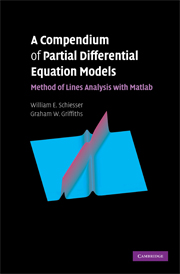
Mathematical modelling of physical and chemical systems is used extensively throughout science, engineering, and applied mathematics. To use mathematical models, one needs solutions to the model equations; this generally requires numerical methods. This book presents numerical methods and associated computer code in Matlab for the solution of a spectrum of models expressed as partial differential equations (PDEs). The authors focus on the method of lines (MOL), a well-established procedure for all major classes of PDEs, where the boundary value partial derivatives are approximated algebraically by finite differences. This reduces the PDEs to ordinary differential equations (ODEs) and makes the computer code easy to understand, implement, and modify. Also, the ODEs (via MOL) can be combined with any other ODEs that are part of the model (so that MOL naturally accommodates ODE/PDE models). This book uniquely includes a detailed line-by-line discussion of computer code related to the associated PDE model.
Recommend this
Email your librarian or administrator to recommend adding this to your organisation's collection.