To save content items to your account,
please confirm that you agree to abide by our usage policies.
If this is the first time you use this feature, you will be asked to authorise Cambridge Core to connect with your account.
Find out more about saving content to .
To save content items to your Kindle, first ensure no-reply@cambridge.org
is added to your Approved Personal Document E-mail List under your Personal Document Settings
on the Manage Your Content and Devices page of your Amazon account. Then enter the ‘name’ part
of your Kindle email address below.
Find out more about saving to your Kindle.
Note you can select to save to either the @free.kindle.com or @kindle.com variations.
‘@free.kindle.com’ emails are free but can only be saved to your device when it is connected to wi-fi.
‘@kindle.com’ emails can be delivered even when you are not connected to wi-fi, but note that service fees apply.
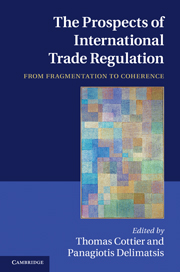
For a long time, the GATT led a life of its own as a self-contained regime. The evolution from tariff to non-tariff barriers brought about increasing overlaps with other regulatory areas. WTO rules increasingly interface with other areas of law and policy, including environmental protection, agricultural policies, labour standards, investment, human rights and regional integration. Against this backdrop, this book examines fragmentation in international trade regulation across a wide array of regulatory fields. To this end, it uses a conceptually coherent theoretical framework which is based on the effort to bring about greater coherence among different policy goals and fields, and thus to embed the multilateral trading system within the broader framework of international economics, law and relations. It will appeal to those interested in a forward-looking discussion of the most pressing issues of the international trade agenda.
Recommend this
Email your librarian or administrator to recommend adding this to your organisation's collection.