To save content items to your account,
please confirm that you agree to abide by our usage policies.
If this is the first time you use this feature, you will be asked to authorise Cambridge Core to connect with your account.
Find out more about saving content to .
To save content items to your Kindle, first ensure no-reply@cambridge.org
is added to your Approved Personal Document E-mail List under your Personal Document Settings
on the Manage Your Content and Devices page of your Amazon account. Then enter the ‘name’ part
of your Kindle email address below.
Find out more about saving to your Kindle.
Note you can select to save to either the @free.kindle.com or @kindle.com variations.
‘@free.kindle.com’ emails are free but can only be saved to your device when it is connected to wi-fi.
‘@kindle.com’ emails can be delivered even when you are not connected to wi-fi, but note that service fees apply.
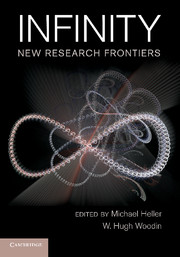
This interdisciplinary study of infinity explores the concept through the prism of mathematics and then offers more expansive investigations in areas beyond mathematical boundaries to reflect the broader, deeper implications of infinity for human intellectual thought. More than a dozen world-renowned researchers in the fields of mathematics, physics, cosmology, philosophy and theology offer a rich intellectual exchange among various current viewpoints, rather than displaying a static picture of accepted views on infinity. The book starts with a historical examination of the transformation of infinity from a philosophical and theological study to one dominated by mathematics. It then offers technical discussions on the understanding of mathematical infinity. Following this, the book considers the perspectives of physics and cosmology: can infinity be found in the real universe? Finally, the book returns to questions of philosophical and theological aspects of infinity.
Recommend this
Email your librarian or administrator to recommend adding this to your organisation's collection.