To save content items to your account,
please confirm that you agree to abide by our usage policies.
If this is the first time you use this feature, you will be asked to authorise Cambridge Core to connect with your account.
Find out more about saving content to .
To save content items to your Kindle, first ensure no-reply@cambridge.org
is added to your Approved Personal Document E-mail List under your Personal Document Settings
on the Manage Your Content and Devices page of your Amazon account. Then enter the ‘name’ part
of your Kindle email address below.
Find out more about saving to your Kindle.
Note you can select to save to either the @free.kindle.com or @kindle.com variations.
‘@free.kindle.com’ emails are free but can only be saved to your device when it is connected to wi-fi.
‘@kindle.com’ emails can be delivered even when you are not connected to wi-fi, but note that service fees apply.
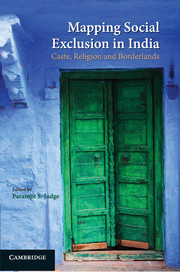
This book assesses the problem of defining exclusion, highlights the need for its contextualisation and establishes a relationship between social exclusion, deprivation and discrimination. It studies the complex mosaic of Indian systems and society, marked with exclusionary practices and structures on the basis of caste. It presents grassroots level information through empirical investigations and studies how physical spaces become sites of exclusion when borders become volatile. Scholars put together their diverse research, studies, perceptions and ideas and, most importantly, their years of expertise to focus on a central theme of social exclusion in Indian society. They study the role of the state as an interventionist force and look into the political mobilisation strategy as a reaction to exclusion. The book also takes a critical look at the reservation policy and argues that state intervention creates certain new forms of exclusion.
Recommend this
Email your librarian or administrator to recommend adding this to your organisation's collection.