To save content items to your account,
please confirm that you agree to abide by our usage policies.
If this is the first time you use this feature, you will be asked to authorise Cambridge Core to connect with your account.
Find out more about saving content to .
To save content items to your Kindle, first ensure no-reply@cambridge.org
is added to your Approved Personal Document E-mail List under your Personal Document Settings
on the Manage Your Content and Devices page of your Amazon account. Then enter the ‘name’ part
of your Kindle email address below.
Find out more about saving to your Kindle.
Note you can select to save to either the @free.kindle.com or @kindle.com variations.
‘@free.kindle.com’ emails are free but can only be saved to your device when it is connected to wi-fi.
‘@kindle.com’ emails can be delivered even when you are not connected to wi-fi, but note that service fees apply.
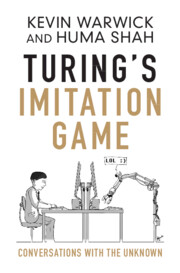
Can you tell the difference between talking to a human and talking to a machine? Or, is it possible to create a machine which is able to converse like a human? In fact, what is it that even makes us human? Turing's Imitation Game, commonly known as the Turing Test, is fundamental to the science of artificial intelligence. Involving an interrogator conversing with hidden identities, both human and machine, the test strikes at the heart of any questions about the capacity of machines to behave as humans. While this subject area has shifted dramatically in the last few years, this book offers an up-to-date assessment of Turing's Imitation Game, its history, context and implications, all illustrated with practical Turing tests. The contemporary relevance of this topic and the strong emphasis on example transcripts makes this book an ideal companion for undergraduate courses in artificial intelligence, engineering or computer science.
Recommend this
Email your librarian or administrator to recommend adding this to your organisation's collection.