To save content items to your account,
please confirm that you agree to abide by our usage policies.
If this is the first time you use this feature, you will be asked to authorise Cambridge Core to connect with your account.
Find out more about saving content to .
To save content items to your Kindle, first ensure no-reply@cambridge.org
is added to your Approved Personal Document E-mail List under your Personal Document Settings
on the Manage Your Content and Devices page of your Amazon account. Then enter the ‘name’ part
of your Kindle email address below.
Find out more about saving to your Kindle.
Note you can select to save to either the @free.kindle.com or @kindle.com variations.
‘@free.kindle.com’ emails are free but can only be saved to your device when it is connected to wi-fi.
‘@kindle.com’ emails can be delivered even when you are not connected to wi-fi, but note that service fees apply.
tom: … nearly everything Jane Austen wrote seems ridiculous from today's perspective.
audrey: Has it ever occurred to you that today, looked at from Jane Austen's perspective, would look even worse?
Whit Stillman, Metropolitan, 1990
Lots of fun with Jane Austen's novels is had in Helen Fielding's two volumes of Bridget Jones's Diary. The man of Bridget's dreams, as is now well known, is called Mark Darcy. She and Mark are introduced at a New Year's Day Turkey Curry Buffet, arranged by friends of Bridget's parents. When she first meets him, Mark (a ‘top human rights lawyer’) is standing aloof, scrutinising the contents of their bookshelves. Bridget, prejudiced against Darcy from the first, thinks him a snob, and her new boyfriend, the rake, Daniel, confirms this opinion when he tells her that he's known Mark since Cambridge and he's a nerdish old maid. Bridget and Mark continue to bump into each other at parties and cross swords, in a series of conversations, though Bridget gradually comes to see that Mark might really care for her. When Darcy goes to great lengths to rescue the family from the financial disaster that Bridget's insufferable mother's romantic escapade has plunged them into, she is ready to fall into his arms – or rather to climb the stairs to his bedroom.
Among the most important English novelists, Jane Austen is unusual because she is esteemed not only by academics but by the reading public. Her novels continue to sell well, and films adapted from her works enjoy strong box-office success. The trajectory of Austen criticism is intriguing, especially when one compares it to that of other nineteenth-century English writers. At least partly because she was a woman in the early nineteenth century, she was long neglected by critics, hardly considered a major figure in English literature until well into the twentieth century, a hundred years after her death. But consequently she escaped the reaction against Victorianism that did so much to hurt the reputation of Dickens, Tennyson, Arnold, and others. How she rose to prominence among academic critics - and has retained her position through the constant shifting of academic and critical trends - is a story worth telling, as it suggests not only something about Austen's artistry but also about how changes in critical perspective can radically alter a writer's reputation. Laurence W. Mazzeno is President Emeritus of Alvernia University, Reading, Pennsylvania.
It is common to speak of Jane Austen's novels as a miracle; the accepted attitude to them is conveniently summarized by Professor Caroline Spurgeon in her address on Jane Austen to the British Academy:
But Jane Austen is more than a classic; she is also one of the little company whose work is of the nature of a miracle … That is to say, there is nothing whatever in the surroundings of these particular writers [Keats, Chatterton, Jane Austen, Emily Brontë], their upbringing, opportunities or training, to account for the quality of their literary work.
The business of literary criticism is surely not to say ‘ Inspiration’ and fall down and worship, and in the case of Jane Austen it is certainly not entitled to take up such an unprofitable attitude. For in Jane Austen literary criticism has, I believe, a uniquely documented case of the origin and development of artistic expression, and an enquiry into the nature of her genius and the process by which it developed can go very far indeed on sure ground. Thanks to Dr Chapman's labours we have for some time had at our disposal a properly edited text of nearly all her surviving writings, and scholarship, in his person chiefly, has brilliantly made out a number of interesting facts which have not yet, however, been translated into the language of literary criticism.
They belong to a class of fictions which has arisen almost in our own times, and which draws the characters and incidents introduced more immediately from the current of ordinary life than was permitted by the former rules of the novel.
– SIR WALTER SCOTT ON JANE AUSTEN'S NOVELS IN A REVIEW OF Emma
Chapter 3 argues that Jane Austen revisited themes from her juvenilia in her published novels, especially Sense and Sensibility (1811) and Mansfield Park (1814), both of which were also lightly revised after initial publication in response to readers and reviewers.They display Austen’s concern with improving her texts and using accurate technical language.Austen’s cautionary stance on “sensibility,” especially female sensibility, within Sense and Sensibility was first developed within her juvenilia and functions as a critique of late eighteenth-century sentimental tropes.Austen’s ambiguous stance regarding the wild women of Mansfield Park, especially when interpreted through the lens of her earlier writings, can be read as an implicit criticism of the systems of female education and marriage that produce their immoral behavior.The chapter’s conclusion shows the culmination of Austen’s masterful revision practices in The Watsons (c.1803) and Persuasion (1817), which are linked to clear stylistic improvements and keen social commentary on the condition of women.
Two decades of intense experimentation and revision preceded the publication of Jane Austen's six major novels: Sense and Sensibility (1811), Pride and Prejudice (1813), Mansfield Park (1814), Emma (1815), Northanger Abbey (1818), and Persuasion (1818). Constantly playing off the tradition, she merges the dramatic interiority of Samuel Richardson with the authorial voice of Henry Fielding to expose characters' minds while prompting the judgement of readers. That flexible narrative voice would catch the attention of Henry James and Virginia Woolf, among others. Even in her last unfinished fragment, Sanditon, Austen was still evolving new techniques and subjects. But her affection for irony, satire, and parody derives just as clearly from Restoration and eighteenth-century drama. Thus Austen, poised between two centuries, writes novels that are as compact, witty, and incisive as plays. Austen's relation to predecessors and contemporaries may be traced through the books she owned, says she has read, alludes to, or seems to echo. Even that may represent a mere fraction of what she knew, for as F. R. Leavis remarks, 'she read all there was to read, and took all that was useful to her - which wasn't only lessons'. Like most authors, Austen made books out of other books as well as out of life. If readers are active rather than passive consumers of texts, so too writers poach freely from other writers. Thus Austen's appropriations signify not lack of imagination, not plagiarism, not submission to 'influence', but sheer competitiveness. Her rewriting of fellow novelists particularly implies critique, for comparisons reveal her irresistible literary-critical impulse to improve upon them.
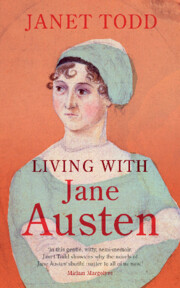
Fanny Price, in Mansfield Park, tells her persistent suitor that 'we have all a better guide in ourselves...than any other person can be'. Sometimes, however, we crave external guidance: and when this happens we could do worse than seek it in Jane Austen's own subtle novels. Written to coincide with Austen's 250th birthday, this approachable and intimate work shows why and how - for over half a century - Austen has inspired and challenged its author through different phases of her life. Part personal memoir, part expert interaction with all the letters, manuscripts and published novels, Janet Todd's book reveals what living with Jane Austen has meant to her and what it might also mean to others. Todd celebrates the undimmable power of Austen's work to help us understand our own bodies and our environment, and teach us about patience, humour, beauty and the meaning of home.
This collection of essays covering many aspects of Austen's life, works and historical context provides the fullest introduction in one volume to the life and times of Jane Austen. Jane Austen in Context is a generously illustrated collection of short, lively contributions arranged alphabetically, and covering topics from biography to portraits and agriculture to transport. An essay on the reception of Austen's work is also included, showing how criticism of Austen has responded to literary movements and fashions. The volume emphasises the subtle interactions between Austen's life and times and her novels. This is a work of reference that readers and scholars of Austen will turn to again and again.
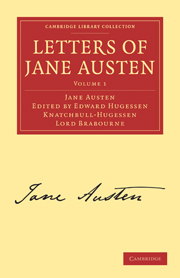
The son of Jane Austen's 'favourite niece' Fanny Knight, Lord Brabourne, had inherited a large number of letters from Jane Austen including some to her sister Cassandra and others to members of the Knight family. The Letters of Jane Austen (1884) publishes these letters for the first time, and sets them in a family context drawn from the reminiscences of those who knew Austen personally. This second of two volumes presents a series of letters written between 1808 and her death in 1817, that is, mostly in the years she was settled at Chawton in Hampshire; in addition Brabourne includes a little group of poems, and other family documents. The letters cover the years of her career as a published author, and include many fascinating comments about her own and others' writings, as well as observations about the world around her.
In ‘The Jane Austen Syndrome’, Marjorie Garber – a Shakespeare scholar and self-confessed sufferer from the syndrome her 2003 essay describes – contributes to a long tradition of criticism asserting Jane Austen's kinship with the Bard. It is not only the case that this pair represent English literature's most masterful creators of character and dialogue. Nor for Garber do the similarities end when we acknowledge that Austen and Shakespeare are cultural icons, possessed of, and perhaps cursed by, a celebrity independent of their perceived value as writers. ‘More than any other authors I know’, she asserts, ‘Austen and Shakespeare provoke outpourings of love.’ That last remark registers the contribution Garber's essay makes to a second venerable strain in Austen's reception history, a tradition of commentary on the ardent identifications that the novels inspire. Jane Austen fosters in her readers, as most other literary giants do not, the devotion and fantasies of personal access that are the hallmarks of the fan. For a century, therefore, many a commentator has accompanied his interest in the novels with an interest in the extravagancy of audiences’ responses to them – an interest, particularly, in how that heady enthusiasm diverges from the level-headed dispassion that is supposed to define a proper aesthetic response. Thus Henry James in 1905 remarks on the rising ‘tide’ of Austenian ‘appreciation’ and finds it, he observes waspishly, to have risen, thanks to the ‘stiff breeze of the commercial’, ‘rather higher … than the high-water mark, the highest, of her intrinsic merit’. John Bailey (1864–1931) notes while introducing his 1927 ‘Georgian Edition’ of her fiction ‘the extraordinary spread of the cult of Jane Austen’ and explains the cult's recruitment successes with a paradox: the passage of time, though putting more distance between her era and readers’, has increased the intimacy of the author–reader relation. ‘She has ceased to be the ‘Miss Austen’ of our parents and become our own ‘Jane Austen’ or even ‘Jane’.’
As Bailey implies when he contrasts his parents’ generation and his own, the late Victorian period is when readers began thinking of Austen as an author with whom they might be on an intimate, first-name footing – whom they could love rather than merely esteem.
Jane Austen has been read as a novelist of manners, whose work discreetly avoids discussing the physical. John Wiltshire shows, on the contrary, how important are faces and bodies in her texts, from complainers and invalids like Mrs Bennet and Mr Woodhouse, to the frail, debilitated Fanny Price, the vulnerable Jane Fairfax, and the 'picture of health', Emma. Talk about health and illness in the novels is abundant, and constitutes community, but it also serves to disguise the operation of social and gender politics. Behind the medical paraphernalia and incidents are serious concerns with the nature of power as exerted through and on the body, and with the manifold meanings of illness. 'Nerves', 'spirits', and sensibility figure largely in these books, and Jane Austen is seen to offer a critique of the gendering power of illness and nursing or attendance upon illness. Drawing both on modern - medical and feminist - theories of illness and the body as well as on eighteenth-century medical sources to illuminate the novels, this book offers new and controversial, but also scholarly, readings of these familiar texts.
The son of Jane Austen's 'favourite niece' Fanny Knight, Lord Brabourne, had inherited a large number of letters from Austen including some to her sister Cassandra and others to members of the Knight family. The Letters of Jane Austen (1884) publishes these letters for the first time, and sets them in a family context drawn from the reminiscences of those who knew Austen personally. This first of two volumes begins with a biographical essay and then includes letters from 1796, when Austen was a young woman of twenty preoccupied with social events and the courtship of her friends, to 1807, which found her in lodging with her mother and sister in Southampton, much sobered by the recent death of her father. Her topics are often domestic ('You know how interesting the purchase of a sponge-cake is to me') and her wit is evident throughout.
When James Edward Austen-Leigh's Memoir of his famous aunt was published in 1870, far from satisfying public curiosity about Jane Austen as the family had intended, it simply raised a series of new questions, particularly about Jane Austen's unpublished work, which had been mentioned only in passing. Austen Leigh was persuaded to issue a much-expanded second edition in 1871. Here he included for the first time the complete texts of Jane Austen's novel in letters, Lady Susan, and the fragmentary novel The Watsons, as well as a brief summary of her last unfinished work, later known as Sanditon. At the same time he took the opportunity to revise the biographical sections of the Memoir partly to include new information that had come to light since the first edition, so that all in all the second edition has a significance for Austen scholars quite separate from the first.
Jane Austen was received by her contemporaries as a new voice, but her late twentieth-century reputation as a nostalgic reactionary still lingers on. In this radical revision of her engagement with the culture and politics of her age, Peter Knox-Shaw argues that Austen was a writer steeped in the Enlightenment, and that her allegiance to a sceptical tradition within it, shaped by figures such as Adam Smith and David Hume, lasted throughout her career. Knox-Shaw draws on archival and other neglected sources to reconstruct the intellectual atmosphere of the Steventon Rectory where Austen wrote her juvenilia, and follows the course of her work through the 1790s and onwards, showing how minutely responsive it was to the many shifting movements of those turbulent years. Jane Austen and the Enlightenment is an important contribution to the study both of Jane Austen and of intellectual history at the turn of the nineteenth century.
To articulate the past historically does not mean to recognise it ‘the way it really was’. It means to seize hold of a memory as it flashes up at a moment of danger … In every era the attempt must be made anew to wrest tradition away from a conformism that is about to overpower it.
Walter Benjamin, ‘Theses on the Philosophy of History’
‘Re-vision’ – ‘the act of looking back, of seeing with fresh eyes, of entering an old text from a new critical direction’ – has been the name of the game in literary and cultural criticism for the last three decades. Meanwhile ‘revision’, in the sense of borrowing from an original to further one's own artistic purposes, has been pursued even more vigorously within the novel, the theatre and film. Inevitably, perhaps, it has been Shakespeare who has served as the cultural hero against whom most artists have wanted to measure themselves, playfully or angrily rewriting the plays from radical, postcolonial, feminist, lesbian or gay points of view, or borrowing from his plots to give added resonance to their own enterprises. There is an immense range and variety of such ‘appropriations’. From the disconcerting eruption into Gus Van Sant's tale of Seattle rentboys, My Own Private Idaho (1991) of lines and even whole scenes of Henry IV, to the incestuous Lear of Jane Smiley's A Thousand Acres (1991) Shakespeare has been ‘plundered’ to serve purposes as diverse as diligent modernisation and outright burlesque.
It is a truth universally acknowledged that in private life Jane Austen was deeply religious. Henry Austen’s Notice stresses her charity, ‘Faultless herself, she always sought, in the faults of others, something to excuse, to forgive or forget. . . . She never uttered a hasty, a silly or a severe expression.’ Her devotion is the other prominent aspect. ‘She was thoroughly religious and devout; fearful of giving offence to God, and incapable of feeling it towards any fellow creature.’
But critics have generally held that her religion has not influenced her novels in any major way and have given it little attention. An exception was Angus Wilson in his series of broadcast talks on Evil in the English Novel, in which he maintained that religious belief and practice influenced Jane Austen’s art directly, though his suggestion that the material of her novels, ‘Three or Four Families in a Country Village’, reflects a belief that the salvation of one’s soul can best be achieved in retirement from ‘the world’ seems to me to be mistaken. The more one reads the novels the more one becomes aware that they are written from an essentially religious outlook on life but that this is so absorbed and taken for granted in her thinking that it is only occasionally made explicit. And, of course, it is an outlook profoundly influenced by the reading and preaching available to her in the early nineteenth century, characterized by a reticence in the expression of faith and a keen interest in the moral life—‘By their fruits ye shall know them’.