To save content items to your account,
please confirm that you agree to abide by our usage policies.
If this is the first time you use this feature, you will be asked to authorise Cambridge Core to connect with your account.
Find out more about saving content to .
To save content items to your Kindle, first ensure no-reply@cambridge.org
is added to your Approved Personal Document E-mail List under your Personal Document Settings
on the Manage Your Content and Devices page of your Amazon account. Then enter the ‘name’ part
of your Kindle email address below.
Find out more about saving to your Kindle.
Note you can select to save to either the @free.kindle.com or @kindle.com variations.
‘@free.kindle.com’ emails are free but can only be saved to your device when it is connected to wi-fi.
‘@kindle.com’ emails can be delivered even when you are not connected to wi-fi, but note that service fees apply.
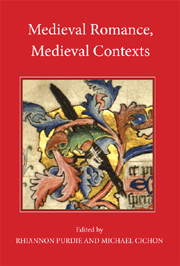
The popular genre of medieval romance explored in its physical, geographical, and literary contexts. The essays in this volume take a representative selection of English and Scottish romances from the medieval period and explore some of their medieval contexts, deepening our understanding not only of the romances concerned but also of the specific medieval contexts that produced or influenced them. The contexts explored here include traditional literary features such as genre and rhetorical technique and literary-cultural questions of authorship, transmission and readership; but they also extend to such broader intellectual and social contexts as medieval understandings of geography, the physiology of swooning, or the efficacy of baptism. A framing context for the volume is provided by Derek Pearsall's prefatory essay, in which he revisits his seminal 1965 article on the development of Middle English romance. Rhiannon Purdie is Senior Lecturer in English, University of St Andrews; Michael Cichon is Associate Professor of English at St Thomas More College in the University of Saskatchewan.
This book is called a manifesto because it has an unapologetically political objective. Richard Utz wants to help reform the way we think about and practise our academic engagement with medieval culture, and he uses his own observations as a medievalist and medievalism-ist over the last twenty-five years to offer ways in which we might reconnect with the general public that has allowed us to become, since the late nineteenth century, a rather exclusive clan of specialists who communicate mostly with each other. The traditional academic study of the Middle Ages, after more than a century of growing and plateauing, is now on the decline. While, at least over the next five to ten years, we will still be basking in the reassuring proximity (at conferences) of thousands of others who are involved in what we do ourselves, there is a manifest discrepancy between the large number of students who request that we address their love of Harry Potter, Lord of the Rings, Game of Thrones, and medieval-themed video and computer games, and the decreasing number of actual medievalists hired to replace retiring colleagues. We should pursue more lasting partnerships with so-called amateurs and enthusiasts for the sake of a sustainable future engagement with medieval culture. Richard Utz suggests some ways we might do this, and looks forward to 'a more truly co-disciplinary, inclusive, democratic, and humanistic engagement with what we call, for better or worse, the Middle Ages'.
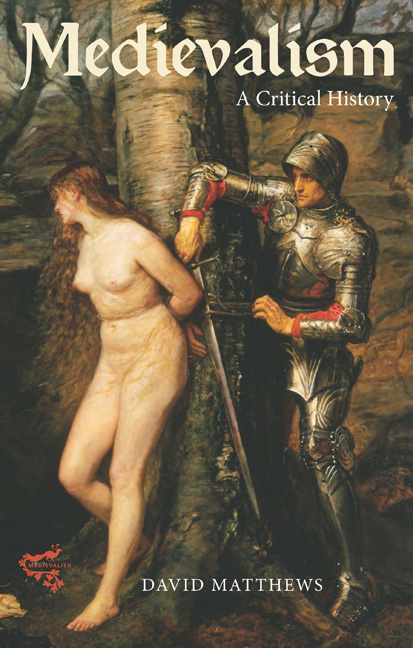
The field known as 'medievalism studies' concerns the life of the Middle Ages after the Middle Ages. Originating some thirty years ago, it examines reinventions and reworkings of the medieval from the Reformation to postmodernity, from Bale and Leland to HBO's Game of Thrones. But what exactly is it? An offshoot of medieval studies? A version of reception studies? Or a new form of cultural studies? Can such a diverse field claim coherence? Should it be housed in departments of English, or History, or should it always be interdisciplinary? In responding to such questions, the author traces the history of medievalism from its earliest appearances in the sixteenth century to the present day, across a range of examples drawn from the spheres of literature, art, architecture, music and more. He identifies two major modes, the grotesque and the romantic, and focuses on key phases of the development of medievalism in Europe: the Reformation, the late eighteenth century, and above all the period between 1815 and 1850, which, he argues, represents the zenith of medievalist cultural production. He also contends that the 1840s were medievalism's one moment of canonicity in several European cultures at once. After that, medievalism became a minority form, rarely marked with cultural prestige, though always pervasive and influential. Medievalism: a Critical History scrutinises several key categories - space, time, and selfhood - and traces the impact of medievalism on each. It will be the essential guide to a complex and still evolving field of inquiry. David Matthews teaches medieval studies at the University of Manchester.
In recent years the general disregard of our field toward medievalisms outside Europe and the Anglophone world has changed noticeably. Volumes such as the 2009 Medievalisms in the Postcolonial World, which Kathleen Davis and I co-edited, as well as Michelle Warren's 2011 Creole Medievalism, have been fully dedicated to the topic. Others have had at least a section on medievalism outside Europe, such as the papers devoted to “countries without a Middle Ages” in Revista de poética medieval's special 2008 issue on medievalisms, which was edited by César Domínguez, and the project Le Moyen Âge vu d'ailleurs, which included four international conferences, several interim publications, and a recent volume by the same name, edited by Eliana Magnani in 2010. These last examples are of particular interest to my current concerns because they include position essays about the meaning and scope of Ibero-American medievalism and were written by local medievalists. The ideas of medievalists regarding the meaning of the Middle Ages in their local context, and especially the persistence of “the medieval” in post-independence nineteenth-century Brazil, will be the main topics of this essay. My discussion of the medieval in nineteenth-century Brazil will note similarities between, on the one hand, current academic medievalism as it appears in the recent critical literature and, on the other hand, the main text I will discuss, Euclides da Cunha's Os Sertões (Rebellion in the Backlands), Brazil's national- foundational text. I will conclude by submitting that Brazilian medievalisms can point to a more spacious and ethically alert meaning for our field, urging the contemporary medievalism collective to a desirable expansion out of our current comfort zones.
Postcolonial Medievalism and Marginality
Not surprisingly, Ibero-American essays like those published in the Revista de poética medieval and Le Moyen Âge vu d'ailleurs take medieval studies as a field established in the metropolitan centers of the European world.
In this paper I would like to address a question that is absolutely central to the definition of “medievalism”: namely, should this term be used for everything that derives from the Middle Ages, or should it be reserved for post-medieval interest in the revival of phenomena belonging to the period or notion of the Middle Ages? The importance of this question has been underscored by its great relevance to many of the conferences and publications sponsored by Studies in Medievalism over the years. Moreover, I am convinced that in limiting the possibility of conclusively theorizing about or mapping medievalism, the ambiguity addressed by this question has significantly hampered scholarly interest in the field. I therefore believe we must tackle this question directly and stake our position(s) in relationship to it.
Of course, I have no illusion that I can give anything near a definitive answer to it, but I would like to contribute to the debate on it by taking up Leslie Workman's classic position that medievalism is the continued construction of the Middle Ages. In one of his editorial introductions, which also observes that the term “The Middle Ages” was a Renaissance humanist creation that has “been elaborated and reinforced from different perspectives from the sixteenth century to the present,” Workman wrote: “[…] medieval historiography, the study of the successive recreation of the Middle Ages by different generations, is the Middle Ages. And this of course is medievalism.”