To save content items to your account,
please confirm that you agree to abide by our usage policies.
If this is the first time you use this feature, you will be asked to authorise Cambridge Core to connect with your account.
Find out more about saving content to .
To save content items to your Kindle, first ensure no-reply@cambridge.org
is added to your Approved Personal Document E-mail List under your Personal Document Settings
on the Manage Your Content and Devices page of your Amazon account. Then enter the ‘name’ part
of your Kindle email address below.
Find out more about saving to your Kindle.
Note you can select to save to either the @free.kindle.com or @kindle.com variations.
‘@free.kindle.com’ emails are free but can only be saved to your device when it is connected to wi-fi.
‘@kindle.com’ emails can be delivered even when you are not connected to wi-fi, but note that service fees apply.
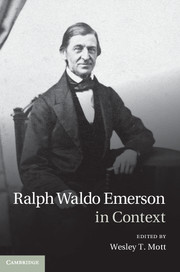
This collection of newly commissioned essays maps the vital contextual backgrounds to Ralph Waldo Emerson's life and work. The volume begins with a detailed chronology of Emerson's life and publishing history, setting the stage for a wide-ranging discussion of his geographic and environmental contexts from early and later life, including his travels and intellectual encounters with the United States, Europe and Asia. It goes on to survey the intellectual terrain of the nineteenth century, exploring Emerson's relationship with key philosophical, aesthetic, theological, scientific, familial, social and political contexts and issues. Finally, it assesses the popular and critical receptions that have solidified Emerson's legacy as a towering figure in American literature, criticism and culture today. Fans, students and scholars will turn to this reference time and again for a fuller understanding of this seminal American writer.
Emerson, said Matthew Arnold, addressing an American audience, ‘was your Newman, your man of soul and genius, speaking to your bodily ears, a present object for your heart and imagination’. Any close resemblance between the two is not, however, easy to establish and need not be attempted. But Emerson compares with the great ecclesiastical leader at least in his power to command a devoted following. He also was an eloquent prose writer, although his poeticizing rhetoric is harder to appreciate in our day than it was in his own. Like Carlyle, moreover, whom he greatly admired, he is a prophet whose message no longer stirs us. But no American religious thinker of his time had anything like his influence or enjoyed such general esteem.
Born, in 1803, the son of a Unitarian minister, Ralph Waldo Emerson was educated at the Boston Latin School and at Harvard University. At first, though an omnivorous reader, he showed no special intellectual promise. In 1819 he began to keep a journal whose entries testify at once a youthful romanticist ardour and a New England conscience. He himself entered the Unitarian ministry, but doubts and mental depression, accentuated if not brought on by the deaths of his young wife and his two favourite brothers, Charles and Edward, combined with his own none too robust physical health to cause him to abandon it in 1832. Free now of professional responsibilities he was able to visit Europe, and whilst in Britain he met Landor, Coleridge, Wordsworth and Carlyle, the last of whom alone seriously impressed him.
Emerson describes a range of experiences that constitute friendship: titanic battles between beautiful enemies; conversational brilliance and expansion; a joyful solitude, as if someone has departed rather than arrived; a generalized benevolence toward people in the street to whom one does not speak; the warm sympathies and household joy one shares with a familiar friend; the disappointment of a friend outgrown. His account shows an intense focus on moral perfection – on our unattained but attainable self, alone and with others – but an equally intense awareness of what he calls in “Experience” “the plaint of tragedy” that sounds throughout our lives “in regard to persons, to friendship and love.” The chapter’s coda charts the opposition in “Love” between love as the experience of being “swept away” and a skeptical vision of marriage as a prison, from which sex, person, and partiality have vanished.
Ralph Waldo Emerson, whose life spanned most of the nineteenth century, is widely regarded as one of the greatest sages in the history of American thought. Among educated American citizenry, Emerson is probably the most commonly read indigenous philosopher—and for good reason. Emerson presents a vision of human beings and their place in the universe which gives meaning and stature to the human condition. His profound, even religious, optimism, gives structure and import to even the smallest and apparently least significant of human activities. The inspirational quality of Emerson's, prose, his willingness to travel far and wide to lecture, his ability to help people transcend the difficulties of the times, all led to his very great national as well as international significance.
Professor Cornelius Felton of Harvard University, reviewing Emerson's Essays, First Series in 1841, predicted that self-reliance “if acted upon, would overturn society, and resolve the world into Chaos.” Since then a long line of Emerson critics have shared Felton's concern over Emerson's radicalism. The more temperate modern version of Felton's charge is that Emerson “brought to full consciousness … the antinomianism latent in the thought of his Puritan forbears.” According to these critics, Emerson is the spiritual descendant of Anne Hutchinson. Removed outside the constraints of seventeenth-century dogma and liberated by Romantic thought, he gives free play to the antinomianism she so cautiously denied. Antinomianism, in this view, lends unity to the disparate writers of the American Renaissance and continuity to the whole of early American literature.
Explicit or implicit in nearly everything Emerson wrote is the conviction that nature bats last, that nature is the law, the final word, the supreme court. Others have believed - still believe - that the determining force in our lives is grace, or that it is the state - the polis, the community - or that it is the past. More recently it has been argued that the central force is economics or race or sex or genetics. Emerson's basic teaching is that the fundamental context of our lives is nature. Emerson's definition of nature is a broad one. Nature is the way things are. Philosophically, Emerson says, the universe is made up of nature and the soul, or nature and consciousness. Everything that is not me is nature; nature thus includes nature (in the common sense of the green world), art, all other persons, and my own body.
In his discerning book entitled Emerson's Angle of Vision, Sherman Paul has pointed out two fundamental ways in which Whitehead, in spite of some obvious differences, is like Emerson. Both Emerson and Whitehead, says Paul, exalted the moral, ethical, and imaginative science of the seventeenth century over the analytical rationalism of the eighteenth century, and, as a logical consequence of this emphasis, both condemned Lockean sensationalism in the same way. Following Professor Paul's suggestion, the purpose of this study is to explore in some detail the basic views of Emerson and Whitehead about religion—man's relation to Nature and God. The remarkable similarities between the views of Emerson and those of Whitehead on this subject may not indicate much, if any, indebtedness of the twentieth-century philosopher to his nineteenth-century predecessor, but if these parallels are extensive and important enough, they may well indicate that Whitehead's total achievement in the philosophy of religion is like that of Emerson—that, religiously, Whitehead may be said to be a kind of twentieth-century Emerson, in one important way, as may appear, more of a transcendentalist than Emerson. Indeed, though the obscurity of his style will prevent him from being as popular as his predecessor, Whitehead's influence as a leader in the religious revolt against the “philosophy of logical analysis” and the other philosophies that make ours an “age of analysis” may in time be as great as that of Emerson in the similar romantic-transcendentalist revolt against the analytical rationalism of the age of “Enlightenment.” More of this later, but first let us examine the evidence.
Students of Emerson, as well as those who have followed the reception of Shakespeare in America, have been disturbed over the words in the essay “Shakspeare; or, the Poet” from Representative Men in which Emerson seems finally to condemn Shakespeare as a “master of revels to mankind” who, after all, shared “the halfness and imperfection of humanity.” Thus Emerson's criticism, it has been said, is “deficient in sympathy,” and “the key to all he has said and written is to be found in the fact that his point of view is not that of the acceptor, the creator,—Shakespeare's point of view, but that of the refiner and selector, the priest's point of view.”
The American Critical Archives was a series of reference books that provide representative selection of contemporary reviews of the main works of major American authors. Specifically each volume contains both full reviews and excerpts from reviews that appeared in newspapers and weekly and monthly periodicals generally within a few months of the publication of the work concerned. There is an introductory historical overview by the volume editor, as well as checklists of additional reviews located but not quoted. This book represents the first comprehensive collection of contemporary reviews of the writings of Ralph Waldo Emerson and Henry David Thoreau. Many of the reviews are reprinted from hard-to-locate contemporary newspapers and periodicals.
Emerson has been called many things, but except by theological stalwarts outraged by the Divinity School “Address,” “radical” has seldom been one of them. Disposed by taste and training to the rule of gentlemen, he was appalled by the Jacksonian rabble even as he saw it impelled by a feeling of human worth much like his own. Emerson's practical politics were instinctively conservative; the political coloring of his writings is harder to assess. It was once commonplace to observe that the literary Emerson had no politics at all and little sense of history as progressive or teleological. Nature and the Soul were timeless; only the outward costumes and idioms changed. More recently, Emerson has been historicized by embedding him within an American world “poised,” as Carolyn Porter has said, “on the verge of the most accelerated capitalist development in modern history.” Surely no contemporary registered the new economic forces more acutely than Emerson did. Yet if the Emerson of the 1940s and 'SOS was construed as loftily indifferent to the currents of the age, the Emerson of the 1980s and '90s has been portrayed as ideologically captive to them.
I wonder if I am the only reader of Emerson who weeps over the death of his son in 1842. I have never heard anyone else confess to this reaction, although the story of how Emerson's “Experience” refers to Waldo Emerson's death is told briefly by Emerson himself, in the willfully perverse third paragraph of the essay. Then it is narrated repeatedly by twentieth-century scholars and critics, who treasure this moment as the most dramatic autobiographical reference in Emerson's published prose: 'In the death of my son, now more than two years ago, I seem to have lost a beautiful estate, - no more. I cannot get it nearer to me. If tomorrow I should be informed of the bankruptcy of my principal debtors, the loss of my property would be a great inconvenience to me, perhaps, for many years; but it would leave me as it found me, - neither better nor worse.'
Chapter 10 charts Emerson’s long engagement with Hinduism, from his college years, when he rejected what he thought of as “Indian Superstition,” to the presence of the Vishnu Purāna and Bhagavad Gīta in some of his greatest essays. In “Plato, or the Philosopher,” Emerson draws from these works the idea of a fundamental unity – “The whole world is but a manifestation of Vishnu” – and credits Plato with absorbing, enhancing, and representing the “unity of Asia and the detail of Europe.” Emerson’s Plato is a representative of Emerson himself, a man who made lists of opposing East-West properties and tendencies on the same pages where he recorded passages from the Vishnu Purāna. Emerson finds a skeptical strain within Hinduism, particularly in “Illusions.” But he also weaves in the contrary vision of deep, but momentary, insight: “by and by, for an instant, the air clears, and the cloud lifts a little.”
Though in some ways Ralph Waldo Emerson (1802–1882) and Edgar Allan Poe (1809–1849) are contrasting figures in the history of American Romanticism, scholarship over the past thirty years connects them as writers whose work articulates concerns over race and enslavement. Moreover, critical recognition that each writer engages such matters emerged only in the late twentieth century, after decades of work that effaced each writer’s political resonance. This chapter approaches these issues through some of the signal trends that have informed scholarship on Emerson and Poe over the past thirty years.
In 1833, Waldo Emerson (as he still called himself) gave a talk at the Unitarian chapel in Edinburgh, Scotland. At least one member of the audience remembered it ecstatically: 'The originality of his thoughts, the consummate beauty of the language in which they were clothed, the calm dignity of his bearing, the absence of all oratorical effect, and the singular directness and simplicity of his manner . . . made a deep impression on me. . . . His voice was the sweetest, the most winning and penetrating of any I ever heard.' The enthusiastic auditor might have added that the go-year-old visiting American speaker did not receive any sort of fee.
When Henry Thoreau began to keep a journal, in October 1837, he almost certainly did so in response to the prompting of Ralph Waldo Emerson: “ 'What are you doing now?' he asked, 'Do you keep a journal?' - So I make my first entry to-day ” (PJ 1:s). Eventually the Journal became the major work of Thoreau’s imaginative life, providing the raw material for his published writings and filling nearly fifty notebooks by the time of his death in May 1862. When Thoreau died, Emerson arranged for the funeral service to be held at Concord’s First Parish Church, and he delivered the eulogy. Emerson expanded his address for the Atlantic Monthly, in August, and reprinted it as the introduction to the volume of Thoreau’s Excursions, which he helped to edit in 1863. Eventually, Emerson’s “Thoreau ” came to stand as the introduction to the twenty-volume Houghton Mifflin “Walden Edition ” (1906) that has been the standard text of Thoreau’s writings for most of the twentieth century.
Thus, Emerson not only called Thoreau into being as a writer but also launched him toward posterity with the first extended account of his life and career. As we shall see, Emerson’s "Thoreau" was hardly the typical laudatory summing-up of a departed friend’s life and achievements. Enormously influential in defining the terms of Thoreau’s reception and of the critical discourse about him in the following century, Emerson’s memorial was also the last word in a long personal struggle between the two men: a struggle to be heard, to be understood, to prevail philosophically, and to realize the high and noble friendship that each aspired to but despaired of ever achieving. During the early years of Thoreau’s literary career, Emerson played a central role as mentor and adviser, giving their relationship a professional, as well as a personal, dimension that further complicated it.
Ralph Waldo Emerson is the central figure in American political thought. Until recently, his vast influence was most often measured by its impact on literature, philosophy and aesthetics. In particular, Emerson is largely responsible for introducing idealism into America in the form of living one's life self-reliantly. But in the past few decades, critics have increasingly come to realize that Emerson played a key role in abolitionism and other social movements around the time of the American Civil War. This selection for Cambridge Texts in the History of Political Thought highlights not only Emerson's practical political involvement, but also examines the philosophical basis of his political writings. All of the usual series features are included, with a concise introduction, notes for further reading, chronology and apparatus designed to assist undergraduate and graduate readers studying this greatest of American thinkers for the first time.