We use cookies to distinguish you from other users and to provide you with a better experience on our websites. Close this message to accept cookies or find out how to manage your cookie settings.
The home of original, interdisciplinary thinking on how military power works within different sites and locales, from everyday settings to geopolitical arenas.
To save content items to your account,
please confirm that you agree to abide by our usage policies.
If this is the first time you use this feature, you will be asked to authorise Cambridge Core to connect with your account.
Find out more about saving content to .
To save content items to your Kindle, first ensure no-reply@cambridge.org
is added to your Approved Personal Document E-mail List under your Personal Document Settings
on the Manage Your Content and Devices page of your Amazon account. Then enter the ‘name’ part
of your Kindle email address below.
Find out more about saving to your Kindle.
Note you can select to save to either the @free.kindle.com or @kindle.com variations.
‘@free.kindle.com’ emails are free but can only be saved to your device when it is connected to wi-fi.
‘@kindle.com’ emails can be delivered even when you are not connected to wi-fi, but note that service fees apply.
This is a not a book about peacekeeping practices. This is a book about storytelling, fantasies, and the ways that people connect emotionally to myths about peacekeeping. The celebration of peacekeeping as a legitimate and desirable use of military force is expressed through the unproblematized acceptance of militarism. Introducing a novel framework - martial peace - the book offers an in-depth examination of the Canadian Armed Forces missions to Afghanistan and the use of police violence against Indigenous protests in Canada as case examples where military violence has been justified in the name of peace. It critically investigates the peacekeeper myth and challenges the academic, government, and popular beliefs that martial violence is required to sustain peace.
This book explores the ways in which affect, colonial histories, and militarism organise global security workforces within private military and security companies (PMSCs). It locates its analysis with Gurkhas; a group of militarised men from Nepal with over 200-years of military experience with the British and Indian armies and the Singaporean police, who now participate as security contractors in global markets. These men are celebrated in British popular culture for their heroic martial attributes and their broader military service to the United Kingdom. However, less known, is the fact that many Gurkhas located back in Nepal and their families are drawn into these markets under often exploitative relations. Drawing upon over a decade of ethnographic fieldwork with unprecedented access to these security communities throughout Nepal and in Afghanistan, the book's motivating questions are how security is made through these market relations and how is this security experienced by Gurkhas and their families.
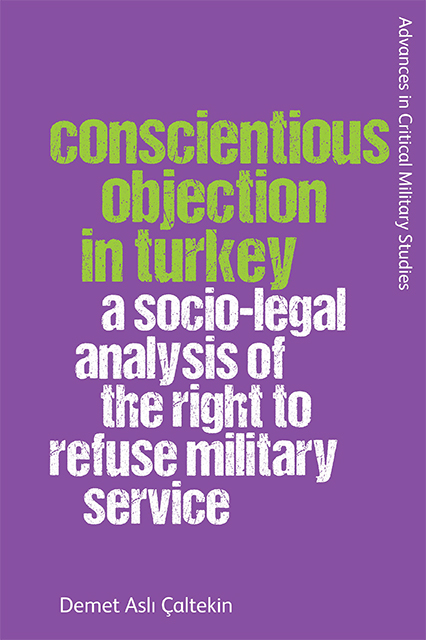
This book provides a socio-legal perspective to critical military studies by asking socio-legal questions about military conscription in Turkey: How do the international and domestic laws approach the conflict between the law and conscience? Why does Turkey insist on the non-recognition of the right to conscientious objection? How are those pursuing their conscience affected by such non-recognition? These questions are important as the law is shaped by the socio-cultural structures in which it operates, and any attempt to create a social change also necessitates understanding and challenging the legal framework. In this light, the book argues that one cannot fully understand and, as a result, resist the militarisation of society without understanding the relationship between the law and social norms.
Recommend this
Email your librarian or administrator to recommend adding this to your organisation's collection.