Book contents
- Frontmatter
- Contents
- Contributor List
- Introduction: Appreciating Bill Stuntz
- Part I The Political Economy of Substantive Criminal Law
- Part II Police Investigations
- Part III Emotion, Discretion, and the Judicial Role
- 9 Two Conceptions of Two Conceptions of Emotion in Criminal Law: An Essay Inspired by Bill Stuntz
- 10 Patrolling the Fenceline: How the Court Only Sometimes Cares about Preserving Its Role in Criminal Cases
- 11 Three Puzzles in the Work of Bill Stuntz
- 12 The Mercy Seat: Discretion, Justice, and Mercy in the American Criminal Justice System
- 13 Epilogue: Three Underrated Explanations for the Punitive Turn
- Index
- References
10 - Patrolling the Fenceline: How the Court Only Sometimes Cares about Preserving Its Role in Criminal Cases
Published online by Cambridge University Press: 05 March 2012

Book contents
- Frontmatter
- Contents
- Contributor List
- Introduction: Appreciating Bill Stuntz
- Part I The Political Economy of Substantive Criminal Law
- Part II Police Investigations
- Part III Emotion, Discretion, and the Judicial Role
- 9 Two Conceptions of Two Conceptions of Emotion in Criminal Law: An Essay Inspired by Bill Stuntz
- 10 Patrolling the Fenceline: How the Court Only Sometimes Cares about Preserving Its Role in Criminal Cases
- 11 Three Puzzles in the Work of Bill Stuntz
- 12 The Mercy Seat: Discretion, Justice, and Mercy in the American Criminal Justice System
- 13 Epilogue: Three Underrated Explanations for the Punitive Turn
- Index
- References
Summary
Introduction
One of Bill Stuntz's many contributions to the legal academy is that he helped bring doctrinal scholarship back into fashion. Not doctrinal work in the narrow sense of describing the evolution of legal rules, but in a richer, more sweeping sense of identifying the larger themes that help explain the forces that shape the inputs and outflow of judicial decisions. Whether he was describing how societal forces such as race and poverty affect the criminal process or discussing the role of institutional actors like police or defense counsel, Bill managed to offer penetrating theoretical insights without forgetting that cases matter, facts matter, and that sometimes, law is simply “what judges do.”
In this spirit, if we look back over the past decade of Supreme Court case law on criminal procedure, some important themes emerge. This chapter discusses two of those themes and offers an argument that, regardless of the correctness of particular case outcomes, the Court has gone off course in two important areas.
Information
- Type
- Chapter
- Information
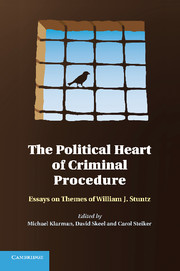
- The Political Heart of Criminal ProcedureEssays on Themes of William J. Stuntz, pp. 177 - 199Publisher: Cambridge University PressPrint publication year: 2011
References
Race, Class, and Drugs 98 1998
Local Policing After the Terror 111 2002
Plea Bargaining as Contract 101 1992
Plea Bargaining Outside the Shadow of Trial 117 2004
Plea Bargaining and Criminal Law's Disappearing Shadow 117 2004
The Jurisdictional Heritage of the Grand Jury Clause 91 2006
Too Many and Yet Too Few: New Principles to Define the Proper Limits for Federal Criminal Jurisdiction 46 1994
Accessibility standard: Unknown
Why this information is here
This section outlines the accessibility features of this content - including support for screen readers, full keyboard navigation and high-contrast display options. This may not be relevant for you.Accessibility Information
Accessibility compliance for the PDF of this chapter is currently unknown
and may be updated in the future.